In the final weeks of the 1986 South Carolina gubernatorial race, voters were presented with an opportunity to compare views of the two men vying to lead the state. Through a series of interviews hosted by Tom Fowler on Carolina Journal, produced by the South Carolina Educational Television Network, Mike Daniel and Carroll Campbell laid out their competing visions for the future of the state. The broadcast offered a candid look at how each man planned to navigate the state’s fiscal challenges and economic development priorities at a time of significant transition.
The Candidates’ Case for Leadership
The 1986 election arrived at a pivotal moment for South Carolina’s political landscape. Mike Daniel, the Democratic Lieutenant Governor, emphasized his experience within the executive branch as a primary qualification for the governor’s office. Reflecting on his tenure, Daniel noted that his time serving alongside Governor Richard Riley provided him with the necessary insight into the state’s mechanisms. He argued that the next administration needed to build upon the foundation laid by the Education Improvement Act, suggesting that a singular focus on economic development was the most critical task ahead.
On the opposing side, Republican Congressman Carroll Campbell framed his candidacy as a transition from federal service back to state-level governance. Campbell, who had represented South Carolina’s 4th district since 1979, argued that his work in Washington—particularly his alignment with the Reagan administration’s legislative agenda—had prepared him to push for state-level autonomy. He told viewers that he did not view the governorship as a career-long ambition, but rather as an opportunity to implement policies that would improve the lives of South Carolinians at home.
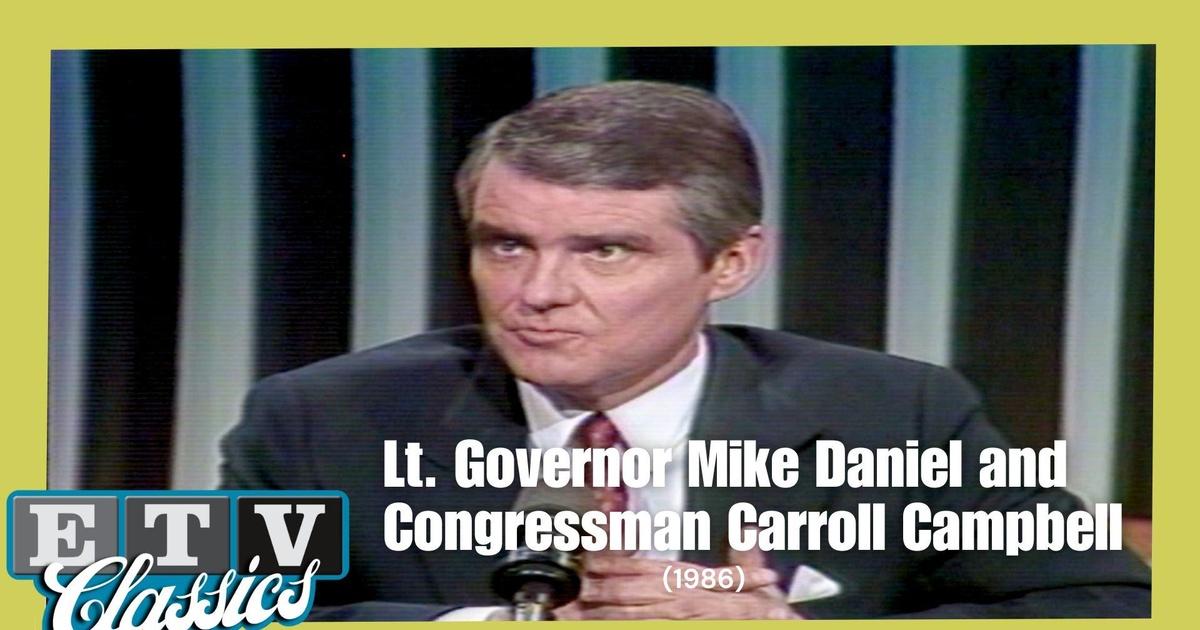
Candidates Debate Funding for the Education Improvement Act
A central point of contention during the 1986 campaign was the state’s budget, particularly regarding the funding of the Education Improvement Act. Daniel pointed to the act as a necessary, if costly, step toward bringing South Carolina’s teacher salaries closer to the southeastern average. He framed the legislation as a vital investment for the state’s youth.
Campbell, however, raised concerns about the fiscal sustainability of the state’s recent spending habits. While acknowledging the importance of education, he questioned the long-term impact of the penny sales tax used to fund these initiatives. According to his comments on the program, Campbell argued that the legislature had engaged in a spending spree when the state had a surplus, a strategy he suggested was unsustainable as the state looked toward the future.
A Legacy Beyond the Campaign Trail
Carroll Campbell served as the 112th governor of South Carolina from 1987 to 1995. His tenure included the state’s response to Hurricane Hugo in 1989 and his role in luring BMW to build its first U.S. manufacturing facility in Greer, South Carolina. David Wilkins, U.S. Ambassador to Canada and former Speaker of the South Carolina House of Representatives, later described Campbell as the “master architect” of the South Carolina Republican Party’s rise to dominance.
For Mike Daniel, the 1986 race marked a chapter in a career that included serving as the 84th Lieutenant Governor of South Carolina from 1983 to 1987. Years later, the contrast between the two men’s approaches—one rooted in the continuity of the existing administration and the other in a push for a shift in state policy—remains a study of South Carolina’s political evolution.
Campbell wrote an open letter to the people of South Carolina in October 2001, announcing that he had been diagnosed with the early stages of Alzheimer’s disease. He passed away on December 7, 2005, at the age of sixty-five. The archival footage from Carolina Journal serves as a reminder of the specific, urgent debates that once animated the state’s electorate, capturing both candidates before the course of the state’s history was altered by the results of that November vote.