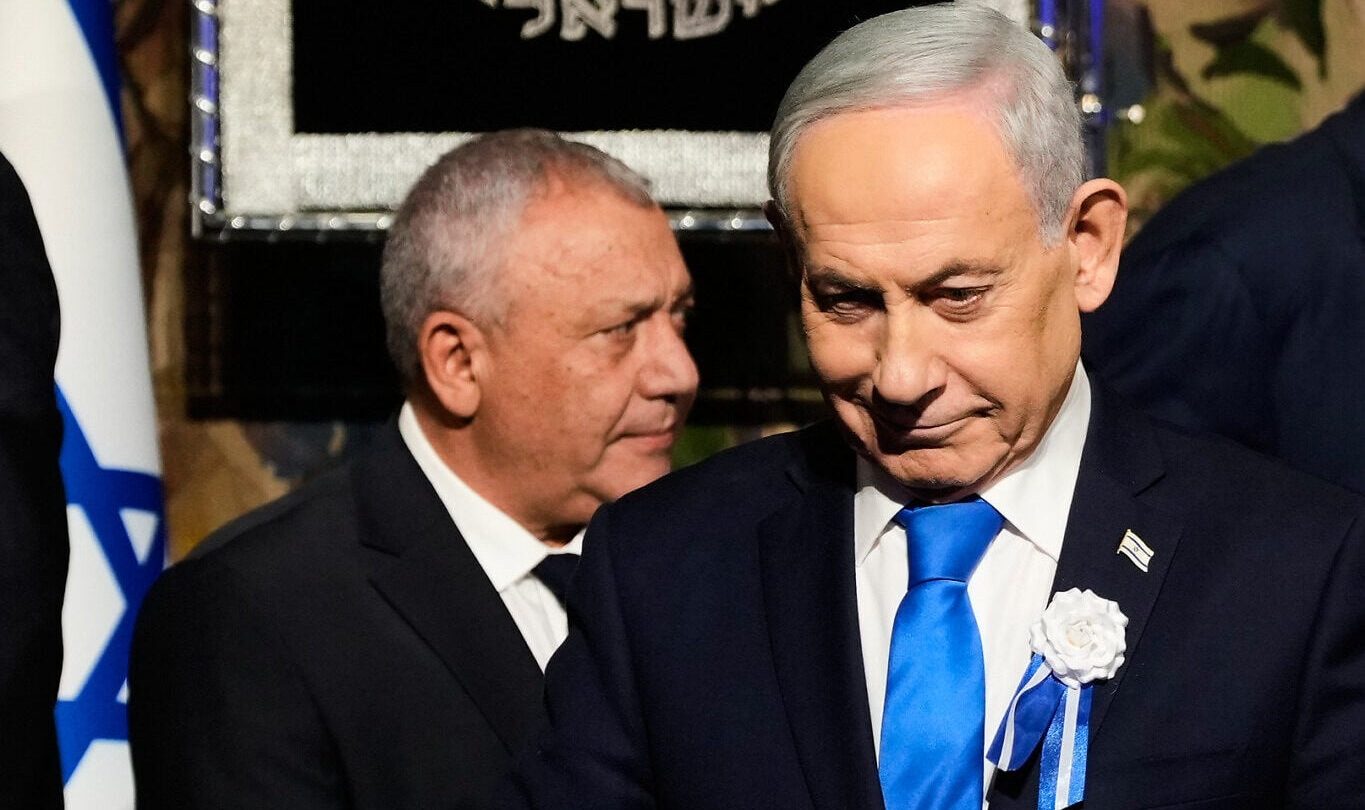
Prime Minister Benjamin Netanyahu called on Gadi Eisenkot to enter a unity government, arguing that a coalition relying on Arab parties could not handle the Iranian threat.
“Let us go into the room, without preconditions,” Netanyahu said in a video statement released on Saturday.
The appeal followed a Thursday meeting between the two leaders. Netanyahu said that the discussion only strengthened the conviction that a national unity government is essential.
To all our friends in the United States and around the world: The Israeli people have voted for change and to replace the current government. Our democracy remains strong and vibrant. We are working to fulfill the will of the Israeli people by forming a new government as soon…
Eisenkot rejected the proposal almost immediately, dismissing the invitation as a political ploy. “Netanyahu is calling for negotiations while they are already underway,” Eisenkot said, adding that “these tricks don’t work on me”.
The political stalemate stems from the October 27 election, which left neither side with an absolute majority in the 120-seat Knesset. Netanyahu’s right-wing and religious bloc secured 53 seats, down from 64 seats in 2022. Meanwhile, Eisenkot’s four-party change bloc won 48 seats, and Arab-led parties captured a record 19 seats.
'So if there are 61 seats, then Hamas is a terror organization?'@ariel_oseran presses Ra’am leader Mansour Abbas on making his willingness to call Hamas a terrorist group conditional on a place in a governing coalition pic.twitter.com/wRdHfrq3Vh
President Isaac Herzog subsequently tasked Eisenkot with forming the next government after 67 lawmakers endorsed him. Eisenkot holds a 28-day window to build a coalition, with a possible 14-day extension.
To reach the 61-seat majority required in parliament, Eisenkot’s bloc is exploring multiple paths. One option involves a minority “national emergency government” where his bloc’s 48 lawmakers vote in favor while 26 legislators from Arab and ultra-Orthodox parties could abstain. However, Avigdor Liberman, leader of the Yisrael Beiteinu party, has refused to join any government dependent on Arab parties, arguing it would be short-lived and would only strengthen Netanyahu.
If Gadi Eisenkot and the opposition bloc are remotely serious about getting rid of Netanyahu, and about Israel’s democratic future, they’ll do the obvious, strategic, and non-racist thing of forming a government with the Arab parties. A Jewish-Arab political partnership is…
Channel 13 reported that the Yashar party is preparing to offer Likud a chance to join a unity government led only by Eisenkot, without a rotation agreement. “We will agree to compromises, but not on the matter of prime minister,” a senior source in Eisenkot’s orbit said.
At the same time, Netanyahu has actively worked to keep ultra-Orthodox parties out of an Eisenkot-led coalition. According to a source familiar with the negotiations, Netanyahu has personally spoken with rabbis and warned them that an Eisenkot government might rely on their support initially before turning to Arab parties after passing the budget.

Political friction spilled onto the streets on Saturday night as Likud MK Elisha Medan set up a protest tent outside the Knesset. Medan called for a national unity government led by Netanyahu that includes Eisenkot.
Inside the parliament, the opposition plans to use its majority to take control of legislative bodies. Lawmakers submitted proposals to replace current Knesset Speaker Amir Ohana, a Netanyahu ally, with Matan Kahana from Eisenkot’s Yashar party.
Did you criticize Israel's Central Elections Committee when it tried to ban the Arab parties? Did you criticize Netanyahu when he warned that "Jewish women from the left are leading Arab women voters to the polls"? Did you criticize the Jewish parties that said they would… https://t.co/5o2d8fWJkl
Eisenkot heads the Yashar Party, while the broader opposition bloc includes Naftali Bennett’s B’Yachad, Yair Golan’s Democrats, and Avigdor Liberman’s Yisrael Beiteinu.
Eisenkot’s bloc has also introduced legislation to establish a state commission of inquiry into the Hamas attacks of October 7, 2023, and to impose term limits on the prime minister.
All the proud declarations that Israel’s democracy gives 2 million Arab citizens the vote will ring increasingly hollow if the opposition refuses to govern with their support — even if that means leaving Netanyahu in power.
Additional proposals submitted by Yashar aim to repeal past judicial overhaul legislation championed by Netanyahu, including changes to the judiciary, the attorney general’s powers, the police, and the legal framework for declaring a prime minister unfit to serve.
With the 28-day deadline giving Eisenkot until December 6 to secure an agreement, the president holds the authority to grant up to 14 additional days if negotiations continue.
Earlier coverage: Gadi Eisenkot Calls Netanyahu's Rule a Dangerous Situation