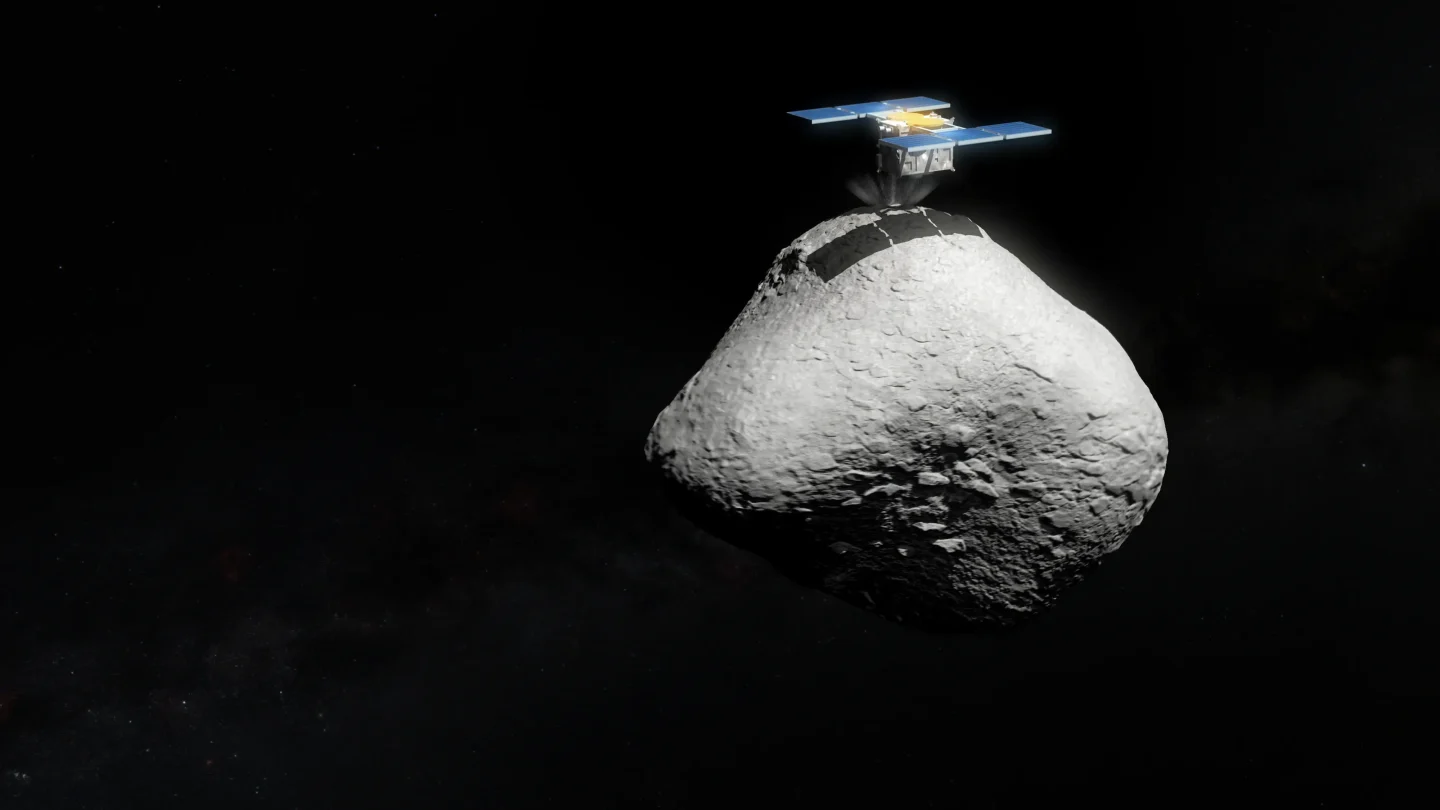
Discovered in 1998, the tiny body rotates on its axis every 5.35 minutes and reflects about 52 percent of the sunlight hitting it.
Researchers noticed that its trajectory deviates slightly from what gravity alone should dictate, a phenomenon known as non-gravitational acceleration.
Astronomers Study 1998 KY26
Astronomers previously suggested the object might be a “dark comet” containing buried ice that warms and releases gas to create a thrust effect, though astronomers never observed the gaseous cloud or tail normally associated with comets.
The researchers analyzed the object’s expected temperatures along its orbit and determined they are too high for water ice to survive for long in the vacuum of space, saying that even in the coldest areas the ice should have gradually evaporated and disappeared. The authors concluded that water-ice venting is no longer a plausible explanation for its unusual acceleration, stating that 1998 KY26 is most likely a waterless asteroid.
NASA Evaluates Asteroid Theories
Alternative theories have emerged.
The researchers built a simple model of the spacecraft and compared how sunlight reflects off it during rotation with recorded observations of the mystery object, finding that the spacecraft model matches eight sets of observations. They also tested whether solar radiation pressure on a cylindrical shape or solar panels could explain the movement of 1998 KY26, concluding that this model aligns even better with hundreds of telescope and radar observations.
Meanwhile, NASA leadership has urged caution regarding the lost spacecraft hypothesis. During an appearance on Fox & Friends, NASA Administrator Jared Isaacman addressed the public speculation.
First, there is nothing about to collide with us, and to be completely clear, I haven’t seen any evidence to suggest that this object represents a threat to our planet or anything other than an asteroid.
Jared Isaacman, NASA Administrator
A separate study published this year in the journal Astronomy & Astrophysics supports a more routine explanation.

Hayabusa2 Rendezvous Planned for 2031
The spacecraft already completed a successful mission to the asteroid Ryugu, from which it collected samples that arrived on Earth in December 2020.
While investigators point out that Leif’s hypothesis has not yet been confirmed and researchers continue to view the object as an asteroid with no proof that such maneuvers occurred, scientists said that in 2023 researchers identified that the orbit of 1998 KY26 is influenced by an additional force not explained by gravity alone.
Orbital calculations show that in 2039 it will pass at a distance safely away from us.