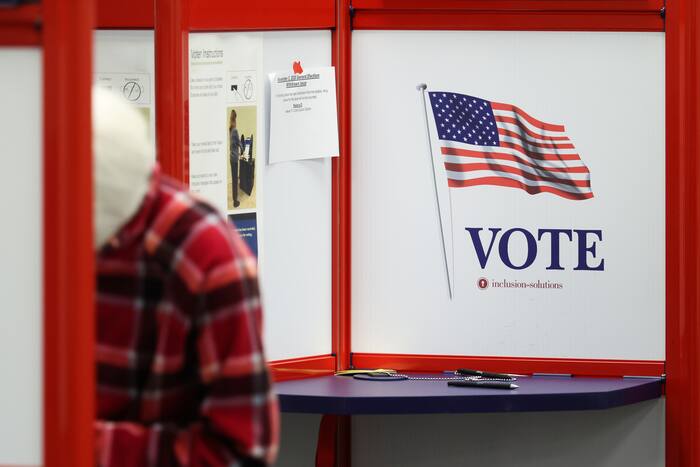
As the 2026 election cycle approaches its conclusion, Texas voters are confronting critical choices amidst an unprecedented total of over 19 million registered voters, as reported by the Texas Secretary of State, which sets a new benchmark for the state. From a gubernatorial showdown to a U.S. Senate race, the choices on Tuesday, November 3, carry implications for classrooms, tax bills, and energy grids across the Lone Star State.
Click2Houston reported that the statewide ballot centers on divergent economic and social visions put forward by candidates, alongside critical local referendums in Harris County and Houston. With polls open from 7 a.m. to 7 p.m. on Election Day, voters are weighing competing promises on property taxes, public education funding, and border security.
The Statewide Confrontation: Abbott and Hinojosa on Taxes and Schools
The race for governor pits Republican Gov. Greg Abbott against Democrat Gina Hinojosa, with Libertarian Pat Dixon also on the ballot. The major candidates have staked out contrasting positions on how to handle the state’s financial surplus and public education burdens.
Abbott has proposed eliminating school district property taxes on homesteads, shifting the burden onto the state to replace that lost funding for local districts. Hinojosa has proposed direct relief through $1,500 payouts to Texas households funded by the state’s Rainy Day Fund—a plan that would require legislative approval. The candidates also diverge on electricity rates, healthcare access, and data-center policy.
Financial Divergence in the U.S. Senate Race
In the contest to represent Texas in the U.S. Senate, Republican Ken Paxton and Democrat James Talarico have offered voters different legislative agendas. Libertarian Ted Brown is also running.
Federal Election Commission data reviewed by ENOUGH revealed a fundraising gap. Talarico raised $140.3 million through his campaign between Jan. 1, 2025, and Oct. 14, 2026. Paxton raised $21.6 million during the same period. Those figures exclude outside super PACs, which can raise and spend unlimited amounts to support or oppose candidates.
The policy platforms reflect these divides. Paxton’s economic proposals include federal tax deductions for specific medical expenses, assistance for first-home down payments, and a doubling of the child tax credit. Talarico has called for a ban on corporate PACs and super PACs, a prohibition on individual stock trading by members of Congress, the overturning of Citizens United, and an end to partisan gerrymandering.

Political advertising has intensified the friction. An outside-group ad claimed Talarico supported jailing parents over decisions involving transgender children. Upon examining the legislative hearing referenced in the commercial, KPRC 2 determined that Talarico made no statements calling for the arrest of parents, nor did he address incarcerating those who decline gender-affirming medical care. A commercial from Talarico’s campaign connected Paxton to both data-center tax incentives and approximately $500,000 in campaign donations. An examination of those financial disclosures indicated that Paxton indeed voted in favor of a data-center tax incentive back in 2013, though the monetary sum encompassed a broader network of contributors connected to the development, ownership, and financing of data centers, thus necessitating extra context.
Local Decisions: Harris County Leadership and Houston Proposition A
Voters in the Houston area are also shaping local governance and public safety policy. Democrat Letitia Plummer and Republican Orlando Sanchez are vying for Harris County judge, squaring off over property tax rates, public safety investments, Flock cameras, and flooding. During his initial budget cycle, Sanchez intends to reduce the county property tax rate without stating a specific percentage, whereas Plummer plans to seek out financial efficiencies to safeguard county initiatives, though she stopped short of pledging a rate cut in her first budget.
Meanwhile, Houston voters face a consequential charter amendment on the ballot. Proposition A combines two policing issues into one yes-or-no vote. While marijuana would remain illegal under the measure, it would prohibit HPD personnel from asking for or carrying out no-knock warrants and designate Class A and Class B misdemeanor possession of the substance as the agency’s lowest enforcement priority. A “yes” vote approves the entire charter amendment, while a “no” vote rejects it.
Voters can confirm their registration status, check voter ID requirements, and locate their polling places using VoteTexas.gov before polls close at 7 p.m.