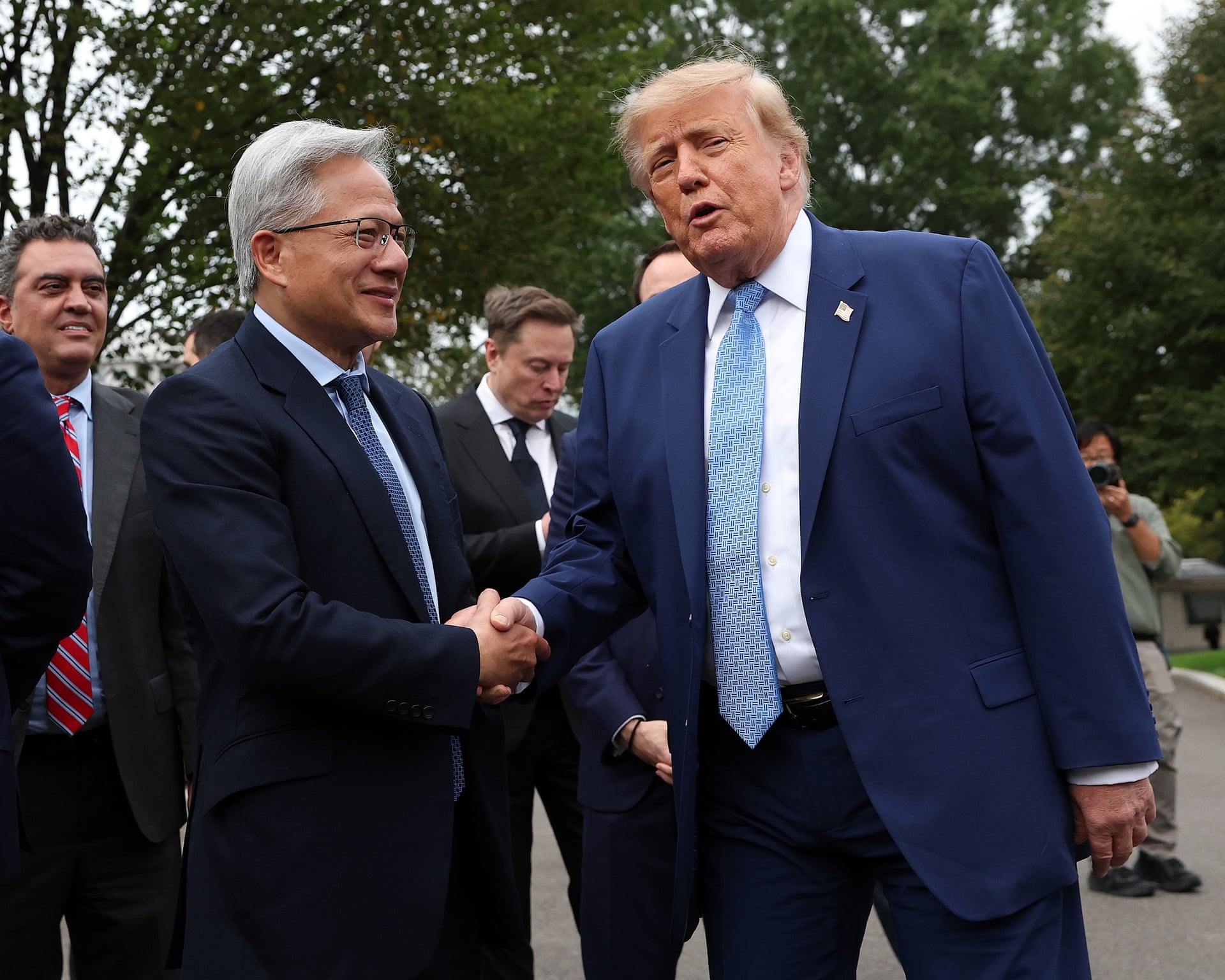
President Trump’s personal intervention to reinstate Nvidia CEO Jensen Huang has triggered a sharp political backlash, raising questions about the intersection of his business interests and national security policy.
The move, which occurred after Huang’s abrupt resignation two weeks ago, has ignited congressional scrutiny and internal dissent within the Republican party.
Nvidia’s board unanimously voted to bring Huang back on Monday, November 23, 2026, after receiving what the company described as “input from senior levels of the United States government,” which provided confidence that the reinstatement posed no national security risk. The decision followed a period of turmoil for the chip giant, which accounts for roughly 80% of the AI GPU market and holds $99 billion in reported investments.
- President Trump personally contacted Nvidia’s board to advocate for Huang’s return, citing the company’s importance to the nation.
- Financial disclosures indicate the president holds between $13 million and $58 million in Nvidia stock, which rallied following the announcement.
- Huang is scheduled to testify before the Senate Banking Committee on December 3, while Commerce Secretary Howard Lutnick is set to appear before the same committee on December 10.
- Congressional leaders from both parties have launched investigations into potential national security risks and administration involvement in the hiring process.
Congressional Oversight and Security Concerns
The circumstances surrounding Huang’s initial resignation—reports of an affair with a former executive at a company accused of smuggling Nvidia chips to China—have become the focal point of upcoming congressional hearings.
I wrote about what Jensen Haung's comeback reveals about gender and power in Silicon Valley https://t.co/K9uSlCJdgO
Lawmakers are now demanding clarity on whether the administration’s involvement compromised U.S. export controls. Intelligence reports indicated that Alice Huang, the executive involved in the affair, maintained contact with an official from China’s Ministry of State Security from the spring of 2025 through the fall of 2026.
“The NVIDIA board’s brief internal investigation and reinstatement of Jensen Huang do not erase the national security threats and questions that must be addressed,” chairmen of three House committees wrote in a joint statement. House Minority Leader Hakeem Jeffries, D-N.Y., demanded the administration explain which senior officials provided the input used to justify the reinstatement.
Four-byline alert: 🚨 “.. over the weekend, Pentagon leaders weighed an audacious idea: invoking a Cold War-era law to pressure Nvidia to restore Jensen Huang as CEO ..”@washingtonpost $NVDA https://t.co/VARozn2kBb pic.twitter.com/6IXHB13u00
Senator Andy Kim, D-N.J., questioned the administration’s ability to prove there is no national security risk, while Republican Senator Tom Cotton described the controversy as “the tip of the iceberg” and expressed alarm that China may have obtained access to advanced chips through the affair.
Financial Stakes and Market Reaction
The president’s active role in the company’s leadership transition has drawn criticism regarding his personal financial interests. According to financial disclosures filed with the Office of Government Ethics, the president held between $13 million and $58 million in Nvidia shares as of the end of 2025.
“.. This whole ordeal only reinforces what Americans already believe about a broken political system that stands up for Big Tech CEOs and not the American people.”@CNBC $NVDA https://t.co/LOLXRZDoow pic.twitter.com/zteTzchLQf
Between January 2025 and September 2026, the president executed over 100 transactions in the company’s stock worth between $27 million and $98 million. The value of his holdings increased by as much as $14.8 million on the day Huang was reinstated.
A White House spokesman said that the president’s portfolio is “independently managed by third-party financial institutions” and that his investments mirror indexes like the Schwab 1000. However, Senator Andy Kim shared reporting that the president may have profited by as much as $15 million on Nvidia shares following the rally triggered by Huang’s return. “We hear the president’s motives loud and clear,” Kim wrote.
President Trump has been exploiting our nation’s highest office to enrich himself and his billionaire buddies. Trump is bragging about pressuring Nvidia, a private tech company that he owns stock in, to bend to his desires, and it’s a grossly corrupt abuse of power for him to…
Internal Republican Dissent
The president’s support for Huang has not found universal backing within the GOP. Some lawmakers have expressed alarm that the administration may have overlooked security vulnerabilities to maintain the status quo in Silicon Valley.
Senator John Kennedy, R-La., stated he expects Huang will “take the Fifth Amendment so he doesn’t incriminate himself in criminal prosecution,” though he added, “It’s not my place as a senator to tell Mr Huang that he can’t cheat on his wife.” Meanwhile, Pentagon officials under Defense Secretary Pete Hegseth reportedly weighed invoking the Cold War-era Defense Production Act to pressure the board into reinstating Huang, viewing the move as essential for military strategy.
Administration Pressures and Corporate Loyalties
The path to Jensen Huang’s reinstatement involved high-level maneuvering, with Pentagon leaders under Defense Secretary Pete Hegseth reportedly considering the use of the Cold War-era Defense Production Act to force the board’s hand.
This audacious proposal reflected a belief in some Silicon Valley circles that the executive’s leadership was vital for military AI strategy. The board ultimately received direct input from senior levels of the U.S. government, which provided the necessary assurance that Huang’s past relationships did not present a national security risk.

The tech industry’s reaction to the initial resignation was overwhelmingly supportive of the CEO. Prominent figures, including YCombinator founder Paul Graham and former Uber CEO Travis Kalanick, rallied around Huang, with Graham noting that the tech world had never been more unanimous on a single issue.
Despite this, some Republican lawmakers, such as Rep. Don Bacon argued the board should have ignored the administration’s desire to save Huang, because the president’s financial stake in the chipmaker made his motives clear.
Public Reactions and Ethical Scrutiny
The president’s financial involvement has sparked sharp criticism from ethics experts. Kathleen Clark, a law professor at Washington University, characterized the situation as exceeding a standard conflict of interest.
Meanwhile, NPR’s Scott Detrow discussed the president’s holdings with Forbes senior editor Dan Alexander, highlighting the broader context of Trump’s business interests. While Trump told The Wall Street Journal that the positive market response validated his decision, public sentiment remains divided.
President Trump says he would welcome Jensen Huang returning as Nvidia CEO, less than a week after Huang stepped down from the company. Asked whether he wanted to see Huang reinstated, Trump replied: “I would not mind that.” pic.twitter.com/kKpeBiUZzi
The controversy has left voters and observers questioning the administration’s priorities. While some supporters of the president praise his intervention as a necessary step for economic stability, others, like those interviewed by NPR, remain skeptical.
Rebecca, a tech observer, said that she initially doubted the reinstatement would occur, while Tim expressed that he saw the return coming, albeit not with such rapid speed. As the hearings approach, the divide between the administration’s defense of “our geniuses” and growing congressional alarm continues to widen.
The Senate Banking Committee is positioned to examine these developments under its broad mandate, which includes jurisdiction over export controls, financial aid to commerce and industry, and the oversight of federal monetary policy.
Established as a standing committee, its scope encompasses the comprehensive review of international economic policies as they affect U.S. credit and financial institutions. By exercising this authority, the committee serves as a primary unit for evaluating how corporate governance and trade practices intersect with national security interests.
The CEO’s Response and Administration Defense
Following his return, Huang apologized to staff, stating, “I made some terrible mistakes,” and said that he is currently attending daily therapy. President Trump has defended his actions, stating he did a “great thing for our country and even for the world.” Addressing concerns regarding the affair, Trump said he believed Huang when the CEO claimed he had no idea the executive was a spy.
The White House has maintained that “we have to protect our geniuses,” while the President suggested that a pardon for Huang is “always an option, I guess, but I don’t think it’ll be necessary.”
President Donald Trump on Sunday defended Nvidia CEO Jensen Huang following reports that the chipmaker was investigating Huang's alleged links to a Chinese spy. Trump said he had not spoken to Huang about the reports but called him an “honorable guy.” pic.twitter.com/u2MWnFfmqs
More on Donald Trump
President Trump defended Nvidia CEO Jensen Huang on Sunday after Huang admitted to an affair with a Chinese businesswoman accused of spying for Beijing. “I just know he’s a fine person, but you never know what is going on,” Trump told reporters before boarding Air Force One in… pic.twitter.com/sRiJVtP1AQ