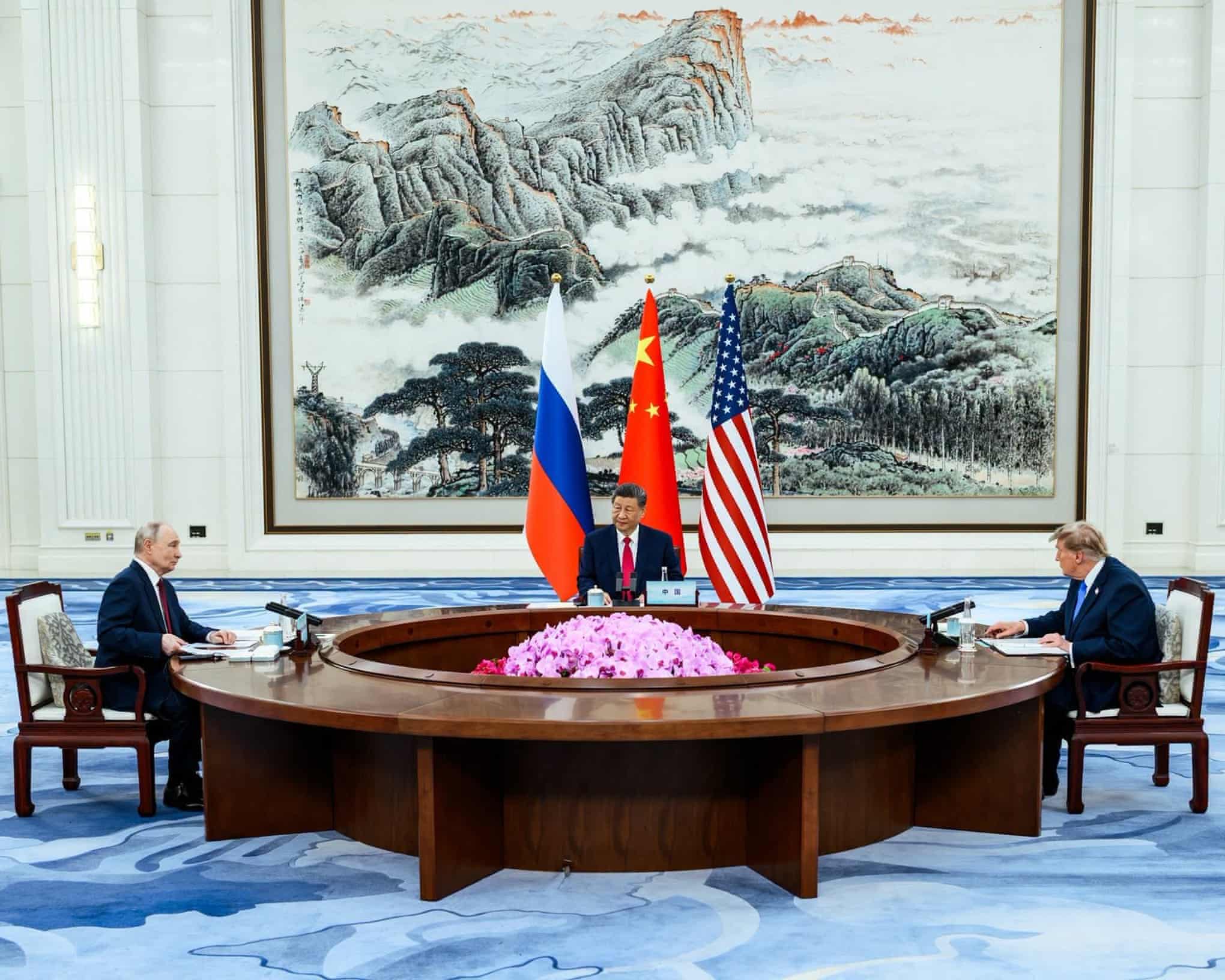
President Donald Trump, Chinese President Xi Jinping, and Russian President Vladimir Putin met for an hour-long trilateral discussion in Shenzhen, China, on Thursday to address global security and international cooperation.
The rare face-to-face encounter, held at Kylin Villa, brought together the leaders of three of the world’s most powerful nations.
While the leaders held individual meetings beforehand, the trilateral session was described by Trump as the start of a historic moment. “We are really making history,” Trump said at the onset of the meeting. Accompanying Trump on the American side of the table were Secretary of State Marco Rubio, Commerce Secretary Howard Lutnick, and White House Chief of Staff Stephen Miller.
President Trump departs China after a historic trip. – Secured $17 billion for U. S. companies. – Met with the world's most important leaders and nations, including President Xi, President Putin, and President Marcos. – Delivered key remarks at both the ASEAN and APEC Summits.… pic.twitter.com/YVqOqnABEY
Joint Declaration on Nuclear Risk and Global Governance
The declaration also addressed the structure of international bodies, with the three heads of state emphasizing the importance of “promoting UN reform so that it may respond more effectively to global challenges.” Furthermore, the men “committed themselves to maintaining strategic stability and international security.”
The statement also addressed the legal standing of state officials, noting that the three leaders “agreed that the International Criminal Court and other similar institutions must not abuse their jurisdiction.” Regarding the potential for future conflict, Trump said that he and Xi felt strongly about the necessity of oil flowing through the Strait of Hormuz.
President Trump's trilateral summit with Chinese President Xi Jinping and Russian President Vladimir Putin has the makings of an unpredictable spectacle – and that's exactly what has U. S. allies anxious. My story on @axios https://t.co/sDYY70NwCg
Diplomatic Optics and Regional Conflict
Patricia Kim, an expert on Chinese foreign policy at the Brookings Institution, stated, “The real test will be whether the three countries follow through on their stated commitment to discuss nuclear risk reduction and preventing nuclear proliferation.” She added that Beijing has little interest in taking on the risks of brokering peace in those conflicts, as it would entangle China in situations it prefers to avoid.
During the summit, Trump addressed his relationship with the other leaders. Having previously met with both Xi and Putin individually, he referred to them as friends. However, this positioning drew criticism from international allies.
A historic first on the world stage. President Donald J. Trump, President Xi, and President Putin hold trilateral talks in China. pic.twitter.com/w2qDiJo8W5
Polish Prime Minister Donald Tusk stated, “Mr Putin is not our friend and will never be,” while Danish Prime Minister Mette Frederiksen called it “very incomprehensible” that a U.S. president would seek to sit down with the Russian leader.
Meanwhile, two of Trump’s special envoys, his son-in-law Jared Kushner and longtime friend Steve Witkoff, were heading to Berlin to meet with Ukrainian President Volodymyr Zelenskyy in hopes of a breakthrough.

Strategic Stability and Future Cooperation
Xi recalled “the history of fighting side-by-side during World War II,” emphasizing the importance of “cherishing the hard-won peace.” Following the meeting, the Kremlin released a video showing Putin thanking Xi for organizing the event, noting he did not think “anyone even expected everything to go so well.” China’s state broadcaster CCTV described the meeting as “positive, constructive, and highly productive.”
The Brookings Institution, which was founded in 1916 as the first private organization dedicated to analyzing national public policy, maintains a long history of influencing government operations. During the post-World War II era, the organization was notably tasked with submitting the administrative plan for the Marshall Plan to ensure the program operated on a businesslike basis.
.@SEPeaceMissions and I are heading to Berlin to consult with President Zelenskyy and European leaders at the Coalition of the Willing meeting. Our priorities for this trip are to further strengthen our close coordination with Ukraine and Europe, work toward a unified position…
Today, the Washington, D.C.-based entity is recognized as the most frequently cited think tank by both United States media and politicians, and it has been consistently ranked as the top think tank in the world by the University of Pennsylvania’s Global Go To Think Tank Index Report.
The leaders also discussed the implementation of “guardrails“for global stability.” We do think that having guardrails, you know, at least on a minimal basis is a positive thing,” Trump said, though he admitted they “didn’t get into definitions.” As the meeting concluded, Trump departed for the Shenzhen Bao’an International Airport, where he engaged in a brief conversation with China’s Foreign Minister Wang Yi before boarding Air Force One en route to Washington.
By meeting Donald Trump and Xi Jinping, Vladimir Putin is sending a holiday postcard to the rest of the world. But instead of ‘Wish you were here’, he’s signed it ‘Look: I’m here.’ My report from Shenzhen. https://t.co/K3SfGT57fN
Trump noted the significance of the event, remarking that “no president has ever—and this is a highly respected, this is a great president, one of the great presidents of China—and he has never gone to the airport to meet somebody.”
Earlier coverage: Trump, Putin, Xi Hold Historic First Trilateral Summit


