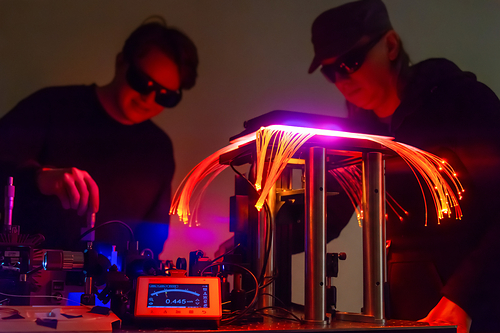
UbiQD, Inc., a quantum dot manufacturer based in Los Alamos, New Mexico, has been awarded a $200,000 grant through the state’s Quantum Technologies Award to develop a specialized light source for quantum computing and secure communication networks. The funding, provided by the New Mexico Economic Development Department (NMEDD) via its Technology and Innovation Office, will support the creation of a device that emits single particles of light, known as photons, one at a time and on demand, connected directly to fiber optic cables. This development aims to eliminate the need for the extreme cryogenic cooling typically required by current quantum hardware.
Most modern quantum computers rely on superconducting circuits that must be chilled to a fraction of a degree above absolute zero, requiring large, expensive refrigeration systems. By using photons to carry information, UbiQD is betting on a system that can operate at room temperature and travel efficiently over long distances.
The Room Temperature Hurdle
The primary technical bottleneck in photon-based quantum systems is the light source. Most current sources either emit a plurality photons at random—which wastes most of their output—or they require the same extreme cooling as the superconducting systems they are meant to replace. UbiQD is attempting to bridge this gap using I-III-VI semiconductor quantum dots, which the company notes are free of cadmium, lead, and mercury.
According to a news release from UbiQD, the grant will fund optical equipment and device prototyping at the company’s Los Alamos headquarters. The team’s immediate goal is to measure how reliably these quantum dots produce single photons and then refine the materials to meet industry performance targets. This isn’t a shot in the dark; the project builds on a 2024-2025 partnership with Los Alamos National Laboratory under the Technology Readiness Gross Receipts (TRGR) Initiative, which provided some of the first detailed measurements of this kind for the company’s proprietary materials.
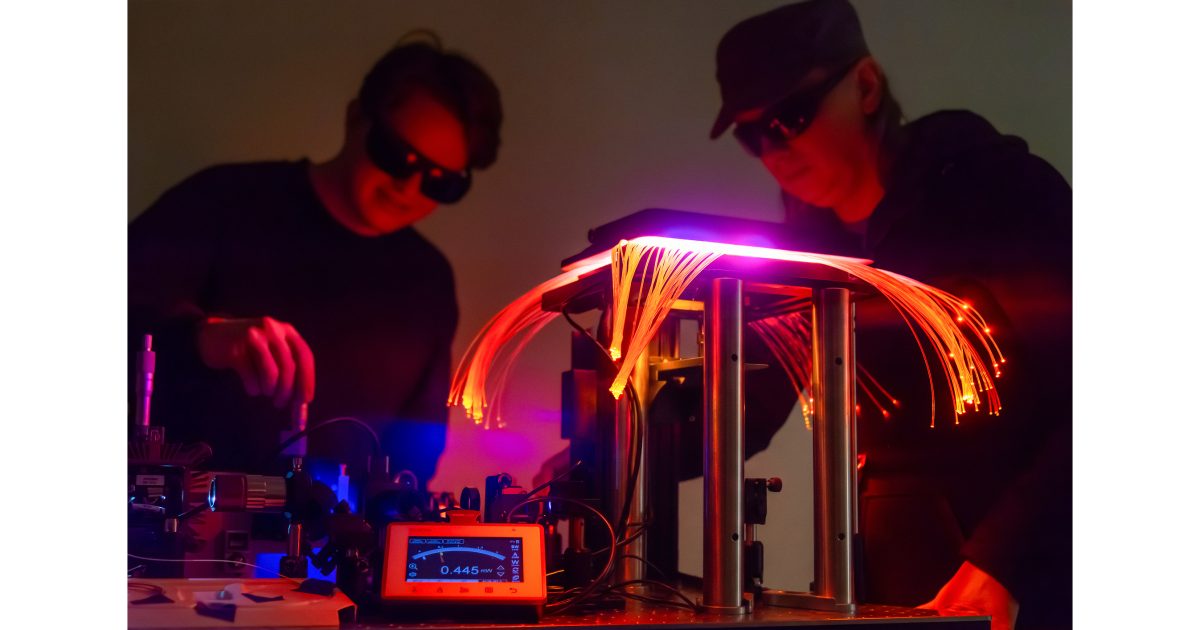
“We’re not just manufacturing materials, we’re building an optical product and an IP position in the quantum industry,” said Nikolay Makarov, Senior VP of R&D at UbiQD and principal investigator on the grant. “Now we’re using what we learned to build a light source that delivers one photon at a time, reliably, at room temperature.”
A Strategy Built on Patents
While the $200,000 grant provides the immediate catalyst for prototyping, UbiQD is playing a much longer game centered on intellectual property. The company has spent several years constructing a layered patent portfolio to ensure that its material science translates into commercial dominance. Currently, UbiQD owns or exclusively licenses 17 granted U.S. patents and 23 granted international patents, with another 27 applications pending.
This portfolio is structured in three distinct tiers:
- Foundational patents covering the quantum dot material itself.
- Patents for turning those materials into usable forms, such as films and concentrates.
- Specific end-use patents for applications in solar, agriculture, and security inks.
One specific piece of IP, US patent #12,085,443, is particularly relevant here. This patent applies not only to quantum hardware but also to faster data center connections. In those facilities, fiber-coupled light sources could offer a way to connect computer servers.
The Skeptic’s Corner: Lab vs. Scale
The company is moving from the theoretical—such as a 2017 Los Alamos study co-authored by Makarov showing that copper indium disulfide quantum dots could emit single photons—to a patentable product. However, the challenge remains “reliability at scale.” Producing one photon on demand in a controlled lab setting is one thing; manufacturing thousands of these devices that perform identically without drifting in emission is another entirely.
From Nobel Research to Commercial Products
The company’s trajectory is deeply rooted in high-level academic research. Founder and CEO Hunter McDaniel, PhD, began his journey as an undergraduate researcher in the group of Nobel laureate John Martinis at UC Santa Barbara. This pedigree has allowed UbiQD to license technology from institutions including M.I.T. and Los Alamos National Laboratory.
The next phase for UbiQD involves the rigorous measurement of photon reliability.



