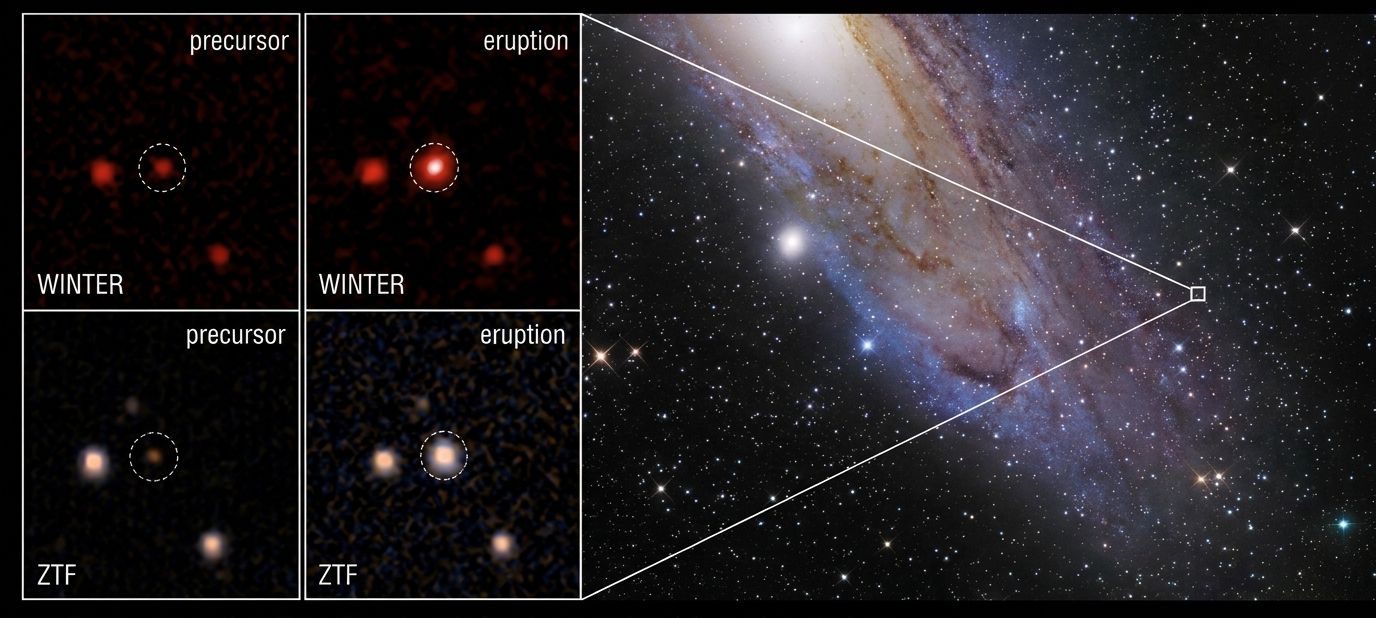
Astronomers in Andromeda have directly witnessed a stellar merger from beginning to end, capturing the final plunge of a star into its massive red giant companion.
The system, nicknamed Bao, is located about 2.5 million light-years away in the Andromeda galaxy, as reported by researchers investigating the first-of-its-kind cosmic event.
Tracking the Seven-Year Brightening of Big Bao
The story began in 2023 when Viraj Karambelkar, then at Caltech, and Kishalay De, then at MIT, noticed the steady brightening of a star in the Andromeda galaxy. Karambelkar spotted the shift in data from the Wide-field Infrared Transient Explorer, while De independently identified it in records from NASA’s NEOWISE mission.
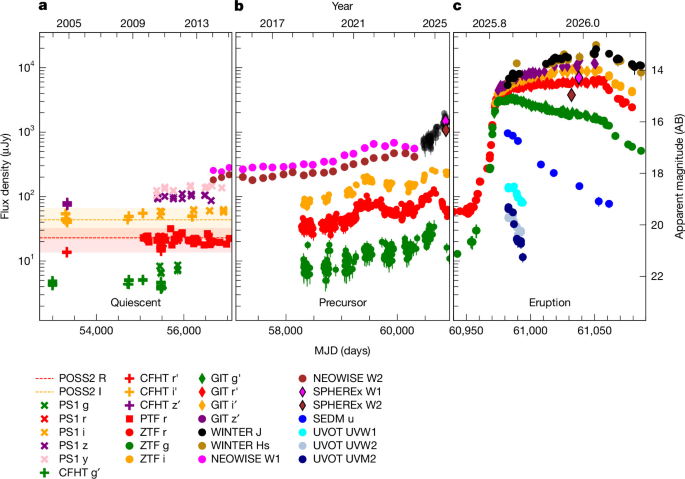
In the new study, the researchers investigated a red giant star designated WNTR23bzdiq, which is located about 2.5 million light-years away in the Andromeda galaxy. Before 2018, the object had a consistent luminosity. For seven years, a giant star in the Andromeda galaxy grew brighter. It swelled to more than twice its original size, even as its surface temperature barely changed.
The team concluded that prior to the eruption, Bao’s primary star dwarfed the sun: It was seven times as massive, 350 times the radius and 18,000 times brighter—making “Big Bao” an appropriate nickname.
In work published last year, after poring through nearly 30 years of telescope data, astronomers had found that the giant began brightening in 2018 and proposed that a smaller star was circling ever closer around a giant companion and had even slipped inside its outermost layers. Astronomers call this elusive phase of a binary star’s life common-envelope evolution.
When a star engulfs its companion, its effect is very subtle — like throwing a bucket of water in a large ocean. We need sensitive telescopes monitoring the sky for a long time in order to catch this effect.
Viraj Karambelkar, astrophysicist at Columbia University
The researchers had previously suggested this brightening potentially occurred because the giant star engulfed a companion star. As this companion spiraled toward the giant’s core, it would generate friction, heat and light, explaining the increasing luminosity.
Then, near the end of 2025, the astronomers saw a giant eruption of light from this giant star. In the new study, the scientists estimated that the eruption expelled an amount of material equal to about 0.1 to 0.2 times the mass of the sun.
October Eruption and Webb Observations
On October 17, 2025, amateur astronomer Koichi Itagaki noticed a bright flash of light from the Andromeda galaxy, prompting follow-up observations across global facilities. The Zwicky Transient Facility and WINTER captured the explosive phase, while NASA’s James Webb Space Telescope observed the system on December 24, 2025, just 47 days after the eruption peaked.
In December 2025, observations from NASA’s James Webb Space Telescope provided the final evidence that allowed researchers to fully reconstruct what happened before, during, and after the merger of a binary star system nicknamed Bao in the Andromeda galaxy.
Viraj Karambelkar said Webb observed Bao only 47 days after the stars’ eruption peaked, the earliest-ever follow-up of an event like this, and that the telescope’s data helped the team characterize what the system looked like before, during and immediately after the merger.
In addition to brightness, astronomers gathered data from spectrographs on the 200-inch Hale telescope at Palomar and the International Gemini Observatory.
Determining the Mass of Little Bao
Combining infrared and optical measurements, the science team ran updated hydrodynamic simulations to reconstruct the common envelope phase where the smaller star spiraled inward through the giant’s outer layers. The modeling yielded the first mass estimate for the smaller companion, nicknamed Little Bao.
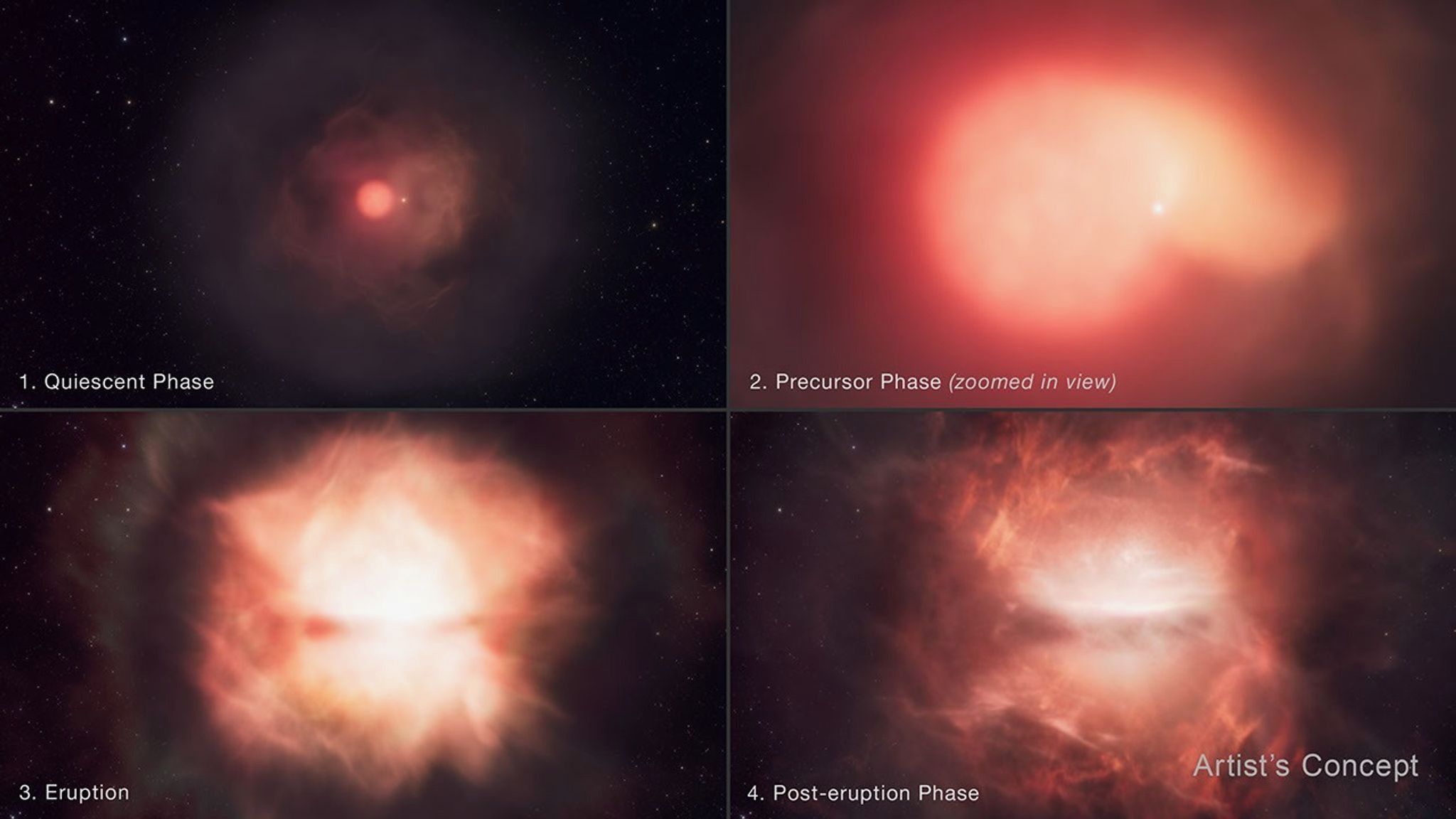
“The other possibility is that both stars survived, in a much shorter orbit. In order to conclusively determine what happened, we need to continue monitoring what the system does, once the heft of the eruption settles down,” Viraj Karambelkar, an astrophysicist at Columbia University, said.
The calculations showed that Little Bao possessed about 70 percent of the sun’s mass. Rather than escaping or settling into a stable tight orbit, the smaller star plunged directly into the giant’s core. The analysis of the optical and infrared images and spectral data suggested that AT2025abao is a stellar merger known as a luminous red nova, in which a smaller star plunges into the core of its larger companion, an event well known to astronomers.
Mansi Kasliwal, a co-author of the study, professor of astronomy at Caltech and director of the Palomar Observatory, said combining their data with data from other global facilities helped the team build a uniquely detailed picture of the AT2025abao system and confirm that a small star had crashed into the core of its larger companion.

In the months following the explosion, the team observed Big Bao with ZTF and WINTER to monitor how its brightness evolved.
The Andromeda Galaxy, cataloged as Messier 31 and NGC 224, is the nearest major galaxy to the Milky Way at approximately 2.5 million light-years away. With a diameter of about 152,000 light-years, it is the largest member of the Local Group in terms of extension. Persian astronomer Abd al-Rahman al-Sufi first recorded it around 964 CE as a “nebulous smear,” the earliest known reference to a galaxy beyond our own.
In 1885, the only supernova ever observed in Andromeda, S Andromedae, appeared; at the time it was mistaken for a nova within the Milky Way. The Milky Way and Andromeda have about a 50% chance of colliding in the next 10 billion years, potentially merging into a giant elliptical or lenticular galaxy.
Stars engulfing their companions have been theorized for many decades, and this event provides the first observations of this theoretical prediction
Viraj Karambelkar, astrophysicist at Columbia University
offering a rare glimpse into the complex processes that occur when a growing star consumes its smaller companion during this dramatic evolutionary phase. The scientists detailed their findings Nov. 18 in the journal Nature.