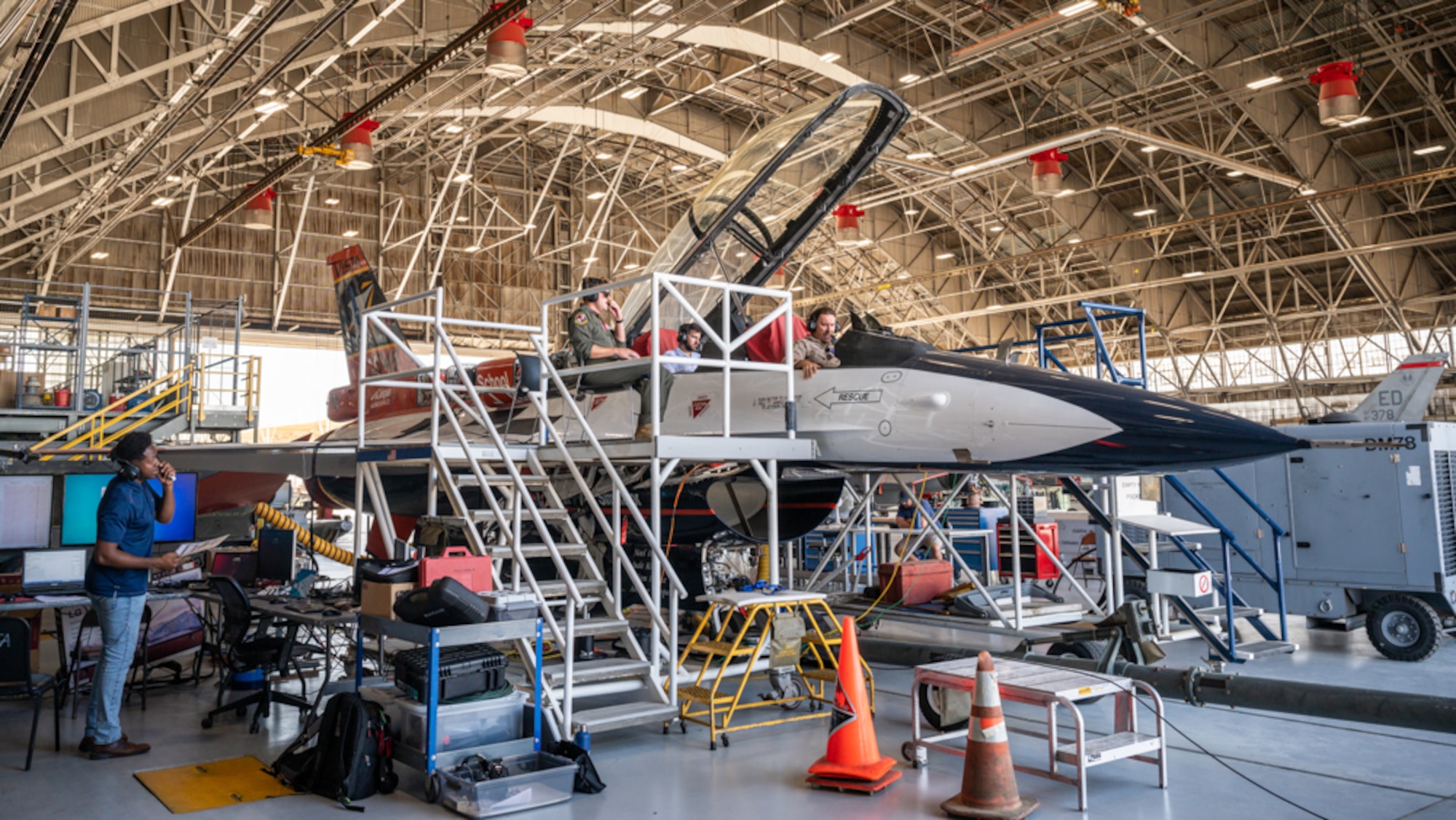
An aircraft burning more than 10,000 gallons of fuel on a cross-country flight faces high aerodynamic drag caused by boundary-layer turbulence at 640 mph.
Mahmoud I. Hussein, a researcher at the University of Colorado Boulder, is engineering synthetic materials beneath aircraft surfaces to harness microscopic vibrations that delay turbulence.
Hussein and his colleagues describe breakthroughs involving super-resonance and scatterless interference in two new studies published in Physical Review X and Proceedings of the Royal Society A. The science of manipulating these internal vibrations, known as phonons, is called phononics, a field Hussein has helped advance for more than two decades. In 2011, he co-founded the Phononics 20xx conference series.
“The prevailing paradigm since the beginning of aviation is to control drag by only shaping the vehicle. Now we have a new concept to influence surface drag using materials that can dynamically interact with the airflow, enhancing the vehicle performance in an unprecedented manner,” Hussein, a professor in the Ann and H.J. Smead Department of Aerospace Engineering Sciences at the University of Colorado Boulder, said.
Engineering Subsurface Materials
In 2015, Hussein introduced phononic subsurfaces (PSubs) to passively control vibrations at surfaces exposed to flowing fluids. Early designs operated at only a single frequency. Hussein demonstrated that arranging these structures in a coiled configuration allows them to influence vibrations across multiple frequencies, a phenomenon called super-resonance.
Researchers can organize multiple structures into a grid or lattice to achieve scatterless interference for downstream control. “This allows effective downstream control,” Hussein said. Adam Harris, a materials science and engineering PhD student and co-author, said the developments bring the technology closer to actual flight conditions.
Scatterless interference gives us a way to attenuate the spatial behavior of the instability field downstream of the PSub, while super-resonance gives us a way to broaden the range of frequencies over which the control can operate. Together, they bring the original PSub concept closer to the level of versatility needed for real-world flow environments.
Adam Harris, materials science and engineering PhD student at the University of Colorado Boulder
Funding Defense Research
Research groups construct working physical prototypes and pursue wind tunnel experiments based on computational research. The technology allows an aircraft wing or fuselage to retain its shape and smoothness while the underlying material interacts with airflow. Funding for the research includes a $7.5 million, five-year Department of Defense Office of Naval Research (ONR) Multidisciplinary University Research Initiative (MURI).