Researchers tracking giant manta rays off Costa Rica between 2018 and 2025 discovered a stark generational divide: immature pups stay close to shallow coastal refuges to evade predators, while mature adults undertake transboundary migrations across Central America.
The ocean-spanning creature is often pictured gliding alone through the deep blue, but early life paints a very different picture. A seven-year investigation led by Jeffry Madrigal-Mesén of Mantas Costa Rica, alongside colleagues from the marine conservation group CREMA and the research network MigraMar, has upended long-held assumptions about how these animals use their marine environment.
Tracking Acoustic and Satellite Data Across Seven Years
To untangle the movements of the endangered animals, the research team deployed a combination of acoustic telemetry using underwater sound pulses and satellite transmitters. Between 2018 and 2025, scientists fitted 59 individual rays with acoustic tags to monitor their movements near reef cleaning stations along the Pacific coast and around Cocos Island, located 330 miles offshore.
While 17 acoustic tags never registered on a receiver, divers’ photographs bridged the gap by identifying ten of those animals through the unique spot patterns on their undersides. Additionally, 12 mantas carried satellite tags that tracked their positions from the surface. The resulting dataset accumulated over 12,000 acoustic detections, painting a detailed picture of contrasting lifestyles.

Juvenile Pups Guard Themselves in Shallow Nearshore Waters
Two of the satellite-tracked animals were immature, each measuring about 10 feet across. Over tracking periods of 108 and 64 days, neither juvenile left Costa Rican waters, though each swam more than 1,200 miles along the continental shelf.
Mature adults can rely on their massive body size and their ability to dive deep to evade threats. But juveniles don’t have that luxury.
Jeffry Madrigal-Mesén, project leader of Mantas Costa Rica
Because young mantas lack the bulk needed to survive encounters with tiger sharks and orca whales in the open ocean, they remain strictly within shallow coastal refuges. These areas provide an abundance of food, safety from apex predator hunting grounds, and essential hygienic services from cleaning stations on the reefs. Photographs from August showed immature mantas returning to the exact spots where they were first tagged for the third year running.
Adult Migrations and the Risks Beyond Protected Waters
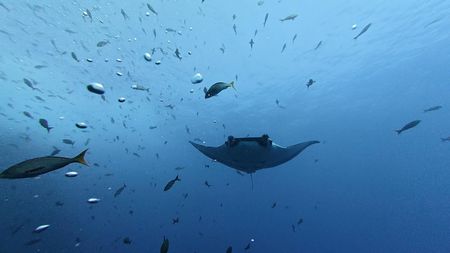
In contrast to the coastal juveniles, nine mature manta rays tracked by satellite journeyed on expansive migrations along the continental shelf break, some reaching as far as the waters off Guatemala. One adult nicknamed Mickey Mouse because of a spot pattern on his belly had movements that suggest the fish also continue to display loyalty to a particular site once they grow up.
Nearshore cleaning stations serve as vital social hubs where courtship and mating occur before adults embark on these long-distance regional trips. Mickey Mouse, a male, logged 462 acoustic detections at a coastal reef called El Secreto in 2020 and returned to the same shelf in 2023 to spend 38 days there.
However, once these adults leave legally protected marine reserves like Cocos Island and Cabo Blanco, their legal protection drops to zero. Migrating adults spent 0% of their offshore travel time inside marine protected areas, exposing them to vessel strikes and industrial fleets such as tuna purse-seine vessels and longliners.
Proposals for Multinational Conservation Swimways
To address these vulnerabilities, researchers advocate for establishing multinational conservation corridors that connect coastal nurseries with adult migratory paths. Genetic work is also underway to determine whether Central America hosts its own distinct manta population rather than migrant groups from Ecuador or Mexico.