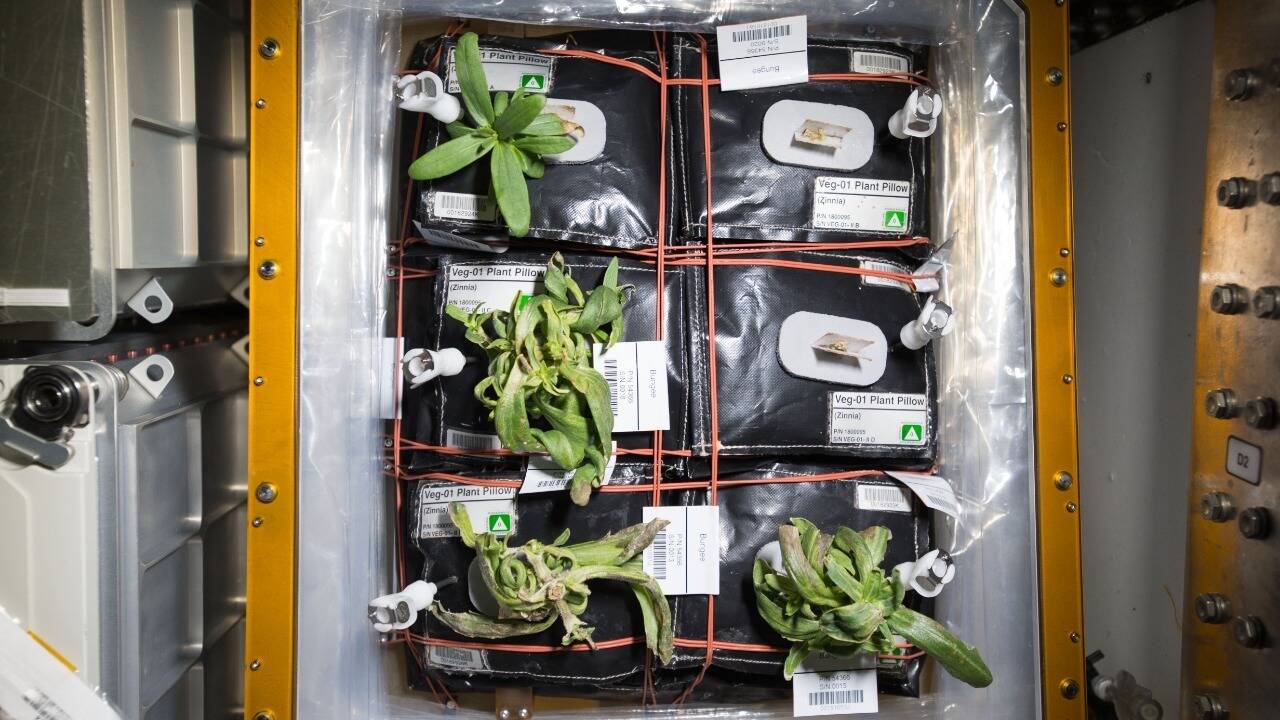
Wheat plants cultivated inside the International Space Station during a 73-day experiment grew 10% taller than Earth controls, while researchers also observed distinct cellular changes in their leaves, chloroplasts, and overall anatomical development under microgravity conditions.
Growing crops in orbit presents a unique set of physiological hurdles for plant biology. On Earth, gravity supplies the constant directional cues that roots and shoots use to orient themselves during development. In the weightless environment of the International Space Station, however, that primary directional reference disappears entirely, forcing plant structures to adapt their growth patterns and cellular composition. NASA uses dedicated facilities aboard the ISS to come up with solutions on how to cultivate plants in environments underpinned by crew time, water supply, and equipment.
The 73-Day PESTO Wheat Investigation on the International Space Station
Researchers have investigated different crops and growing systems to determine how plants respond to the conditions aboard the orbiting laboratory. One such investigation aboard the International Space Station, known as PESTO, found that wheat plants grown in space turned out to be 10% taller than those on Earth. The findings are part of NASA’s wider initiative to understand whether crops can be grown during space missions of long duration. This allowed researchers an opportunity to examine how plant structures respond and develop under microgravity.

Microgravity did alter leaf development and cellular composition of the plant, but the plant as a whole remained unharmed. Though the wheat grown in space was 10% taller than Earth-based plants used for comparison, it wasn’t enough to verify whether a crop had more nutritional value or would produce more food. Another investigation aboard the ship, called the Seedling Growth investigation, found that seedlings were able to acclimate to the space conditions by altering the expression of certain genes related to stress.
Engineering Controlled Environments for Long-Duration Space Missions
Long-duration missions require self-sufficient food production systems to support astronauts during voyages spanning months or years away from Earth.
- Vegetable Production System (Veggie): A low-power growing chamber that can hold six plants and includes adjustable lighting and nutrient-delivery arrangements for crop experiments.
- Veggie PONDS: The Passive Orbital Nutrient Delivery System, or Veggie PONDS, offers another arrangement by using holders with small water reservoirs.
The system could also impart information to researchers at NASA’s Kennedy Space Centre, where its operation is managed, reducing the routine attention that astronauts were responsible for. Plant-growth systems addressed the practical challenges of spaceflight.
Expanding Space Agriculture Beyond Wheat Cultivation
NASA’s plant experiments, however, do not end here; they have also extended their studies beyond wheat. The Veg-04A and Veg-04B investigations grew Mizuna mustard, while Veg-05 examined tomatoes under different lighting conditions. Researchers compared crop yields, nutritional composition, and microbial levels with those of plants grown on Earth.
Beyond standard crop production, current space biology efforts also examine host-pathogen interactions in orbital environments. MVP-Plant-02 will examine the interaction between Arabidopsis thaliana, a small flowering plant related to mustard, and Golovinomyces cichoracearum, a fungus that causes powdery mildew. The team will investigate whether the fungus develops more aggressively in microgravity and how the plant’s gene activities change as the disease progresses. Researchers will compare plants grown in microgravity with plants maintained at Earth-like gravity aboard the station, as well as a separate ground control at Kennedy Space Center. This approach will allow the team to distinguish the effects of microgravity from other factors associated with growing plants in space.
The investigation will use the Multi-Use Variable-g Platform, or MVP, a system developed by Redwire Space Technologies Inc. To accomplish this, the Redwire and UF team developed the Conidia Application Device, a specialized system for applying fungal spores to plant canopies during spaceflight. The Conidia Application Device will allow astronauts to perform sterile ejections of powdery mildew spores onto Arabidopsis canopies, all within a closed system,
Soltez said. Soltez’s participation also reflects the project’s role in preparing the next generation of scientists to conduct research at the intersection of plant health and space exploration. Since we get to grow plants in microgravity from seed, all plant defense mechanisms have been suppressed or turned on by microgravity before the spores land on plant tissues,
Schuerger said. It is a much better test than inoculating seedlings on the ground before launch.
Applying the pathogen after the plants have experienced microgravity allows researchers to investigate how the space environment affects plant biology before infection begins. Previous space-based plant disease research applied the pathogen before launch.
Building on UF’s leadership in space biology MVP-Plant-02 draws on complementary strengths within UF/IFAS. Schuerger brings more than four decades of experience developing integrated disease management strategies for plants grown in greenhouses and biological life support systems. Ferl and Paul have also brought decades of space biology experience and have led extensive research into plant growth and gene expression in space. Their collaboration combines plant pathology — the study of plant diseases and their causes — with plant physiology and molecular biology to investigate not only whether disease occurs, but also how plants respond at the genetic level. By bringing together expertise in plant pathology, horticultural sciences and space research, the team is working toward a future in which astronauts can grow healthy plants — and produce fresh food — during missions far from Earth.