Researchers have discovered a new way for time crystals to form through wave coarsening, where spontaneous vibrations in a 3D-printed metamaterial merge and slow down until the structure beats in unison. The laboratory result, reported in Nature, offers a path past the fragility plaguing microscopic quantum systems.
Coarsening is a familiar march toward equilibrium. When iron magnetizes, tiny magnetic domains twist and merge until the entire material points one way. When oil and water emulsions separate, droplets swallow their neighbors to grow larger over time through slow, diffusive transport. An international team has uncovered a dramatic vibrational counterpart to that process, driven entirely by waves rather than diffusion.
The research was led by Jonas Veenstra. Jack Binysh of the Institute of Physics at the University of Amsterdam also led it, alongside colleagues at institutions in Delft, Leiden, Birmingham, and Cambridge, including senior authors Anton Souslov and Corentin Coulais. Their findings demonstrate how active, non-reciprocal systems can organize their own motion without an outside rhythm imposed upon them.
Constructing the Honeycomb Lattice
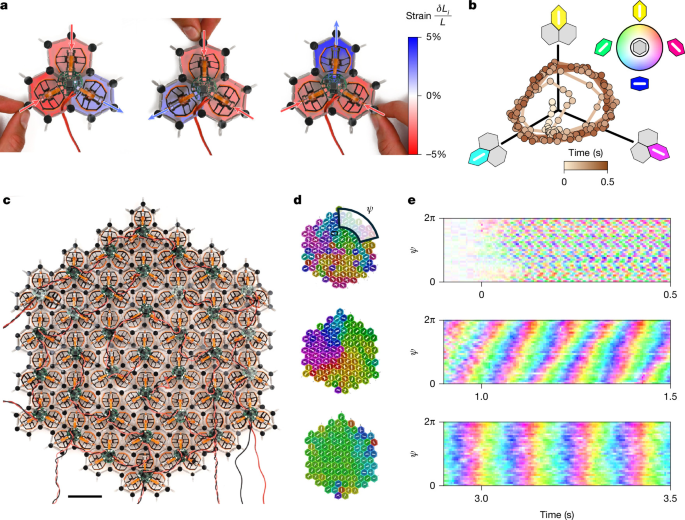
To test whether wave coarsening could occur in a physical machine, the team constructed an unusual metamaterial whose mechanical properties emerge from its engineered structure rather than its chemical composition. The 3D-printed honeycomb lattice consisted of 37 interconnected units equipped with sensors, actuators, and tiny electronic controllers.
Each unit comprised three elastic hexagons programmed to respond asymmetrically to one another. When a single hexagon compressed, its clockwise neighbor compressed too. Its counterclockwise neighbor expanded.

When the team nudged the honeycomb to introduce small, random disturbances, individual units initially vibrated rapidly at around 30 times per second. Gradually, larger waves appeared around the material’s edge and overwhelmed the smaller jitter. As those waves grew longer, their oscillations slowed until the entire structure moved together in a single, synchronized rhythm.
Simulating the Time Crystal
A synchronized wave alone does not prove the creation of a time crystal. Researchers had to demonstrate that the emergent order could persist despite external noise and random jostling. To test this stability, the team turned to mathematical analysis and computer simulations, introducing artificial noise into their models to see if the coherent rhythm would collapse.
The simulations revealed that the oscillations remained steady even as the modeled system approached an effectively infinite size. This resilience under noise mirrors the core definition of a time crystal. It is a phase of matter that exhibits periodic motion in time, analogous to how an ordinary spatial crystal exhibits periodic order in space.
To verify that the phenomenon was not a quirk of the honeycomb geometry, the team also built an elastic ring featuring 24 motors governed by the same non-reciprocal force rules. Floating the ring on an air table to minimize friction, they observed traveling waves that combined into slower, larger oscillations. While the ring experiments revealed how waves naturally favor longer wavelengths through a feedback loop, the researchers did not separately establish that the ring formed a time crystal.
Scaling Up Mechanical Components
Most prior realizations of time crystals have lived in microscopic settings, such as trapped ion chains or atomic, photonic, and Rydberg systems. By contrast, the Amsterdam-led experiment brings time crystallization to centimeter-scale mechanical components governed by classical engineered forces, tracing every step of its formation.

Active elastic media appear across biology and technology, from autonomously oscillating epithelial cell sheets to soft robotics. The authors suggest that wave coarsening could serve as a route towards time-crystallization in systems with additional symmetries and associated Goldstone modes. These can be used across acoustics, optomechanics, living matter, and soft robotics.
In robotics, programming a material to coordinate its own movement from rapid local jitter into slow, coherent deformation could lead to machines that self-organize their gait without centralized electronic controllers. How far this self-organization extends beyond these specific laboratory designs remains unknown.