Young adults in their 20s and 30s with severe obesity face a roughly 40% higher risk of developing cancer within a decade compared to their normal-weight peers. This finding, emerging from a massive study of over 6.3 million adults, suggests that abdominal fat acts as a primary driver of risk that standard BMI measurements often miss, Pharmacy Times reported.
The scale of the research is staggering. Researchers from Soongsil University and The Catholic University of Korea analyzed health screening and insurance data from 6,313,338 Korean adults aged 20 to 39. By following this cohort for an average of 11 years, the team identified a clear, ascending ladder of risk: as body weight increased, so did the incidence of early-onset cancer.
Waist circumference outweighs BMI
For years, the medical community has relied on Body Mass Index (BMI) as the gold standard for obesity classification. However, this research indicates that where you carry the weight matters more than how much you weigh. According to reports from Newswise and 헤럴드경제, abdominal obesity—measured by waist circumference—is a more potent predictor of cancer risk than BMI alone.
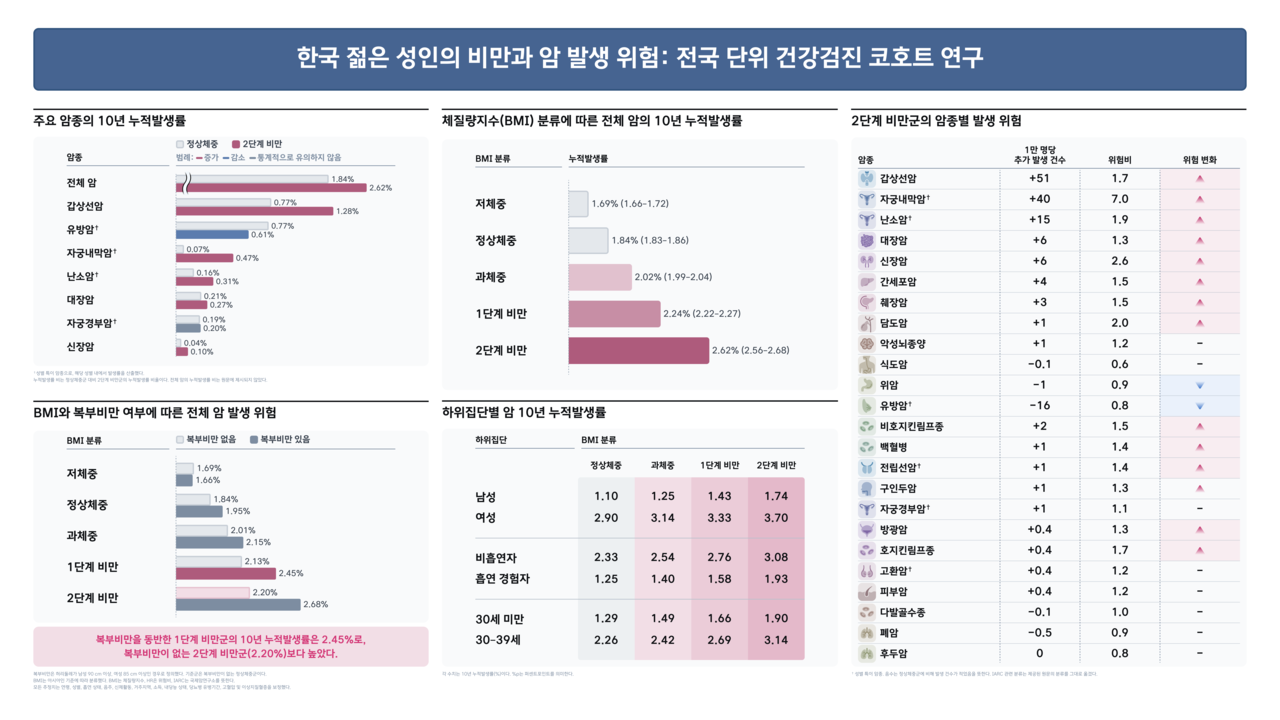
The data reveals a striking contrast. Within the “class 1 obesity” group, those with abdominal obesity saw a 10-year cancer incidence of 2.45%. That figure actually exceeds the 2.20% incidence rate found in “class 2 obesity” participants who did not have abdominal obesity. In simpler terms, a person with a lower overall BMI but higher belly fat may face a higher risk than someone with severe obesity who lacks abdominal fat.
The absolute numbers provide a grounded perspective on these percentages. Pharmacy Times noted that the difference between normal weight and class 2 obesity was 0.78 percentage points, which translates to roughly 8 additional cancer diagnoses per 1,000 individuals over a 10-year span.
Men face higher relative risk of obesity-linked cancer
The association between weight and cancer was not uniform across the population. The relative risk was notably stronger in men. For those in the class 2 obesity category, men showed a hazard ratio of 1.58 compared to 1.28 for women. However, 헤럴드경제 highlighted that the increase in cancer incidence was particularly pronounced among women and adults in their 30s.
When looking at specific types of cancer, the disparities became even more acute. The study identified the strongest associations with thyroid, endometrial, and ovarian cancers. In one of the most alarming statistics, the incidence of endometrial cancer in the class 2 obesity group was approximately seven times higher than in the normal-weight group, according to 헤럴드경제.
This fits into a broader global pattern. The National Cancer Institute and the CDC have linked excess body weight to at least 13 different types of cancer, including multiple myeloma and colorectal cancer. While the Korean cohort didn’t pinpoint the exact biological pathways, experts generally point to chronic inflammation and shifts in hormonal signaling as the likely culprits.
The tension between observation and causation
Despite the strong correlation, there is a critical scientific caveat: this was an observational study. It proves a link, but it does not prove that obesity causes the cancer, nor does it prove that losing weight in your 20s will definitively prevent it. There are “residual confounders” at play—specifically smoking habits. Even after adjusting for smoking status, the researchers noted that differences in the intensity and duration of smoking could still influence the results.
“Abdominal obesity can serve as a key indicator for distinguishing cancer risk, which is why it is important to manage not just body weight but also waist circumference from a young age,” they said, as reported by 헤럴드경제.
There is also the question of population specificity. Because the data came from a Korean health-screening population, clinicians caution that the results may not translate perfectly to other populations.
Clinical shifts in preventive care
The “so what” of this study lands squarely on the shoulders of primary care providers and pharmacists. Traditionally, obesity in young adulthood is discussed in the context of metabolic syndrome—diabetes, hypertension, and heart disease. This data pushes the conversation toward oncology.
For the average adult, this means the timeline for “preventive” health is moving backward. While the US Preventive Services Task Force currently recommends colorectal cancer screening starting at age 45 for average-risk adults, this research suggests that the modifiable risk factors—like waist circumference—should be addressed decades earlier.
The rise of early-onset cancers—those appearing before age 50—has been a growing concern for public health officials. With obesity rates among young people climbing steadily, the intersection of weight management and cancer prevention is no longer a theoretical concern; it is a clinical necessity.