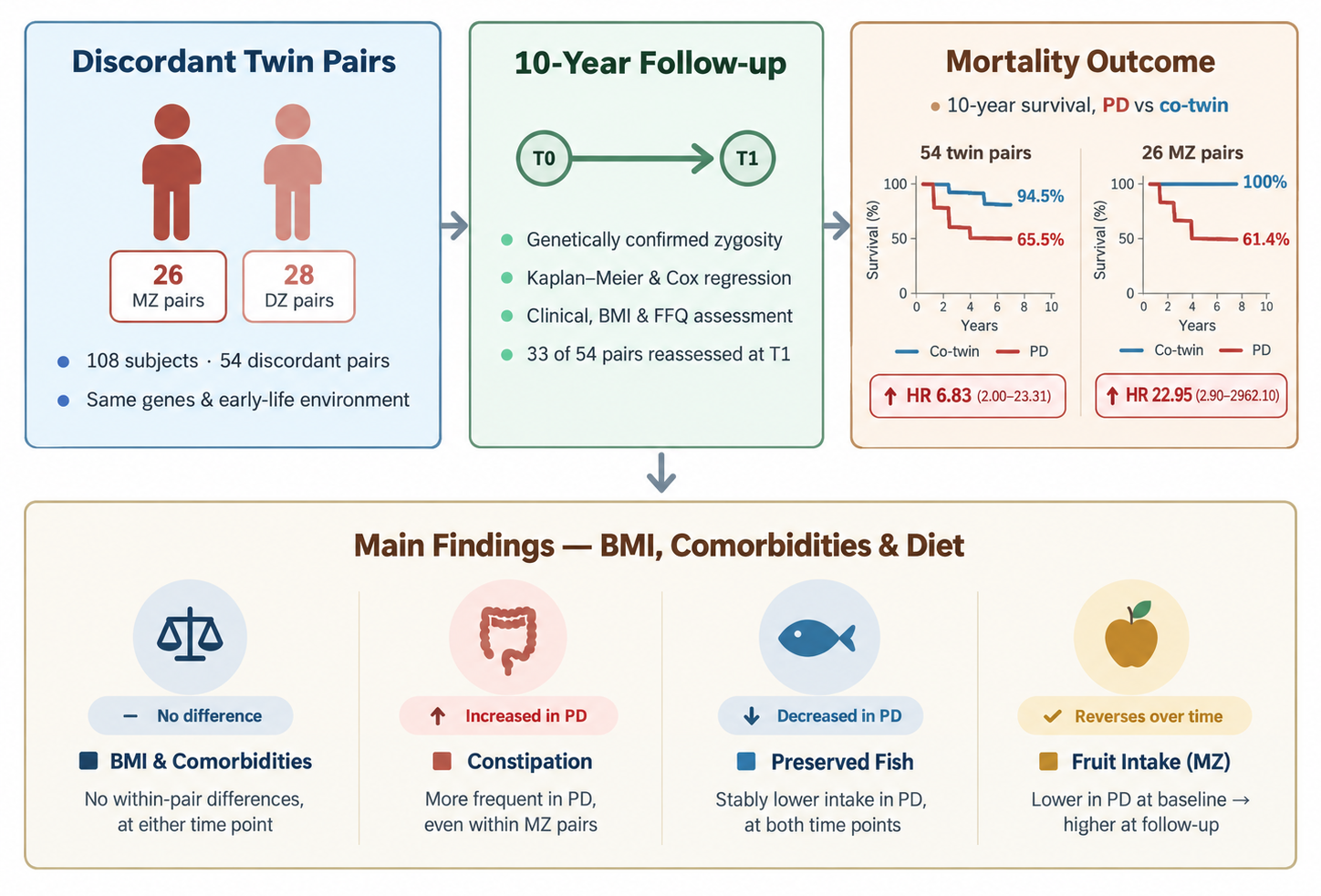
In a longitudinal study of twins discordant for Parkinson’s disease, researchers found a stark survival gap: 31.5% of twins with the disease died over a ten-year period, compared to just 5.6% of their unaffected co-twins. This finding, detailed in a study published in the journal Brain Sciences, suggests that while genetics provide the blueprint, the actual trajectory of the disease is heavily influenced by factors beyond DNA.
The study is a critical piece of the puzzle because it utilizes the “twin model” to isolate why one person develops a neurodegenerative disorder while their genetically identical counterpart does not. By tracking 54 pairs of twins in Italy—including 26 monozygotic (identical) and 28 dizygotic (fraternal) pairs—researchers could strip away the noise of shared socioeconomic backgrounds and early childhood nutrition to see what actually drives mortality in Parkinson’s patients.
Identical genes do not guarantee identical outcomes
The most striking data emerged from the monozygotic subgroup. In these pairs, every single death recorded over the decade occurred in the twin affected by Parkinson’s. If the disease were purely a genetic destiny, one might expect a more balanced distribution of risk or a similar decline in the unaffected twin. Instead, the divergence was sharp.
This gap suggests that shared genetic material alone cannot explain the excess mortality associated with the disease. It points to a complex interaction between “modifiable factors”—things we can change or avoid—and the biological progression of the disorder. The study looked at everything from smoking habits to exposure to organic solvents and pesticides, though the results on environmental toxins were clouded by recall bias, as participants had to remember exposures from years prior.
The stakes here are human and immediate.
The slow slide of clinical divergence
While some markers remained stable, others widened like a growing rift. The researchers found that constipation was the most consistent clinical difference between the pairs. Not only was it more frequent in affected twins at the start, but the gap worsened over the ten years. Regular bowel habits became increasingly rare for those with Parkinson’s, while the unaffected twins remained stable.
Interestingly, some common assumptions about Parkinson’s didn’t hold up in this specific cohort. Nutritional status—measured by body weight and BMI—showed no significant difference between the twins. This is notable because involuntary weight loss is often cited as a hallmark of PD progression. However, the researchers admitted that because follow-up weight was self-reported, the reliability of this specific data point is limited.
Dietary habits also showed surprising consistency. Most twins ate similarly, with a few exceptions: affected twins tended to eat less fish, and their fruit intake fluctuated, starting lower but ending higher than their co-twins. These nuances suggest that diet may play a role, but perhaps not the primary role in survival.
| Metric | Affected Twins | Unaffected Co-Twins |
|---|---|---|
| 10-Year Mortality Rate | 31.5% | 5.6% |
| MZ Subgroup Deaths | All deaths occurred here | Zero deaths |
| Primary Clinical Divergence | Worsening constipation | Stable bowel habits |
| Nutritional Status (BMI) | No significant difference | No significant difference |
The “delayed onset” phenomenon
Perhaps the most unsettling discovery for clinicians was the conversion of “discordant” twins to “concordant” ones. In two identical twin pairs, the unaffected twin eventually developed Parkinson’s, but with a time lag. In one case, the gap between the first and second diagnosis was 14.5 years; in another, it was 12 years.
This reveals a hidden danger: a lack of symptoms in a genetically predisposed individual does not mean they are “safe.” It may simply mean their onset is delayed.
Some might argue that the small sample size—108 total participants—limits the ability to draw sweeping conclusions. It is true that the magnitude of survival divergence in the MZ subgroup is uncertain due to the low number of total deaths. However, the pattern is too consistent to ignore.
The study concludes that while comorbidities like hypertension didn’t differ significantly between the pairs, the disease itself creates a survival divide that genetics cannot bridge. The real work now lies in figuring out exactly which environmental triggers flip the switch for one twin but leave the other untouched.
The divergence in survival suggests that Parkinson’s is not a static sentence, but a dynamic process where the body’s resilience—or lack thereof—determines the final chapter.