Researchers have confirmed that an asteroid roughly 160 meters wide slammed into the southern North Sea between 43 and 46 million years ago. The impact carved out the Silverpit Crater and generated a towering tsunami exceeding 100 meters, resolving a decades-long scientific debate over the formation’s true origin.
More than two decades after its initial discovery beneath the seabed, the geological formation known as the Silverpit Crater has finally been unmasked as the scar of an ancient cosmic collision. A research team led by Dr. Uisdean Nicholson of Heriot-Watt University in Edinburgh reconstructed the violent prehistoric event by combining advanced three-dimensional seismic imaging, computer simulations, and microscopic rock analysis.
Located approximately 130 kilometers off the coast of Yorkshire, England, the crater rests about 700 meters beneath the floor of the southern North Sea. The depression measures roughly three kilometers across and is encircled by a much wider zone of geological fractures where the rock fractured during the cataclysm.
Decades of Contention Over the Silverpit Crater
When scientists first identified the unusual structure in 2002, its true nature instantly sparked fierce scientific disagreement. While some geologists suspected an extraterrestrial impact right away, others argued that mundane terrestrial forces—such as the underground shifting of ancient salt deposits—were responsible for the circular depression.
The controversy persisted for years, culminating in a formal debate among geologists in 2009. That lingering uncertainty has now been shattered by physical proof recovered from deep rock cuttings.

New seismic imaging has given us an unprecedented look at the crater. Samples from an oil well in the area also revealed rare ‘shocked’ quartz and feldspar crystals at the same depth as the crater floor. We were exceptionally lucky to find these — a real ‘needle-in-a-haystack’ effort. These prove the impact crater hypothesis beyond doubt, because they have a fabric that can only be created by extreme shock pressures.
Dr. Uisdean Nicholson, sedimentologist in Heriot-Watt University’s School of Energy, Geoscience, Infrastructure and Society
These shocked minerals bear internal crystal structures that ordinary geological processes cannot replicate. Their presence at the exact depth of the crater floor establishes that an extreme high-speed impact occurred.
Reconstructing a 330-Foot North Sea Tsunami
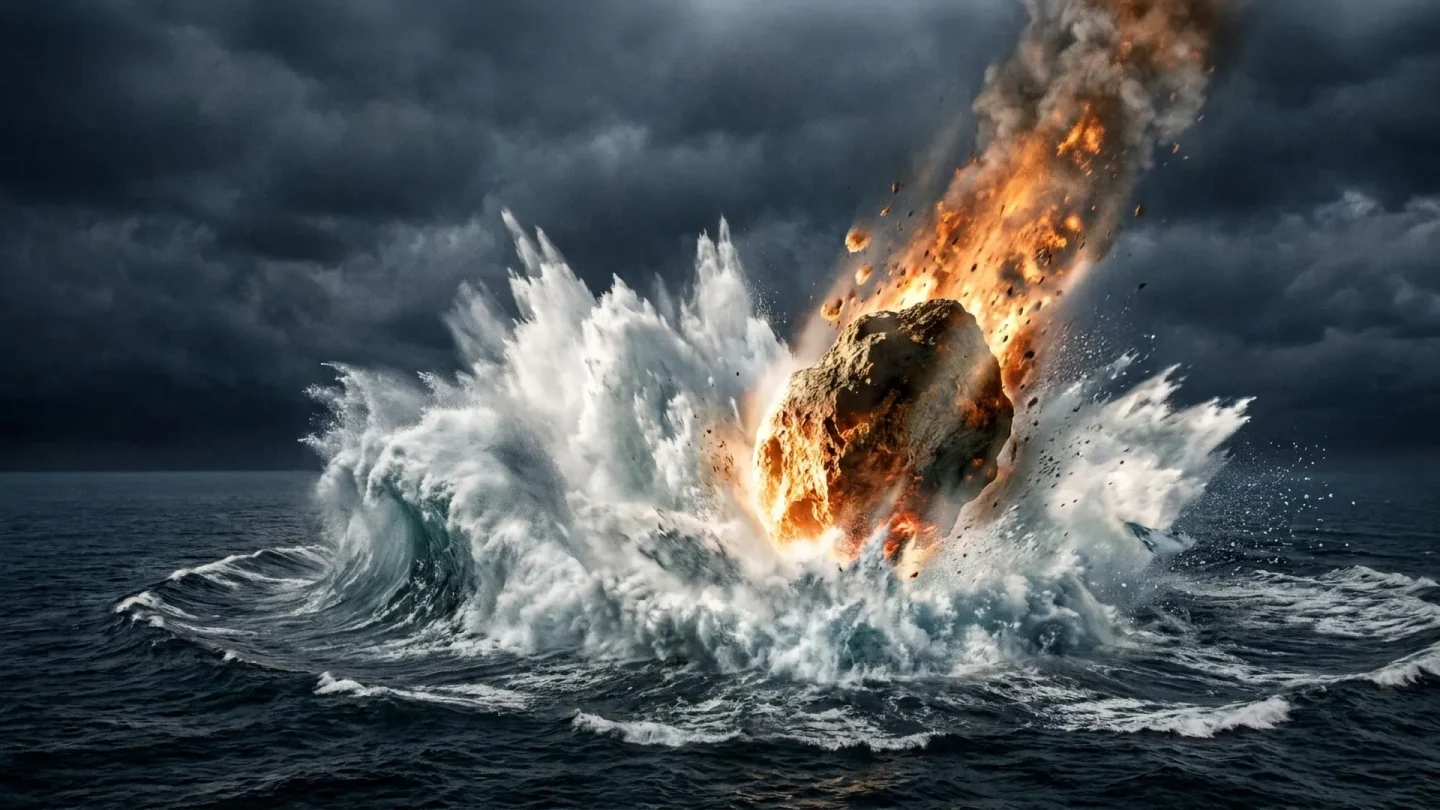
With the impact origin confirmed, the research team turned to computer models based on physical laws to simulate the collision. The analysis indicates that an asteroid measuring about 160 meters across approached from the west and struck the seabed at a shallow angle.
The collision is believed to have blasted massive quantities of rock and seawater roughly 1.5 kilometers into the air. As that displaced material collapsed back down, it generated a monster wave.
Our evidence shows that a 160-meter-wide asteroid hit the seabed at a shallow angle from the west. Within minutes, it created a 1.5-kilometer-high curtain of rock and water that then collapsed into the sea, creating a tsunami over 100 meters high.
Dr. Uisdean Nicholson, Heriot-Watt University
That height surpasses a thirty-story building. Although the wave's exact reach across the regional coastline is difficult to reconstruct from computer modeling alone, the simulation shows the massive destructive energy released when a cosmic projectile hits the ocean.
Why Underwater Craters Remain Exceptionally Rare
The findings, published in Nature Communications, elevate Silverpit into a very exclusive category of geological features. Earth’s active plate tectonics and relentless erosion erase nearly all traces of most impact events over time.
Roughly 200 confirmed impact craters exist on land, but only about 33 have been identified beneath the ocean. Marine structures are notoriously difficult to preserve and investigate.
The Silverpit structure now joins other marine and buried impact sites, including the asteroid associated with the dinosaur extinction.
Funding for the research was provided by the Natural Environment Research Council.