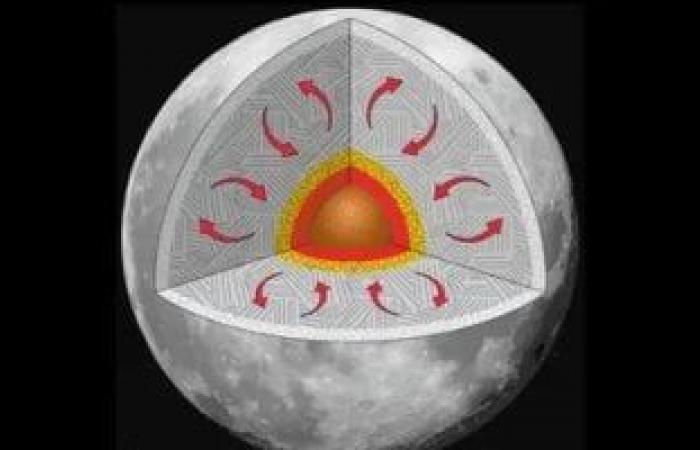
The Moon is physically shrinking.
Thomas Watters, the study’s lead researcher and a geologist and honorary scientist at the Smithsonian Institution’s National Air and Space Museum Center for Earth and Planetary Studies, noted in a statement, The number of these recent faults revealed by the LROC camera images is much larger than I had imagined.
Researchers expect that existing faults will continue to grow and new ones will form as the interior temperature continues to decline. The cooling process is not a finished event.
Surface Cracks Map Core Heat Loss
LROC observations revealed lobe scarps—long, curved structures created when the surface shrinks and cracks, pushing layers of rock upward.
The imagery also shows narrow wrinkles known as small ridges within the lunar maria, the dark, expansive plains of the Moon.
Single-Plate Body Differs From Earth
The Moon is a single-plate body with an outer shell consisting of one continuous mass. This differs from Earth, which possesses roughly 15 major tectonic plates.
Lunar fractures occur wherever the shrinking crust reaches a breaking point. Because there are no plate boundaries, these fractures are not concentrated in specific zones but are distributed across various regions of the surface.
Crust Thickness Affects Stability
Regions with a thicker lunar crust are more stable and contain fewer cracks. Mapping thousands of formations revealed that the Moon does not shrink uniformly, as some areas exhibit a much higher density of faults than others.
This thickness likely acted as an insulator in the Moon’s early history, shielding the warm interior and slowing the initial rate of heat loss, contraction, and cracking before those processes accelerated over time.
A significant number of the cracks spread across the lunar surface formed during relatively late stages of its history.