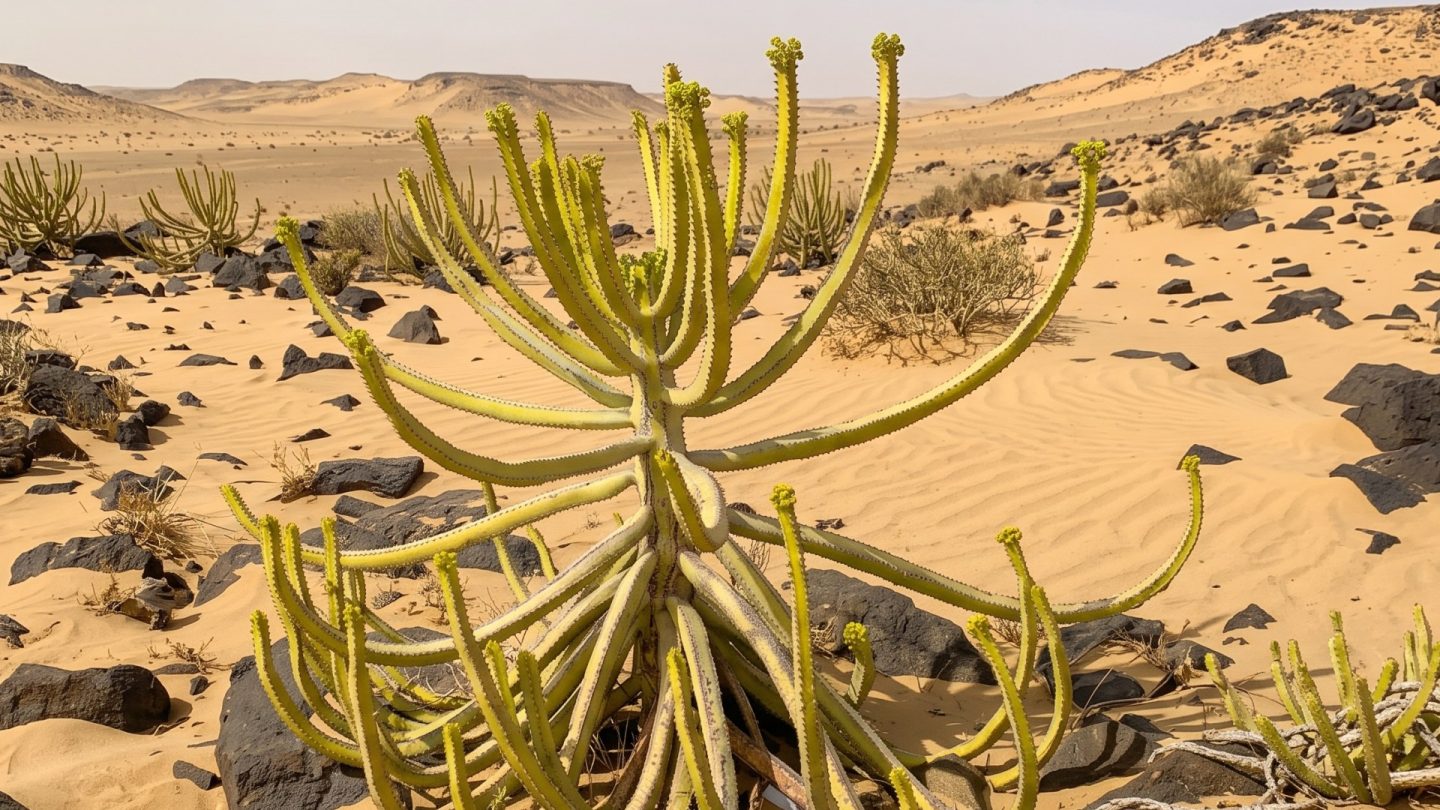
Four endemic succulent plant species in Saudi Arabia face a growing existential threat as climate change shrinks their high-altitude habitats. Researchers using ecological niche modeling warn that geographic isolation across the southwestern mountain peaks prevents these slow-growing plants from relocating to cooler zones, raising distinct risks for their long-term survival.
Deep in the rugged terrain where the southwestern mountains of Saudi Arabia rise sharply toward the Red Sea, a quiet ecological squeeze is unfolding. Stretching from Taif through Al-Baha and Asir all the way down to Jazan, a dramatic escarpment lifts peaks like Jabal Al-Soudah to high altitudes above sea level. These highlands interrupt moist air masses rolling off the coast, creating a distinct climate of regular cloud cover and moderate rainfall that contrasts sharply with the surrounding desert lowlands.
Botanists describe these lofty heights as sky islands—isolated pockets of moisture and moderate temperatures that harbor a high concentration of plant species found nowhere else on Earth. Among them are four endemic succulent species belonging to the aloe and spurge genera: Aloe armatissima, Aloe shadensis, Euphorbia taifensis, and Euphorbia saudia arabica.
Climatic Thresholds and Habitat Suitability Across the Escarpment
While succulents possess built-in physiological defenses against dry conditions—including crassulacean acid metabolism photosynthesis that minimizes water loss—they remain bound by strict environmental boundaries. The research team modeled the current and future geographic distribution of the four species using computer modeling tools and found that their habitat requirements are far narrower than the vast appearance of the mountain range suggests.
According to the findings, habitat suitability for these plants peaks within an elevation range of roughly 900 to 1,600 meters, paired with moderate seasonal rainfall and warm-season maximum temperatures spanning 32 to 38 degrees Celsius. Al-Hashimi explains that highland plants may share similar drought tolerances, but they rely on distinctly different seasonal rainfall patterns, exact elevations, and annual temperature ranges to thrive.
Diverging Fates Under Projected Climate Scenarios
The study reveals that the four species will respond very differently to future warming. Under a medium-emissions scenario, Aloe armatissima and Euphorbia taifensis face severe losses of their suitable habitat. Aloe armatissima is of particular concern, with models projecting a reduction in its suitable area by up to 85% by the second half of the century.
By contrast, Aloe shadensis and Euphorbia saudia arabica navigate a different trajectory. Their suitable ranges face a dip around the middle of the century before experiencing a partial recovery in distribution between 2061 and 2080. However, researchers emphasize that a projected expansion in climatic suitability does not mean the plants will actually occupy those new spaces.
Geography and Human Activity Hinder Succulent Migration
Even where future climates turn favorable, physical geography stands in the way. Succulents are slow-growing and have limited seed dispersal capabilities. Because they live on isolated mountain blocks separated by inhospitable lowlands, they cannot migrate as fast as the climate shifts.
Climate change is only part of the equation. Human activity compounds the ecological pressure through overgrazing, urban expansion, and the unmanaged collection of succulents. The study stresses that long-term survival depends not just on maintaining a suitable climate, but on protecting existing populations from ground-level threats.
Abdulrahman Al-Hashimi, associate professor in the Department of Botany and Microbiology at King Saud University, said that Consequently, the survival of these plants depends not only on the continuation of a suitable climate, but also on their ability to reach new habitats, and on protecting existing populations from other pressures.
Targeted Conservation Priorities in Asir and Al-Baha
To safeguard these rare species, researchers recommend focusing conservation efforts on the highest elevations in Asir and Al-Baha, including Jabal Al-Soudah and Jabal Shada. These zones emerge from the models as the most climatically stable refuges across multiple scenarios.
Field validation remains an essential next step. Scientists say targeted ground surveys are needed to check model predictions against actual plant distributions, alongside collecting detailed data on population sizes, soil conditions, and land-use patterns. Conservation recommendations also call for seed banking, living collections, and formal extinction-risk assessments aligned with International Union for Conservation of Nature criteria.