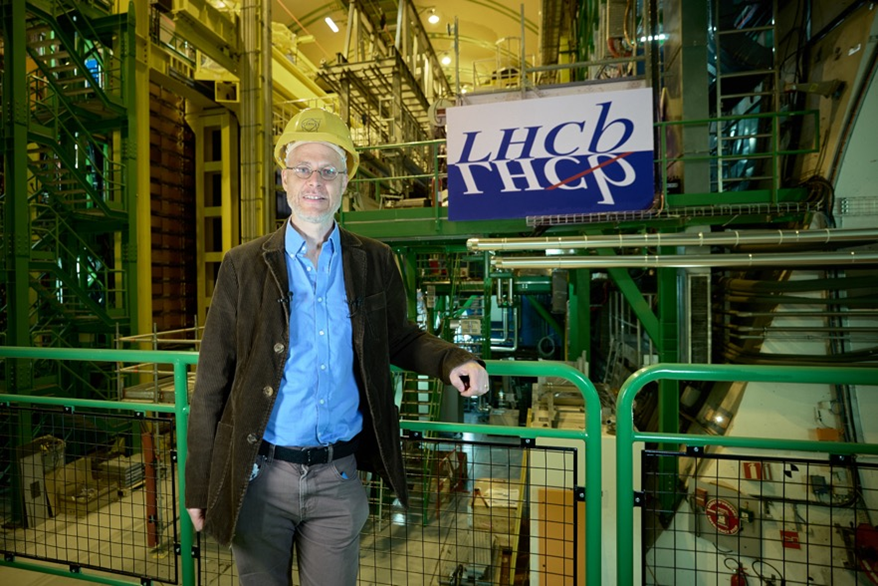
Physicists working on the LHCb experiment at CERN’s Large Hadron Collider have detected evidence of a rare neutral beauty meson decay that occurs only once in roughly 10 billion events.
Four Decades of Searching for a One-in-Ten-Billion Decay
The measurement captures the transformation of a neutral B0 meson into a muon and an antimuon, written as B0→μ+μ−. Researchers announced the findings during a seminar at CERN, marking the first time a single experiment has captured enough statistical evidence to record the extraordinarily rare event.
Physicists have chased the decay for more than forty years. Marco Santimaria, who co-led the international analysis team, noted that Extreme precision is required to pick the muons out of the overwhelming background.
In 2015, a joint analysis involving the LHCb and CMS collaborations published an early indication of the decay in the journal Nature, reporting 3.0 sigma evidence based on Run 1 data, though subsequent analyses incorporating results through 2018 could not confirm that initial signal.
Niladri Sahoo, a particle physicist at the University of Birmingham and convener of the LHCb Very Rare Decays working group, explained that this potential discovery alongside a much more precise measurement of a previously observed sibling decay provides a powerful new test of the Standard Model and a window into potential new physics.
Professor Guy Wilkinson, a physicist at the University of Oxford, noted that the LHCb project is a major success story for CERN, with Oxford maintaining a leading role dating back to the inception of the project in 1995.

The experiment itself is funded by the Science and Technology Facilities Council as part of UK Research and Innovation, with the UK LHCb collaboration including researchers from ten UK universities alongside the STFC Rutherford Appleton Laboratory.
Upgraded Detectors and Machine Learning Cut Through Collision Noise
Observing the phenomenon required significant hardware and software improvements at the Large Hadron Collider. Following a major overhaul, the experiment began collecting collision data in 2024 at five times its previous rate, granting researchers a substantially larger sample of particles to analyze.
Professor Chris Parkes, Head of the Department of Physics and Astronomy at The University of Manchester, led the international LHCb collaboration through the construction of the upgrade and led the collaboration’s approval of the new result.
A major UK-built component of the upgraded LHCb detector is the Vertex Locator, a silicon pixel system that sits just five millimetres from the LHC beams. The device tracks particle trajectories with extreme precision, allowing scientists to pinpoint where beauty mesons are produced and where they decay.
Researchers combined the hardware updates with advanced machine-learning techniques to suppress the vast background of competing particle processes that would otherwise have swamped the signals.
Statistical Significance and Comparison With the Standard Model
Data recorded by the LHCb collaboration across 2024 and 2025 yielded evidence at a statistical significance of 3.2 standard deviations. When the team combined those newer measurements with legacy data gathered between 2011 and 2018, the overall statistical significance increased to 3.2 standard deviations, corresponding to roughly a 0.3 percent chance that the signal occurred by chance.
While this level of certainty crosses the threshold for scientific evidence, it remains well below the five-sigma requirement needed to claim a formal discovery in particle physics, a standard comparable to the bar used to announce the Higgs boson in 2012.
| Process and Metric | Measured Value | Standard Model Prediction |
|---|---|---|
| B0 decay branching fraction (new data) | 1.26 in 10 billion | 1.03 in 10 billion |
| B0 decay branching fraction (combined) | 1.14 in 10 billion | 1.03 in 10 billion |
| Bs0 decay branching fraction | 3.31 in a billion | 3.66 in a billion |
| Bs0 effective lifetime (combined) | 1.60 picoseconds | Consistent with model |
Rare Decays Test Limits of the Standard Model
The measurements agree with the predictions of the Standard Model, but analyzing increasingly precise rare decays helps researchers test the limits of current physics and narrow the parameters where undiscovered particles might hide. Professor Brian Cox, a particle physicist at The University of Manchester who was not involved in the experiment, said: This is an important result and a beautiful example of how science advances.
Physicists describe the measurement as a step toward exploring the :zeptoverse, an extreme distance scale roughly a million times smaller than a proton where hypothetical forces and particles could exist.

Earlier coverage: CERN Physicists Detect Ultra-Rare Particle Decay After 40 Years