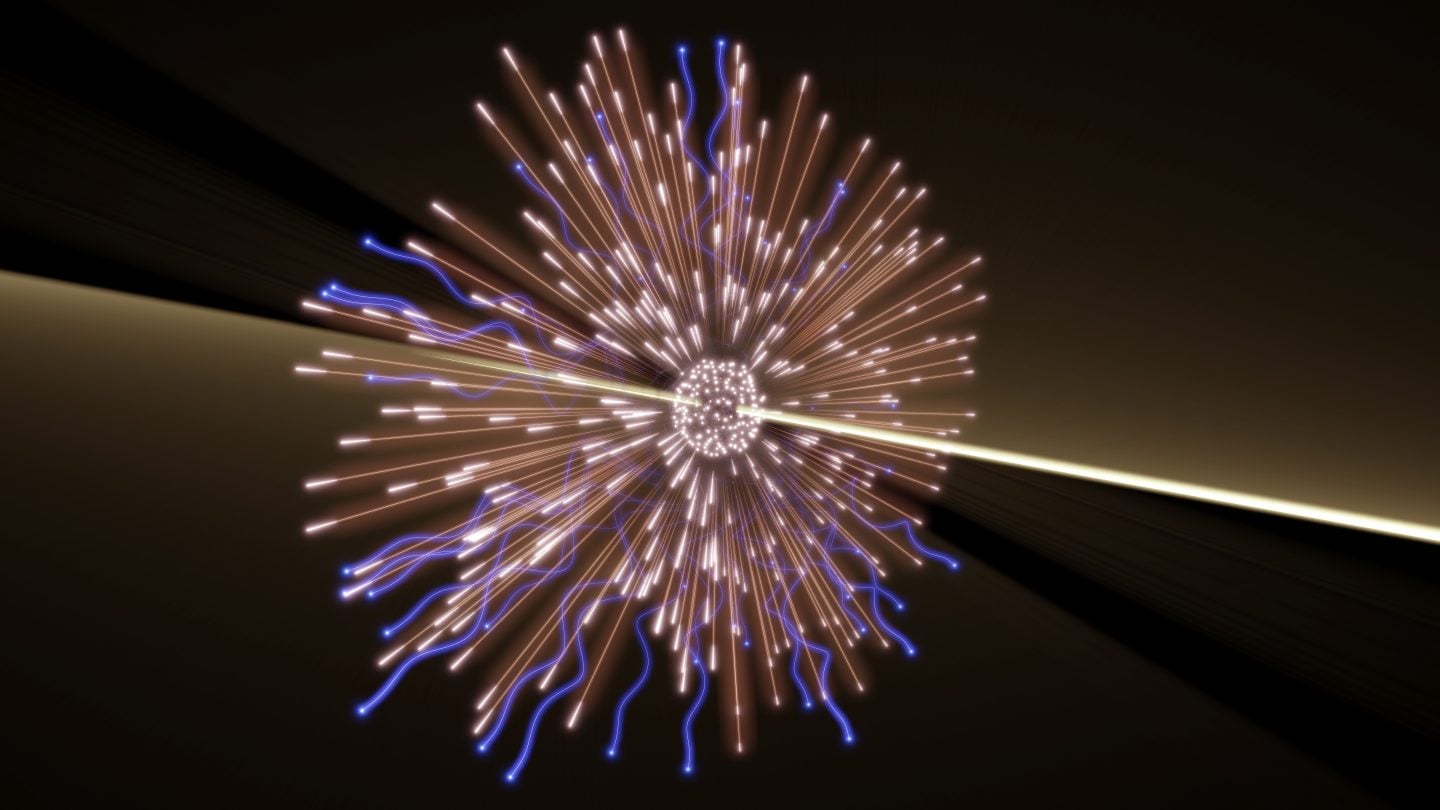
Physicists announced on Tuesday, November 3, 2026, that an international collaboration has found evidence of an extremely rare particle decay after more than 40 years of searching, bringing researchers closer to studying a subatomic scale known as the zeptoverse.
Physicists Detect Rare Beauty Particle Decay
Researchers using the upgraded LHCb experiment at CERN detected signs of a beauty particle decaying into two muons. Physicists have been chasing this decay for more than forty years, according to Marco Santimaria, who co-led the 19-person international analysis team. The Large Hadron Collider, a massive particle accelerator operated by CERN on the Swiss-French border, smashes particles together at extremely high speeds to allow scientists to study smaller subatomic components. Particles containing beauty quarks typically exist for about 1.5 trillionths of a second before decaying into other particles. The research involved about 20 physicists from the UK, Germany, Italy, Spain and the Netherlands.
The process, known as Bd to mu, occurs in only one out of every ten billion beauty particles.

This process only happens for one in every ten billion beauty particles, so it’s incredibly difficult to find,
said Dr. Harry Cliff of the University of Cambridge’s Cavendish Laboratory, who led the analysis. The findings were scheduled to be presented at CERN on Tuesday. Harry Cliff added that physicists have been looking for this rare type of decay since 1984, which was before he was born, and noted that seeing clear evidence for this decay for the first time was thrilling.
Upgraded Detectors Deliver Statistical Significance
The breakthrough relied on the upgraded Large Hadron Collider beauty experiment, which began recording collisions in 2024 at up to five times its previous rate. At the heart of the breakthrough is the upgraded LHCb experiment, which includes the Vertex Locator, a highly sophisticated silicon pixel detector assembled by researchers at the University of Liverpool.
Sitting just five millimetres from the LHC beams, the Vertex Locator forms the first layer of the experiment’s particle-tracking system. Professor Tara Shears from the University of Liverpool and the LHCb-UK spokesperson stated that being able to see such an incredibly rare decay with the potential to tell so much about the universe is testament to the skills, ingenuity, and real craftsmanship of their talented staff who built the Vertex Locator. UK researchers also contributed to the Ring Imaging Cherenkov system, which identifies different types of particles by detecting light produced when particles travel through a gas faster than light can. Researchers combined new data collected in 2024 and 2025 with earlier measurements from runs between 2011 and 2018.
The resulting statistical significance reached 3.2 sigma, which meets the threshold for first evidence in particle physics, corresponding to just a 0.3 percent chance that the signal occurred randomly, though it remains below the five-sigma requirement for a discovery. The analysis also produced the most precise measurements yet of another rare decay, Bs to mu, first observed by LHCb in 2015. The discovery was supported by the Science and Technology Facilities Council.

Scientists Probe the Zeptoverse
The measurement brings scientists closer to exploring distance scales of around one zeptometre, or a trillionth of a billionth of a metre, which is 100 billion times smaller than an atom. Scientists infer the existence of dark matter from its gravitational effects on visible matter, including the movement of stars and galaxies.
We’re knocking on the door of this zeptoverse.
Dr. Harry Cliff, University of Cambridge
While the new measurements align with the predictions of the Standard Model, studying such rare processes with high precision could help physicists identify signs of previously unknown particles or forces, potentially offering clues to mysteries like dark matter. The Large Hadron Collider is being upgraded through a project backed by 28 countries contributing a total of £150 million, although UK Research and Innovation withdrew its share of the financial commitment in January. Seeing clear evidence for this decay for the first time is thrilling,
Harry Cliff said.
Earlier coverage: Right-Handed Neutrino May Explain Matter Survival in Early Universe