
Physicists working at CERN’s Large Hadron Collider have detected evidence of an extraordinarily rare particle decay after more than four decades of searching. The milestone achievement, announced on November 3, 2026, brings researchers closer to exploring the subatomic realm known as the zeptoverse.
Tracking the Ultra-Rare Beauty Quark Decay at CERN
The LHCb collaboration found evidence of a one-in-ten-billion decay of a beauty particle, marking the first time a single experiment has captured the phenomenon. The process involves a particle containing a beauty quark and a down antiquark—known as Bd—decaying into two muons. Muons are heavier relatives of electrons. Beauty quarks are produced in huge numbers during proton collisions at the Large Hadron Collider, but they exist only fleetingly, decaying after around one and a half trillionths of a second. Back in 2015, the CMS and LHCb Collaborations performed a combined analysis that yielded the initial observation of Bs → μ+μ– along with a candidate signal for Bd → μ+μ–, though subsequent data additions extending through 2018 failed to corroborate the Bd → μ+μ– evidence.
Calculations predict this specific transformation happens roughly once for every 10 billion beauty-particle decays. Dr. Harry Cliff, from Cambridge’s Cavendish Laboratory, who led the analysis, noted the extreme difficulty of the hunt. This process only happens for one in every ten billion beauty particles, so it’s incredibly difficult to find,
he explained.
Four Decades of Searching and Upgraded LHCb Technology
Researchers have pursued this elusive decay since 1984. Marco Santimaria, who co-led the international analysis team, remarked on the duration of the effort in a press release.
Physicists have been chasing this decay for more than 40 years,
Marco Santimaria, co-lead of the international analysis team
Marco Santimaria is a physicist at the INFN Laboratori Nazionali di Frascati. Niladri Sahoo, a University of Birmingham particle physicist who heads up the LHCb Very Rare Decays working group, noted that these findings offer both a stringent test of the Standard Model and a pathway to search for new physics.
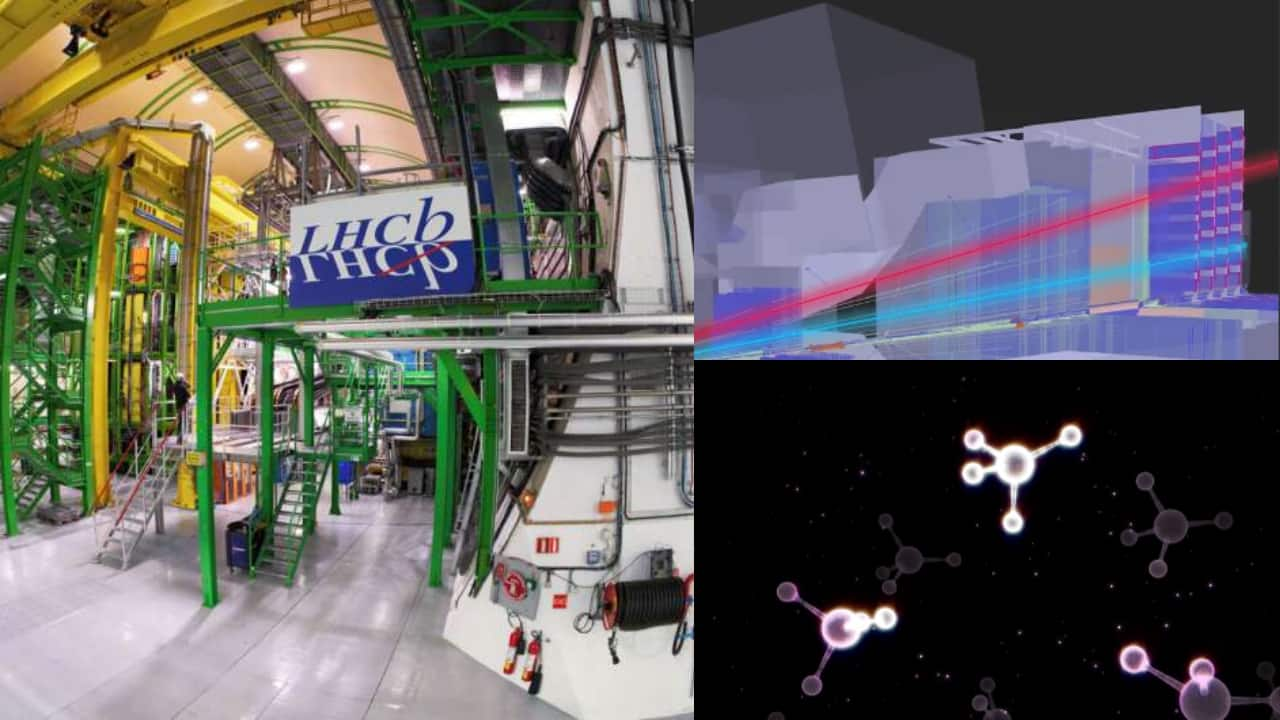
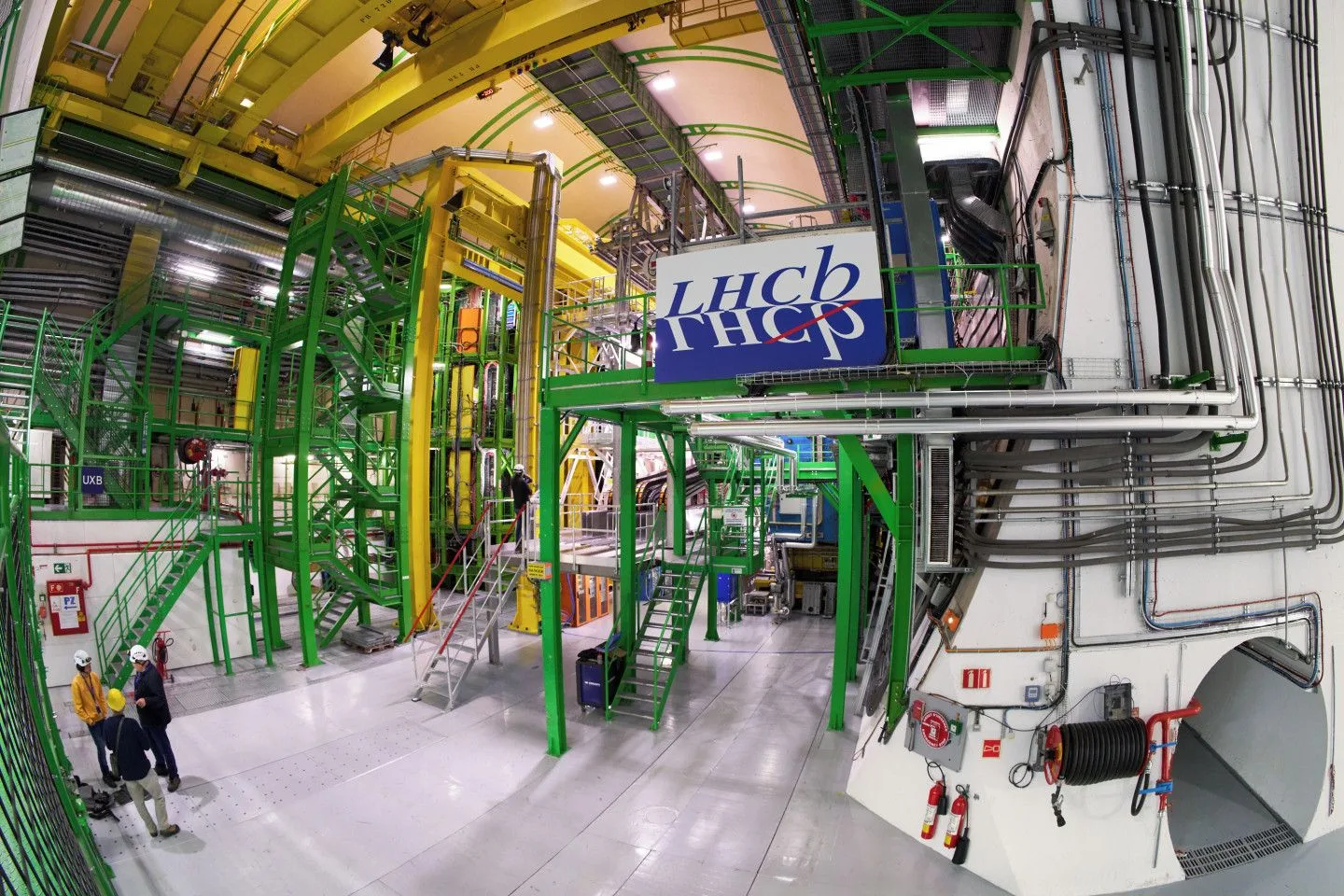
Success ultimately hinged on major hardware and software improvements. The upgraded Large Hadron Collider beauty experiment began collecting collision data in 2024 at up to five times its previous rate. Researchers also integrated advanced machine-learning techniques to suppress the vast background of processes that would otherwise have obscured the rare signals. Scientists at the University of Manchester contributed to the development of the enhanced hardware, which features a silicon detector situated a mere 5 millimeters away from the particle beams to monitor where particles are created and subsequently decay. UK researchers also contributed to the Ring Imaging Cherenkov system, which identifies different types of particles by detecting light produced when particles travel through a gas faster than light can.
Dr Stefano De Capua noted the broad industrial collaboration required for the detectors.
We worked with nearly 90 UK companies to construct this detector and trained the next generation of scientists and engineers on the novel technologies we are using,
Dr Stefano De Capua, University of Manchester
Nearly 90 British companies took part in the construction.
Combined Data Reaches Three Point Two Sigma Significance
To establish evidence of a new phenomenon, particle physics requires a significance level of three standard deviations, or 3 sigma, which corresponds to a 0.3 percent chance that the signal is a statistical fluke. By combining new data gathered between 2024 and 2025 with archival runs spanning 2011 to 2018, the collaboration reached a significance of 3.2 sigma. Data taken from 2024 to 2025 alone revealed evidence at a level of 3.0 standard deviations.
While falling short of the strict 5-sigma threshold required for a formal discovery, the measurement aligns closely with the predictions of the Standard Model. Rather than revealing an immediate discrepancy, the findings constrain the parameter space where undiscovered particles might hide. In the same analysis, the team also made precise measurements of the sibling process, the decay of the heavier B0s meson into two muons, finding a branching fraction of 3.31 in a billion against a Standard Model prediction of 3.66 in a billion, marking the most precise determination to date.
Probing the Zeptoverse Frontier
The measurement opens an observational window into distances measured in zeptometers, which equal one billionth of a trillionth of a meter. This scale is roughly a million times smaller than a proton, placing it among the most minute dimensions ever probed by experimental physics.
Further progress is already mapped out on the facility’s timeline. The LHCb experiment will continue collecting data into the early 2030s. A subsequent upgrade could multiply the experiment's data-gathering speed by another factor of 10, enabling scientists to study rare decays in greater detail and hunt for traces of previously undiscovered particles.
The work was signed by the whole LHCb collaboration, with R. Aaij listed as first author in a paper submitted to Physical Review X. Researchers emphasized that exploring this tiny world could eventually help scientists understand the first infinitesimal fraction of a second after the Big Bang and provide insights into dark matter.
Earlier coverage: LHCb Researchers Find First Evidence of Rare Beauty Particle Decay