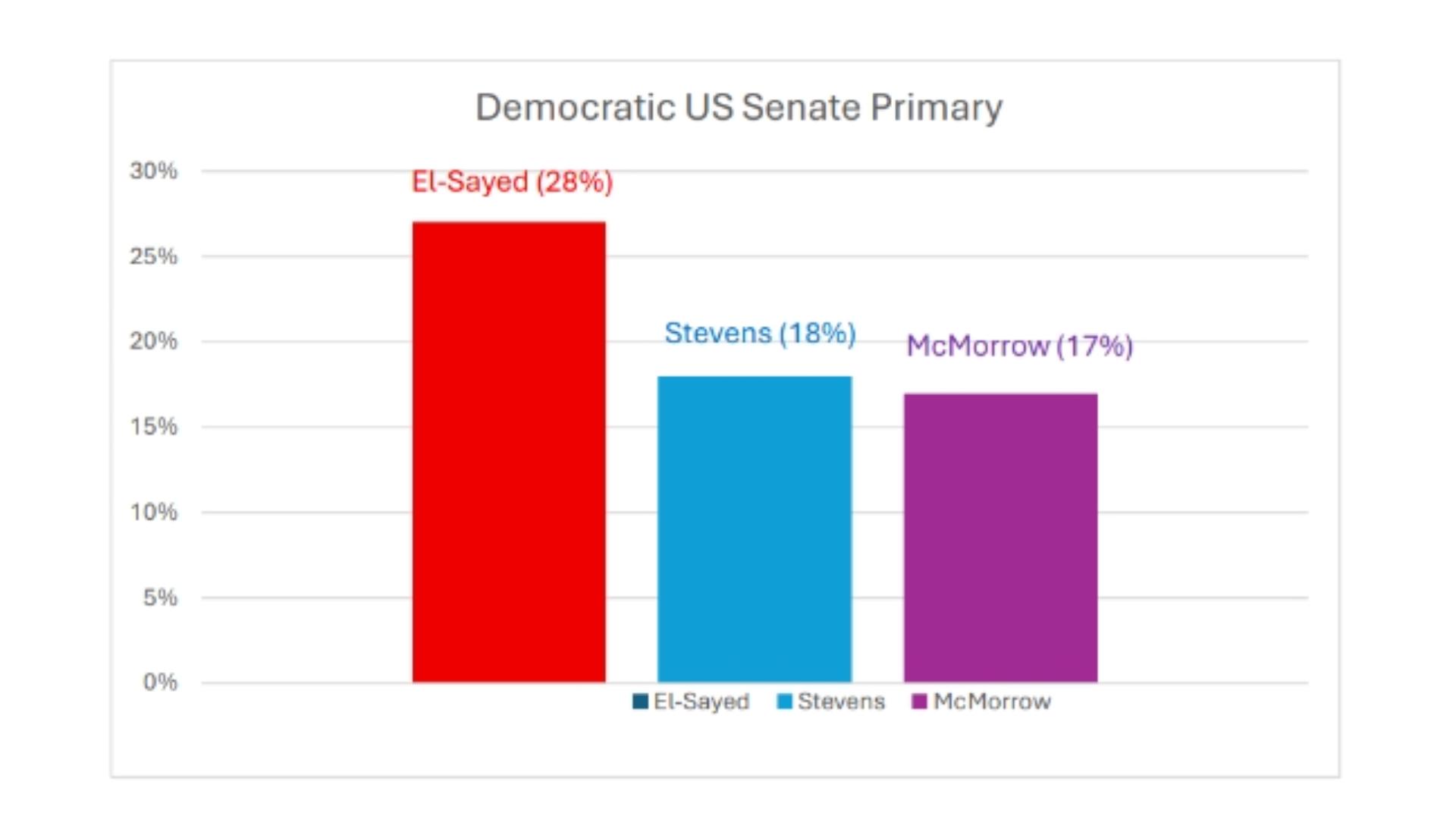
Democrat Abdul El-Sayed holds a 49% to 44% lead over Republican Mike Rogers in Michigan’s U.S. Senate race, according to a New York Times/Siena University poll. With six weeks until Election Day, the battleground contest highlights stark demographic divides across the state.
With six weeks remaining before Election Day, Democrat Abdul El-Sayed holds a five-point advantage over Republican Mike Rogers in Michigan’s closely watched U.S. Senate contest, according to a New York Times/Siena University poll. The survey places El-Sayed at 49% support among likely voters in the battleground state, compared with 44% for Rogers. Don Levy, executive director of the Siena Research Institute, pointed to the state as a vital, must-hold contest for Democrats working to maintain control of the upper chamber.
Demographic Divides and Voter Favorability for El-Sayed and Rogers
The poll reveals a distinct generational split between the two candidates. Rogers, 63, leads the 41-year-old El-Sayed by nine percentage points among voters aged 45 and older, a demographic that comprises about two-thirds of the likely electorate. Conversely, El-Sayed holds a 39-percentage-point advantage among voters aged 44 and younger. Regionally, El-Sayed has secured strong core backing across left-leaning demographics, including a 79% to 3% lead among voters in Detroit, according to survey analysts cited by One America News Network.
Voter perceptions of candidate character also favor El-Sayed. Forty-six percent of respondents reported a favorable opinion of El-Sayed, and an equal 46% said he has good character. In contrast, 39% of voters viewed Rogers favorably and attributed good character to him.
Policy Clashes over Artificial Intelligence and Campaign Debates
Artificial intelligence has emerged as a prominent campaign issue. El-Sayed has advocated for stronger restrictions on AI, including a development pause, and leads Rogers by 11 percentage points among voters asked which candidate would better handle AI data centers. Rogers has taken a different stance from Trump, stating that AI regulation would be a top priority if elected. Rogers has also attempted to court independents and crossover voters by portraying his opponent as an extremist. Fifty percent of surveyed voters agreed that El-Sayed was the more extreme candidate, while 36% pointed to Rogers.
Rogers has also targeted El-Sayed over his ties to left-wing streamer Hasan Piker, who campaigned alongside El-Sayed during the Democratic primary. The poll indicated that 29% of Michigan voters view Piker very unfavorably and 5% view him somewhat unfavorably, while just 6% reported a favorable view and the majority had never heard of him. Despite a competitive primary against Representative Haley Stevens, 62% of Democratic and Democratic-leaning voters said the contest ultimately strengthened their party.


