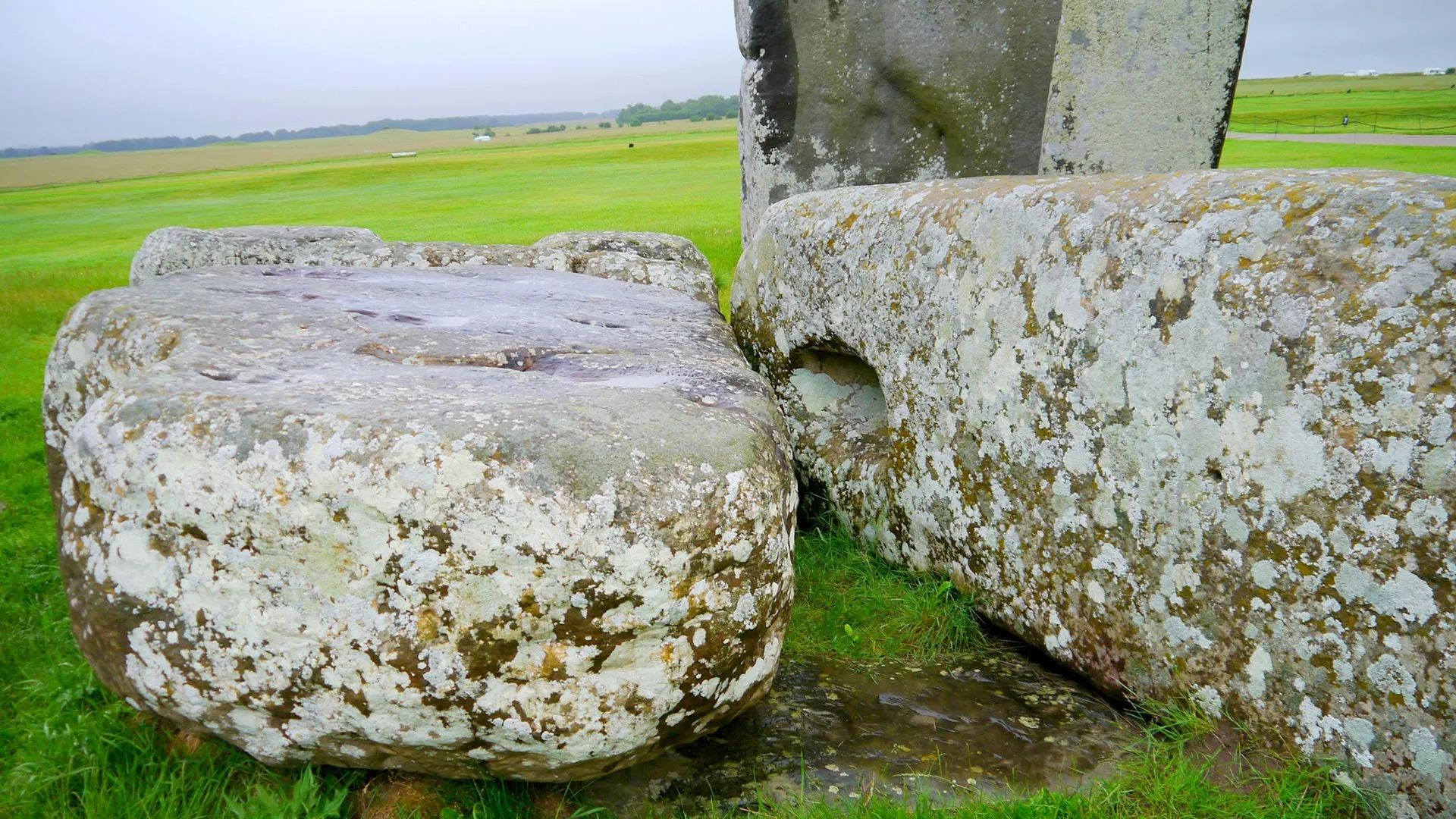
Scientists analyzing Stonehenge’s massive Altar Stone have eliminated several suspected origins in northeastern Scotland after finding no matching geological fingerprint.
Search Narrows in Orcadian Basin
Measuring 4.9 meters long and weighing about six metric tons, the prehistoric sandstone slab lies flat beneath the fallen stones of the Great Trilithon. A comprehensive geological investigation published in the Journal of the Geological Society in November 2026 tested leading theories by combining fresh monument observations with stone fragments preserved in museum collections, as direct sampling of the monument is not possible.
Researchers focused on the Orcadian Basin in northeastern Scotland after earlier research overturned a century-old theory pointing toward Wales. Despite studying the sandstone’s physical structure, mineral content, chemical composition, and isotopic signatures, the international team found that none of the locations examined matched the stone’s distinct properties. The Altar Stone is characterized as a well-sorted, fine- to very fine-grained calcite-cemented sandstone.
By combining a wide range of analytical techniques, we have built the clearest picture yet of the stone’s composition and tested the leading theories about its origins. So far, none of the locations examined have the same set of characteristics as the Altar Stone.
Duncan Pirrie, lead researcher
Pirrie said that while the exact birthplace remains unverified, the negative results successfully narrow the geographic scope for future fieldwork.

Century-Old Welsh Theory Overturned
For generations, geologists relied on a landmark 1923 paper by H.H. Thomas that attributed the monument’s smaller bluestones and the Altar Stone to western Wales. That consensus shifted when recent scientific testing identified northeastern Scotland as a more probable regional source. The latest analysis builds on that shift by establishing rigorous criteria to differentiate promising rock formations from non-matching outcrops across Britain.
The study, titled “Searching for the origin of the Stonehenge Altar Stone: new sedimentological, petrographical, mineralogical, geochemical and isotopic constraints,” involved 13 authors. The research team included contributors such as Rob A. Ixer, Nick J. G.
That tells us the search is not over, but we are now far better equipped to focus on the areas most likely to yield an answer.
Duncan Pirrie, University of South Wales
Nick Pearce of Aberystwyth University said that in a geological detective story, ruling out potential source areas is as vital as identifying new ones.
Aberystwyth Experts Frame the Detective Work
Professor Richard Bevins, honorary professor in the Department of Geography and Earth Sciences at Aberystwyth University, said that for almost a century the prevailing view held the Altar Stone came from west Wales. Professor Nick Pearce, emeritus professor of geochemistry in the same department, emphasized that ruling out potential source areas is just as important as identifying new ones in a geological detective story.
Bevins added in a statement that with each new piece of evidence the team moves closer to solving one of Stonehenge’s most enduring mysteries.
Study Builds on Shift from Wales to Scotland
More recently, the age of detrital zircon, rutile and apatite grains in the Altar Stone was used to infer a provenance from the Orcadian Basin of northeast Scotland.
Stonehenge stands out for its well-documented long-distance transport of geological materials, with many of the bluestones moved roughly 225 kilometers from West Wales. A confirmed Scottish origin for the Altar Stone would imply a journey of more than 460 miles, likely by sea, illuminating the organization and transport methods of Neolithic communities.
Implications for Prehistoric Engineering
Stonehenge was constructed in multiple phases between approximately 3000 and 1600 BC. While builders transported smaller bluestones roughly 225 kilometers from western Wales, a confirmed Scottish origin for the Altar Stone would imply a journey of more than 460 miles, likely by sea. Pinpointing the exact quarry would illuminate the organization, engineering capacity, and transport methods of Neolithic communities.
With each new piece of evidence, we move closer to solving one of Stonehenge’s most enduring mysteries.
Richard Bevins, study co-author