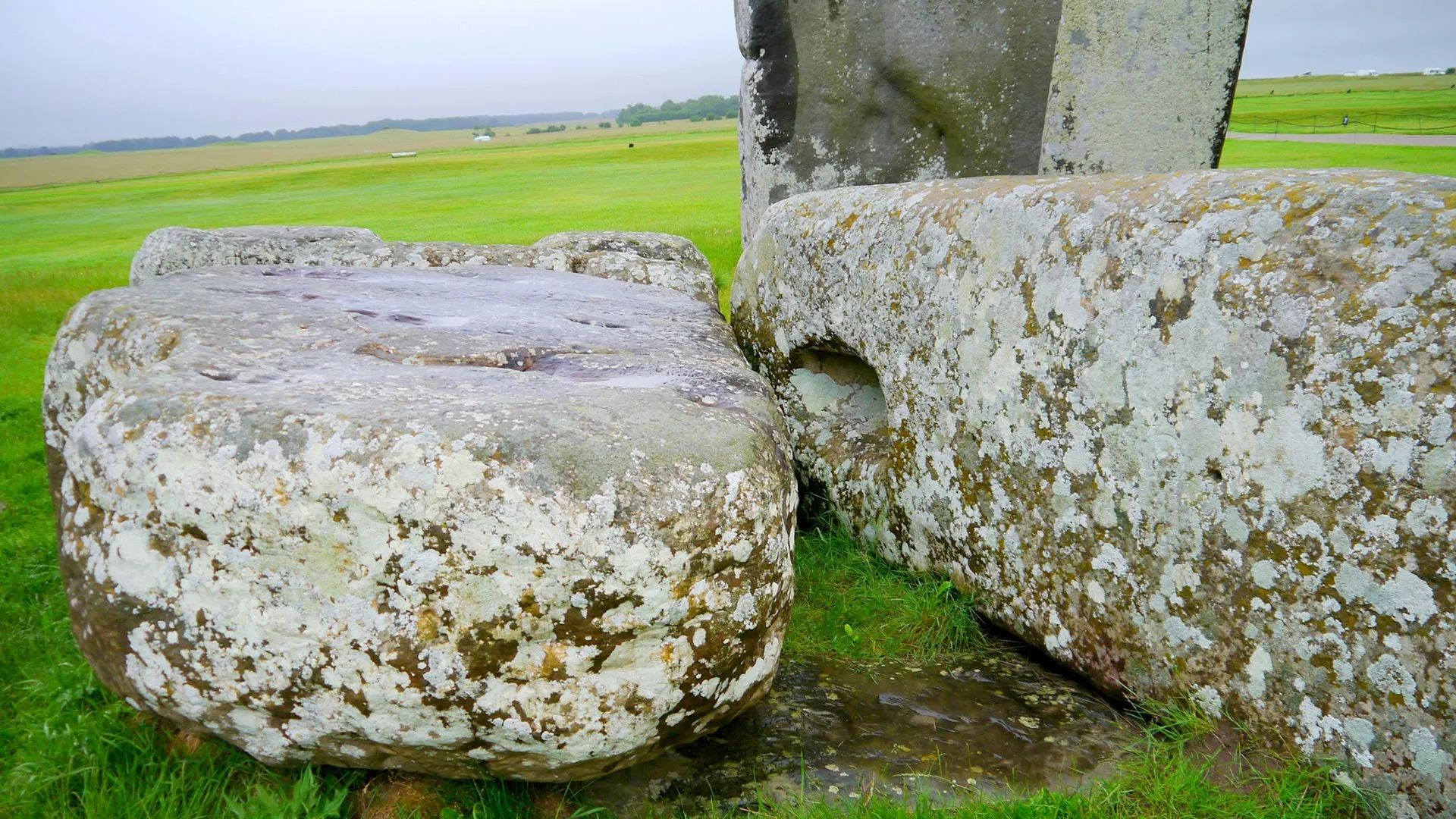
Scientists hunting the origin of Stonehenge’s six-ton Altar Stone have ruled out several key sites in northeastern Scotland, leaving the prehistoric monolith’s true birthplace unresolved.
- The Altar Stone measures 4.9 meters long and weighs about six metric tons.
- Researchers published their multi-proxy geological study on November 5, 2026, in the Journal of the Geological Society.
- For nearly a century, scientists believed the slab came from western Wales before recent tests pointed toward Scotland.
Search Narrows Across Scotland
The massive sandstone slab lies flat at the center of the prehistoric monument on Salisbury Plain in southern England, partly buried under the collapsed stones of the Great Trilithon. For more than a hundred years, archaeologists and geologists believed it originated in western Wales alongside the smaller bluestones.
That consensus shifted when recent research analyzed the slab’s unique mineral fingerprint and redirected the search toward Scotland. A landmark study published in the journal Nature in August 2024 traced the stone to northeastern Scotland, overturning the century-old theory that originated with geologist H.H. Thomas’s 1923 paper.
The Altar Stone is composed of a well-sorted fine- to very fine-grained calcite-cemented sandstone, making it distinctive among the stones at the monument. Direct sampling of the Altar Stone is not possible, so the team studied the stone in situ alongside museum samples confidently attributed to it.
To pinpoint the exact source, an international team examined the stone itself alongside fragments preserved in museum collections. Investigators tested the sandstone’s physical structure, mineral content, chemical composition, and isotopic signatures to establish a geological fingerprint. They focused particularly on the Orcadian Basin in northeastern Scotland, but found that none of the locations examined so far share the stone’s exact set of characteristics.

“This is the most comprehensive geological investigation of the Altar Stone ever undertaken. By combining a wide range of analytical techniques, we have built the clearest picture yet of the stone’s composition and tested the leading theories about its origins. So far, none of the locations examined have the same set of characteristics as the Altar Stone. That tells us the search is not over, but we are now far better equipped to focus on the areas most likely to yield an answer,” said Professor Duncan Pirrie, Emeritus Professor at the University of South Wales and leader of the study.
Candidates Eliminated in Geological Detective Work
The findings published in the Journal of the Geological Society do not rule out Scotland entirely. Instead, they establish stricter criteria to help researchers separate promising rock formations from non-matching outcrops. Team members said discarding incorrect sites represents genuine progress.
“In a geological detective story such as this, ruling out potential source areas is just as important as identifying new ones. Every location eliminated narrows the search and brings us closer to discovering where the Altar Stone originated. The stone is unique among those at Stonehenge, and tracing its source would provide valuable new insights into its remarkable journey to Salisbury Plain thousands of years ago,” said Professor Nick Pearce, Emeritus Professor of Geochemistry in the Department of Geography and Earth Sciences at Aberystwyth University.
Richard Bevins said the latest work establishes specific geological markers needed to identify a true match.
The study, titled “Searching for the origin of the Stonehenge Altar Stone: new sedimentological, petrographical, mineralogical, geochemical and isotopic constraints,” was authored by 13 researchers including Duncan Pirrie, Richard E. Bevins, Rob A. Ixer, Nick J. G. Pearce, Peter Turner, Matthew R. Power, Stephen Hillier, Andrew C. Morton, Ian Saunders, Sergio Andò, Marta Barbarano, Andrew Horbury, and Gregory D. Price.
A new study exploring the origins of the six tonne Altar Stone at Stonehenge has ruled out a theory that it came from an area of Scotland. https://t.co/d084OqXvps
The investigation involved the University of South Wales, Aberystwyth University, University College London, the University of Aberdeen, the University of Plymouth, the James Hutton Institute, the Swedish University of Agricultural Sciences, the University of Milano-Bicocca, and several industry partners. The work delivers a thorough multi-proxy assessment of the Altar Stone’s sedimentology, geochemistry, detrital and diagenetic mineralogy, drawing on both in situ examination and museum samples.
Prehistoric Engineering Traced on Salisbury Plain
Stonehenge was constructed in multiple stages between approximately 3000 and 1600 BC. Its builders hauled smaller bluestones roughly 225 kilometers from west Wales. If the Altar Stone originated in northeastern Scotland, its journey to Salisbury Plain covered a substantially greater distance of more than 460 miles at least, likely by sea.
The Altar Stone’s geochemical fingerprint points to the Orcadian Basin, a Devonian-age sedimentary basin that extends from the Moray Firth north to the Shetland Islands and west to Strathy in Caithness, with hydrocarbon wells confirming its reach to the Outer Moray Firth and East Shetland Platform.
Its strata form part of the Old Red Sandstone, deposited in the ancient Lake Orcadie, where cyclical lacustrine rhythms produced finely bedded sequences of mudstone, coarse siltstone, and very fine sandstone — flagstones that split readily along bedding planes.
The basin’s Middle Devonian deep-lake phase, dated to the late Eifelian and correlated with the Kačák Event, generated a lake covering at least 50,000 km² and exceeding 100 metres depth, depositing the organic-rich laminites and fish-bearing beds such as the Achanarras Fish Bed Member.
Discovering where the megalith came from would illuminate the organizational capacity, engineering skill, and transport methods of Neolithic communities. The stone’s purpose at the monument, and when it was transported to the site, remains unknown. Researchers plan to use the refined geological fingerprint to guide future fieldwork across targeted regions.