Researchers published an open-access study on Wednesday in the peer-reviewed journal Nature detailing a new way to design structural materials by introducing controlled network irregularity rather than relying on uniform, repeating unit cells.
Scale-Rich Networks Work
Synthetic metamaterials are engineered by copying a single foundational block, such as a square or hexagonal honeycomb, many times over to achieve precise, periodic microstructures.
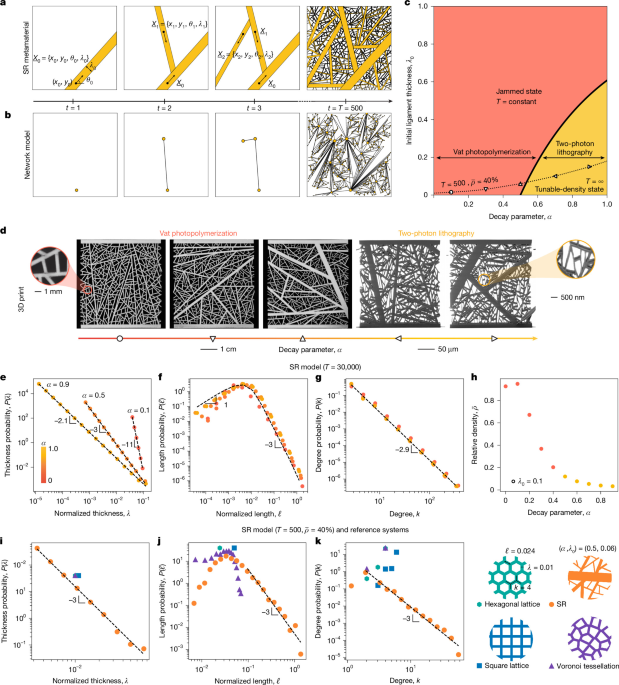
Drawn from patterns found in plant leaf veins, dragonfly wings, and complex social networks, the newly designed scale-rich metamaterials use an algorithm to generate physical networks of tiny, interconnecting support beams whose length, thickness, and connectivity vary widely.
The algorithm begins by placing a point at a random coordinate in a designated space and drawing a straight line through it at a random angle across the domain or until it hits another boundary. Repeating this process with subsequent points generates progressively shorter and thinner lines that intersect to form a dense, web-like skeleton.
“Because there is such a richness of length scales in these networked materials, if one part fails, there is a strong web of structures around it that keeps the entire material from failing catastrophically,” Carlos Portela, associate professor of mechanical engineering at MIT, said.
“This is a completely new way of thinking for metamaterials,” says study author Carlos Portela, associate professor of mechanical engineering at MIT.
The study features co-authors Andrew Yen-Jong Chen, Mohammad Charara, and Jayna Wadhwa, along with Ting-Ting Gao, Csaba Both, and Albert-László Barabási from Northeastern University, alongside Niek Mooij representing Utrecht University in the Netherlands.
Researchers Test Physical Properties Using Resin Samples
Researchers manufactured centimeter-scale resin samples to test the physical properties of these structures. They used a vat photopolymerization 3D printer with a printing resolution of about 100 microns, setting the total number of beams to 500 to evaluate average properties (MIT Team Designs Scale-Rich Metamaterials That Spread Out Impact Damage).
For materials, the team used Anycubic Tough Resin 2.0 for large-deformation and impact tests. In conventional uniform lattices, members along a given cross-section tend to deform simultaneously under heavy loads, causing a chain reaction of localized buckling that prevents the material from distributing stress.
By contrast, the scale-rich network samples demonstrated an ability to distribute damage uniformly and withstand sudden impacts (Inspired by networks found in nature, engineers design stronger, more resilient “metamaterials”).
The network-inspired structures exhibited a localization parameter value under 0.2 through 25% macroscopic strain, which is 37% lower than the Voronoi geometry. They could be constrained further to under 0.08 through a checkerboarding approach (Scale-rich network-based metamaterials | Nature).
At a relative density of 20%, the structures span an effective stiffness anisotropy range from 0.04 to 0.78. At a relative density of 40%, they span 0.12 to 0.88, and at a relative density of 70%, they span 0.26 to 0.93.
Researchers confirmed that the hexagonal lattice spans 0.87 to 0.94 and the Voronoi tessellation spans 0.88 to 0.97, remaining nearly isotropic across a wide range of relative densities.
Pomelo-Inspired Structures Protect Embedded Fragile Objects
The research team also designed structures inspired by the thick, non-uniform rind of the pomelo citrus fruit to protect embedded fragile objects (MIT Team Designs Scale-Rich Metamaterials That Spread Out Impact Damage).
By varying the density of nucleation points radially, they created a peripheral skeleton with a dense outer edge enclosing a brittle square core made of polymethyl methacrylate to simulate equipment needing protection.
Under macroscopic strain, the internal stress on the core surrounded by the scale-rich network was substantially lower than that observed with square or hexagonal lattices (MIT Team Designs Scale-Rich Metamaterials That Spread Out Impact Damage).
Numerical simulations involving elastic waves showed that square and hexagonal lattices yield an effective refractive index between 1.0 and 1.9 at relative densities of 20% to 75%. Scale-rich networks can be tuned across a range from 1.5 to 8.3 (MIT Team Designs Scale-Rich Metamaterials That Spread Out Impact Damage).