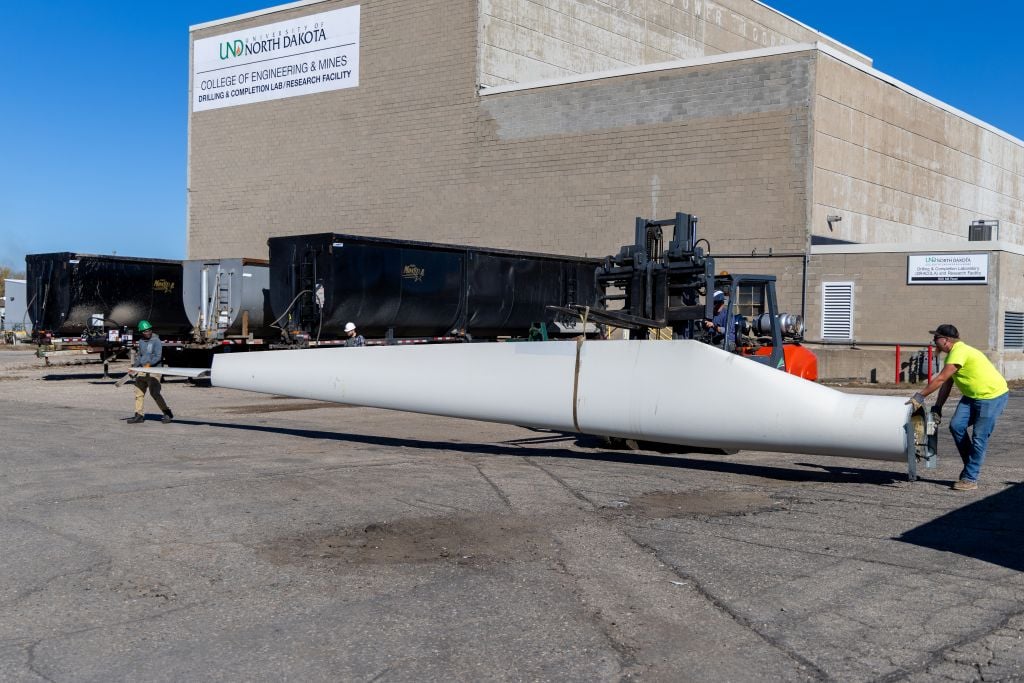
Researchers in Beijing have developed a rapid electrical heating method to transform decommissioned wind turbine blades into silicon carbide and graphene, offering a potential path to upcycle fiberglass composite waste that otherwise clogs landfills. The technique relies on short electrical pulses to push pulverized blade material to roughly 2,000 degrees Celsius in milliseconds.
How Flash Joule Heating Converts Turbine Blade Waste
Wind turbine blades are typically engineered from glass fibers bound together with a carbon-rich polymer resin. While this thermoset composition gives blades the durability required to withstand decades of harsh weather, ultraviolet radiation, and lightning strikes, it also makes them exceptionally difficult to break down when they reach the end of their operational lifespan as older fleets reach their end-of-life.
To solve this recycling bottleneck, scientists at Tsinghua University turned to a technique known as flash Joule heating. Led by environmental engineer Hao Bi, the research team pulverized old blades and applied high-current electrical pulses to the blend.
high-current electrical pulse applied to conductive raw materials to raise their temperature to 2,000 degrees Celsius [3,632 degrees Fahrenheit] or even higher in milliseconds.
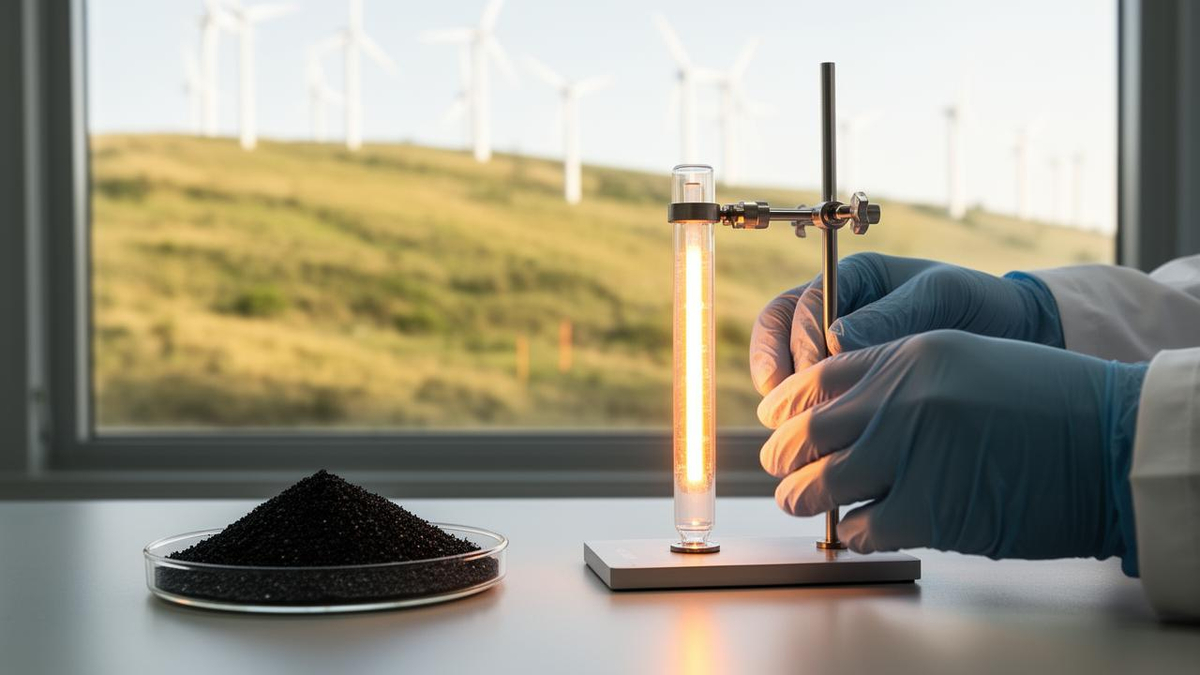
Under these extreme thermal conditions, carbon reacts with the silica found in the fiberglass to produce silicon carbide, an extremely hard and heat-resistant compound. Simultaneously, the remaining carbon atoms reorganize into graphene, a honeycomb-like lattice coveted for its strength and ability to conduct heat and electricity.
Using Recovered Materials to Reinforce New Rotor Blades
Rather than simply destroying the waste, the process aims for true upcycling by feeding the recovered silicon carbide and graphene back into manufacturing supply chains. When researchers incorporated just 0.3 percent of the recovered material by weight into epoxy resins, the mixture demonstrated measurable improvements in mechanical performance.
The additive raised the resin’s resistance to deformation by 27 percent under tension and 9 percent when bent at just 0.3% by weight. Adding the material at 0.1 percent by weight increased thermal diffusivity—the rate at which heat disperses through a substance—by 41 percent.
Scaling up Recycling Faces Testing Limits and Steep Costs
Conventional disposal methods carry steep financial and environmental costs. Pyrolysis processes run about $460 per ton, while chemical dissolution demands approximately $1,800 per ton according to Bi. The new route cuts greenhouse gas emissions by 92% and 83%, respectively, compared with chemical dissolution and heat-recovery recycling.
Despite these promising figures, scaling remains a formidable challenge. Testing has thus far been restricted to tiny batches, with the largest successful run processing only 10 grams of material. Although a bigger reactor capable of processing 200-gram quantities has been engineered and constructed by the group, they note that further development is required, specifically to guarantee uniform thermal distribution and uniform output quality.
Describing the findings as an encouraging proof of concept backed by early scale-up data, Hao Bi noted that it remains hard to foresee when the method might be deployed at a real wind farm.
Addressing the Growing Global Wave of Decommissioned Wind Infrastructure
The timing of the research coincides with a mounting waste crisis across China, Europe, and the United States, where the first generation of 20-year wind turbines is reaching retirement as the first generation of 20-year blades comes down. Between 2025 and 2030, the yearly volume of discarded turbine blades across Europe alone is expected to surge from 20,000 tonnes to 55,000 tonnes as aging turbine groups arrive at their operational finish line.
Strict regulatory actions have intensified the urgency for viable recycling solutions. Countries including Germany and Austria have enacted landfill bans on composite waste, and industry bodies such as WindEurope introduced a voluntary industry-wide landfill ban that came into effect last year.