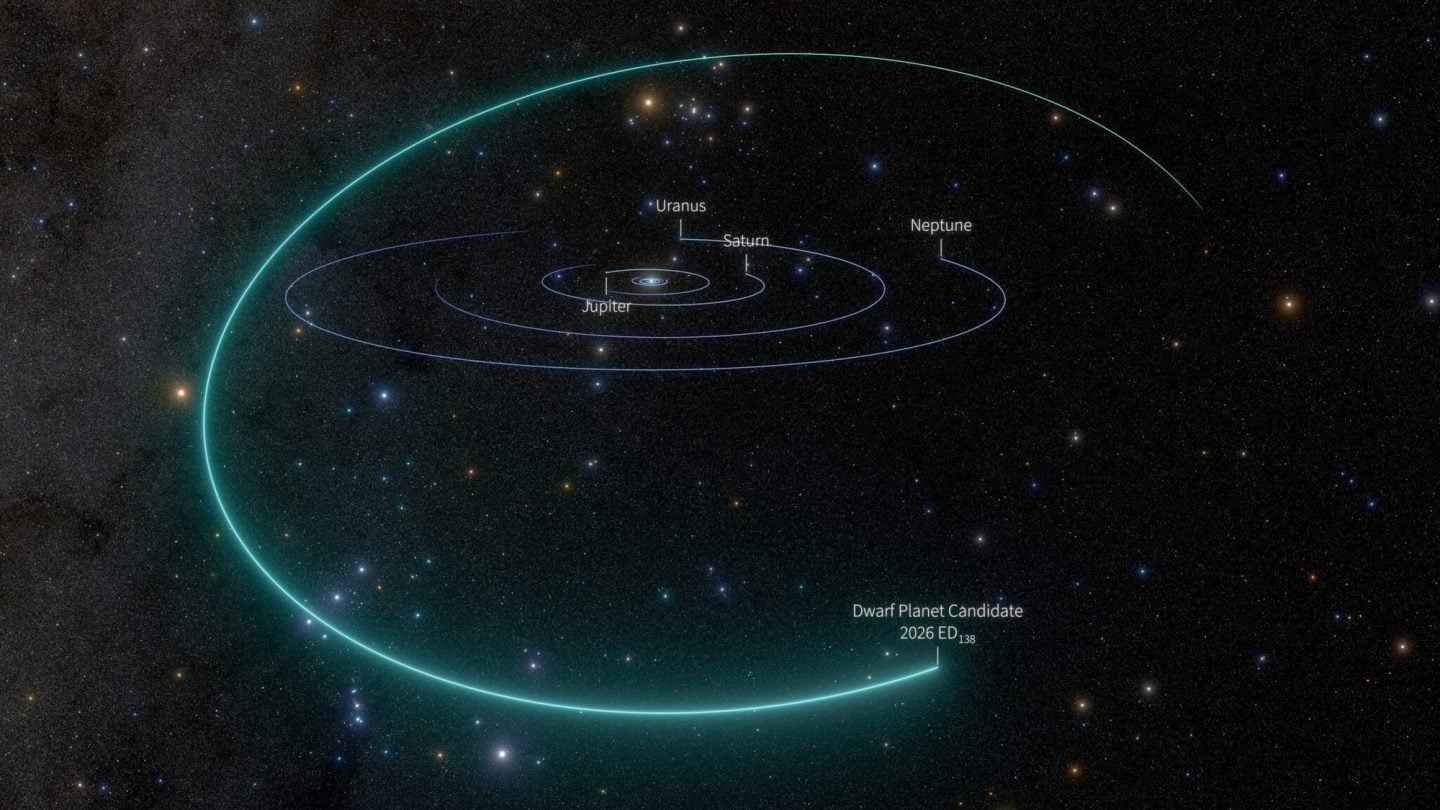
Astronomers announced on October 27, 2026, that the Vera C. Rubin Observatory discovered a potential dwarf planet named 2026 ED138 orbiting 46 astronomical units from the Sun.
A powerful search algorithm scouring billions of astronomical detections has turned up a distant world that may soon join the solar system’s elite dwarf planet roster. Announced on October 27, 2026, the icy candidate designated 2026 ED138 lies approximately 46 astronomical units from the Sun, placing it well beyond the average orbit of Pluto.
Matthew Holman and Kevin Napier Find ED138 in Rubin Observatory Data
The discovery came to light when Matthew Holman, a Rubin Operations team member and in-Kind contributor, ran collected observatory data through specialized software. Developed alongside Center for Astrophysics colleague Kevin Napier, the program sifts through billions of moving object detections to connect faint points of light whose positions trace an orbit around the Sun.
My first reaction was excited surprise.
Matthew Holman
ED138 stood out immediately due to its brightness and distance. Holman admitted he initially began checking whether his code had made a mistake before Mario Jurić, the Rubin Solar System lead scientist, examined Rubin’s catalogs to verify the signal.
The Vera Rubin Observatory is located in Chile. The facility began its ten-year survey in June 2026, though its solar system team had already submitted observations of more than 11,000 new asteroids and roughly 380 new trans-Neptunian objects to the Minor Planet Center in April.
Thirty Rubin Sightings and a Decade of Archival Precovering
Following the initial identification, Jurić dug through observatory records and found 20 additional sightings, bringing the total number of Simonyi Survey Telescope observations to 30 across 20 distinct nights between March 4 and July 11, 2026. Further investigation revealed that the Dark Energy Camera on the Víctor M. Blanco 4-meter Telescope at Chile’s Cerro Tololo Inter-American Observatory had captured the object as far back as 2016.
By combining modern telescope data with older archival images, researchers plotted a ten-year trajectory for the distant object. Megan Schwamb, a reader in astrophysics at Queen’s University Belfast and a member of the Rubin Solar System Operations team, expressed surprise that such an object was found so early during commissioning observations. Mario Jurić and Matthew Holman presented these findings at the 59th Annual Division for Planetary Sciences meeting in Spokane, Washington.
ED138 Stays Hidden in the Milky Way
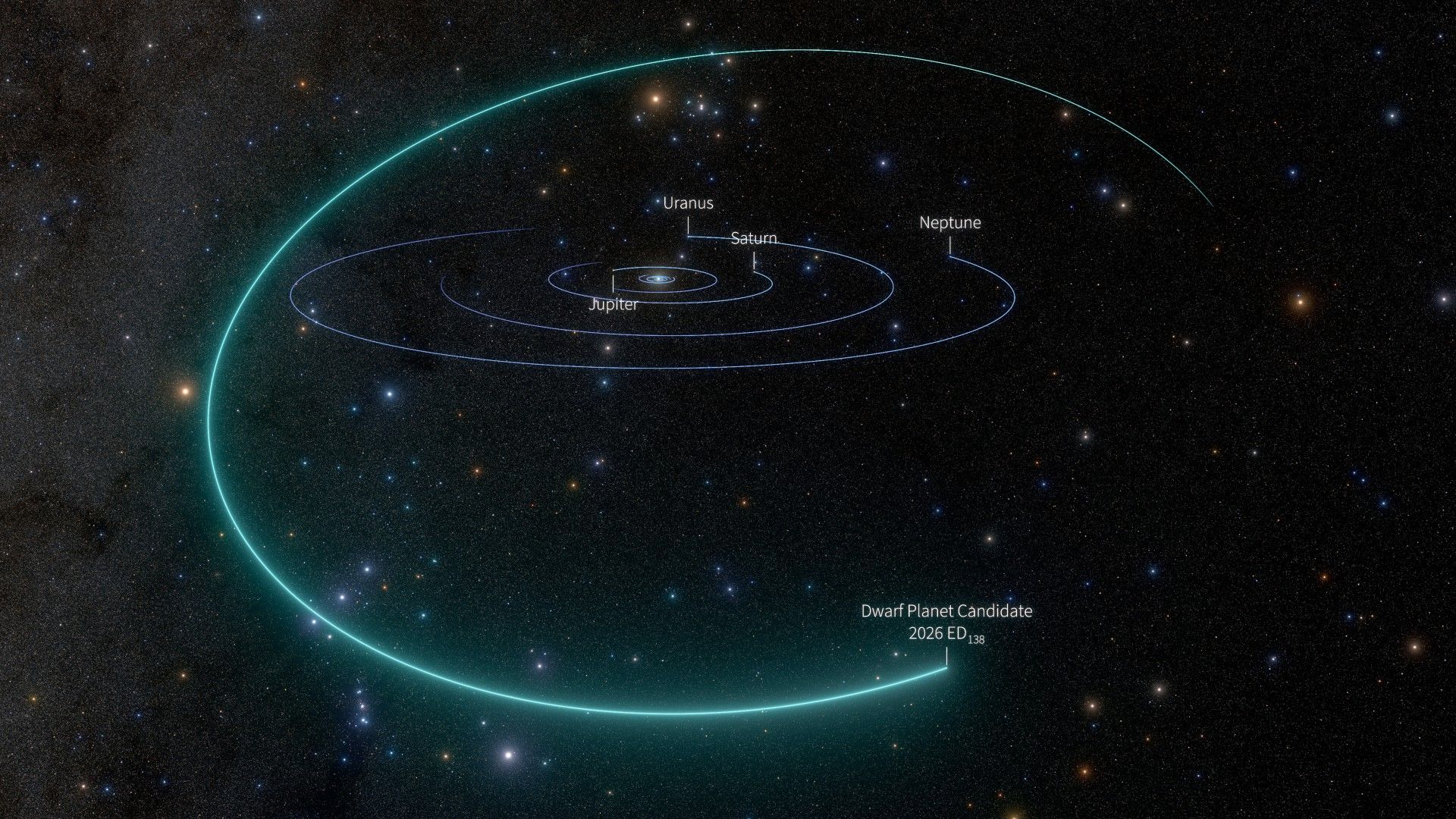
Despite being bright enough that really capable amateurs can spot it with proper equipment, ED138 avoided detection for years because of its celestial address. The candidate sits within a crowded patch of sky right along the plane of the Milky Way, where millions of background stars obscure moving solar system objects.
ED138 travels along an orbit inclined by nearly 25 degrees relative to the flat plane shared by most planets, categorizing it as a hot-classical trans-Neptunian object.
Astronomers Calculate Size and Path Toward Official Dwarf Planet Status
Astronomers calculate that ED138 spans between 600 and 1,500 kilometers in diameter. Precise dimensions are unconfirmed.
Once we really know its size, then we can make a much more clear statement about whether this is a dwarf planet or not
Matthew Holman
Confirming its status will require infrared observations. If confirmed by the International Astronomical Union, ED138 would join an exclusive group of five officially recognized dwarf planets: Pluto, Ceres, Eris, Haumea, and Makemake. Can infrared observations determine if ED138 qualifies as a dwarf planet?
More on Matthew Holman
Meet our Solar System's newest dwarf planet candidate: 2026 ED138!Orbiting past Pluto, scientists found it in NSF–DOE Rubin Observatory data from earlier in 2026. Early analysis suggests it's 600–1500 km across, one of the largest found past Neptune!🔗 https://t.co/wTOg898zBu pic.twitter.com/hEgnk597rl
NSF–DOE @VRubinObs Discovers New Dwarf Planet Candidate in Our Solar SystemThe candidate, provisionally designated 2026 ED138, was found by scientists working to improve Rubin's algorithms that search for distant moving objects in our Solar System.🔗 https://t.co/OPIC57K0m4 pic.twitter.com/Qx9zBCkAmm
Did we find a new dwarf planet?@VRubinObs has revealed a new dwarf planet candidate that orbits our Sun beyond Pluto! And it may be among the largest and brightest objects discovered in this region of the Solar System: https://t.co/mPcVYVhvXZ pic.twitter.com/d94196aMuT