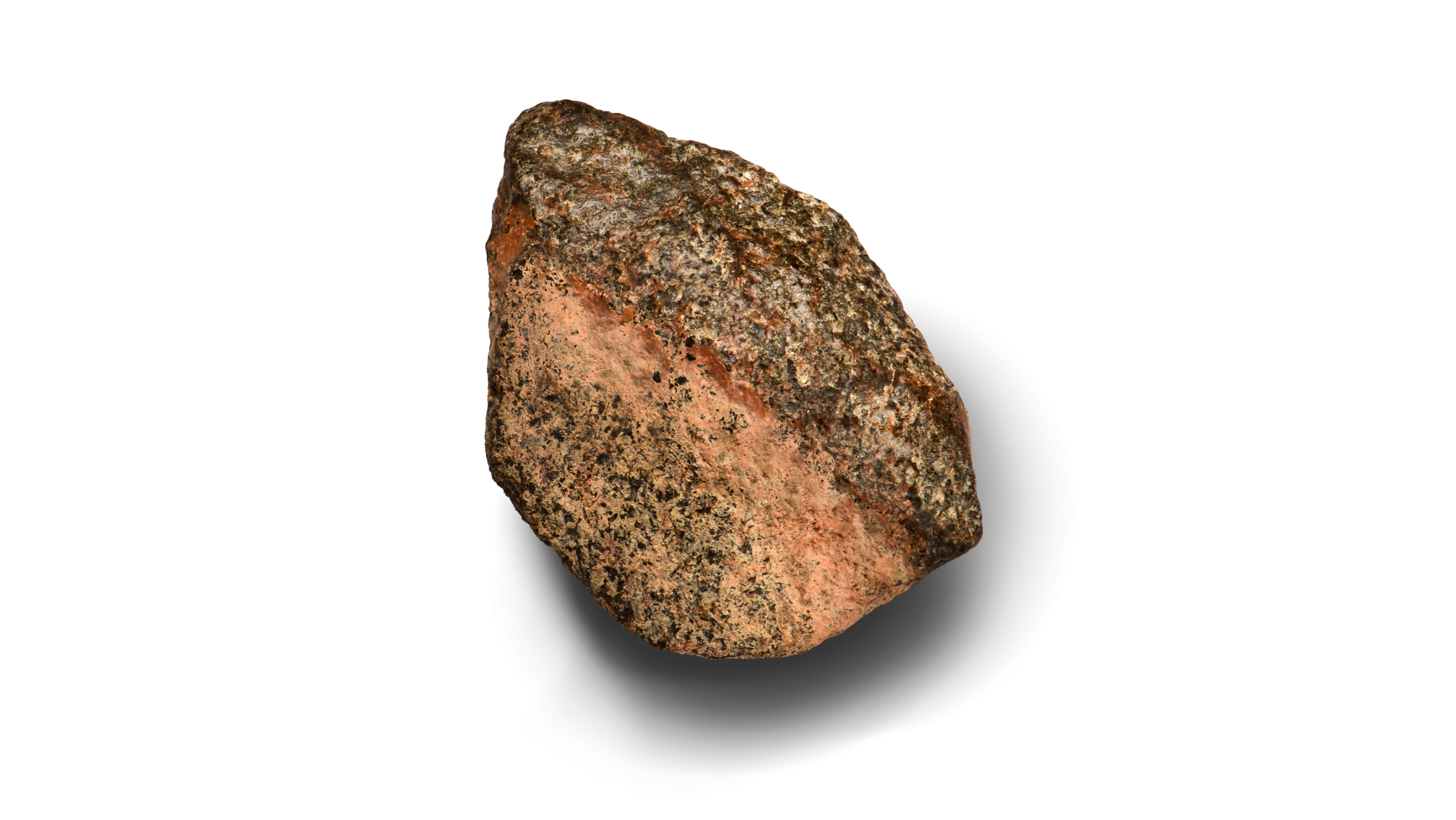
A nearly two-pound meteorite recovered from the Sahara Desert in 2022 has been identified as a 4.1-billion-year-old piece of Mars.
The rock, cataloged as Teghaza 001, formed during the Pre-Noachian period when the Red Planet was far more Earth-like.
Researchers published their initial analysis of the meteorite in the journal Science, detailing a rare, unadulterated sample of ancient Martian crust and mantle.
Dating Ancient Zircon Crystals in Teghaza 001
When collectors first discovered the rose-colored stone near a salt plain in Mali, its origins remained a mystery. University of New Mexico researchers initially flagged it as Martian after matching its oxygen isotopes to geochemical fingerprints found in other meteorites from the planet.
Yang Liu’s Jet Propulsion Laboratory examined the unusual textures and minerals, discovering microscopic zircon crystals embedded in the sample. These crystals allowed scientists to precisely date the igneous rock.
Francois Tissot of the California Institute of Technology applied an in-situ rubidium-strontium age-dating technique that analyzed a fragment smaller than a fingernail, preserving the rare specimen while yielding the extreme age.
Unlike the well-known Black Beauty meteorite, which is a younger conglomeration of various rock fragments dating to about 2.1 billion years old, Teghaza 001 consists of a single unadulterated rock type. Scientists describe it as one of the oldest Martian meteorites ever identified by a substantial margin.
Water Alteration and Early Martian Environments
Compositional analysis revealed that fluids altered the igneous minerals roughly 4.1 billion years ago. Lee Saper, a former JPL postdoctoral scholar now at NASA’s Ames Research Center, said that the rock records interactions of water and rock and preserves an imprint of the ancient Martian atmosphere as it lost moisture.
The Pre-Noachian period spanned from 4.5 to 4.1 billion years ago, representing an era when Mars maintained a denser atmosphere, surface water, and a protective magnetic field against radiation. Agee pointed out that if primitive life ever flourished on the surface of Mars, this timeframe offered the most viable conditions.
Because the meteorite is chemically distinct from younger shergottites, researchers believe it originated from an underrepresented region of the Martian southern highlands that rovers have yet to explore.
Garnet Discovery in Meteorite NWA 8171
In a separate finding detailed in Geochemical Perspectives Letters, researchers examining a different Martian meteorite fragment found microscopic grains of garnet—a mineral never before detected in any Martian sample.
The mineral proved to be andradite, an iron-rich form of garnet with a yellowish-green hue rather than a deep red gemstone color. Measuring roughly 0.8 by 0.5 millimeters, the grains sparked immediate questions about the geological forces required to produce them.
According to Kizovski, this finding will broaden our understanding of the geological phenomena achievable on Mars while potentially providing insights into how the planet evolved throughout its existence.
Garnet typically forms under extreme heat, pressure, or hot fluids through metamorphism, which could be triggered on Mars by meteorite impacts or rising magma. James Darling of the University of Portsmouth said that the findings add a striking new dimension to our understanding of Martian geology.
Unique Clues Within Ancient Meteorites
One of the paper’s reviewers called Teghaza 001 a Rosetta Stone for Mars, as Yang Liu said that it was only after looking closely that investigators realized how truly unique the meteorite is.

Because Teg 001 is chemically and geologically distinct from other Martian meteorites, scientists believe it originated from a previously underrepresented region of Mars where rovers have not yet explored. Scientists are currently uncertain about the nature of the environment where it formed, whether the process involved a type of magma not yet discovered on the planet, or if metamorphism was responsible.
Expanding Knowledge of Martian Geological History
The best known of the 18 fragments from that meteorite fall is a piece nicknamed Black Beauty, catalogued as NWA 7034. While most Martian meteorites are roughly 200 million years old, Teghaza 001 stands out for its texture, age, and the uniqueness of its igneous minerals.
Serving as the world’s largest hot, non-polar desert, the Sahara Desert spans an area of 4,619,260 km2 (1,783,510 sq mi) across North Africa. This vast region extends from the Atlantic Ocean in the west to the Red Sea in the east, providing the expansive hyper-arid environment where significant specimens like Teghaza 001 are recovered.
Unusual Martian Mineral Textures
The meteorite features a basaltic breccia structure containing various mineral fragments held together by hardened magma, akin to a fruitcake where basalt acts as the cake and other minerals serve as the fruit and nuts. Because NWA 8171 is a breccia comprised of multiple material types, investigators acknowledge a small theoretical possibility that the garnet grains could have originated elsewhere before being incorporated into the rock.