Researchers published a paper identifying David Hole's 2015 Maryborough Regional Park rock as a 4.6 billion-year-old meteorite.
David Hole found a heavy reddish rock in Maryborough Regional Park in central Victoria, Australia, in 2015.
Hole pulled the unusual stone from yellow clay using a metal detector. He took the heavy specimen home because he thought he had found a gold nugget in a region famous for its 19th-century gold rush.
Standard tools failed completely.
Hole tried opening the find with a rock saw, an angle grinder, a drill, and even dousing it in acid. A heavy sledgehammer also failed to crack the dense material.
Hole brought the stubborn object to the Melbourne Museum for proper identification years later. Geologists quickly realized he was not trying to break open gold at all.
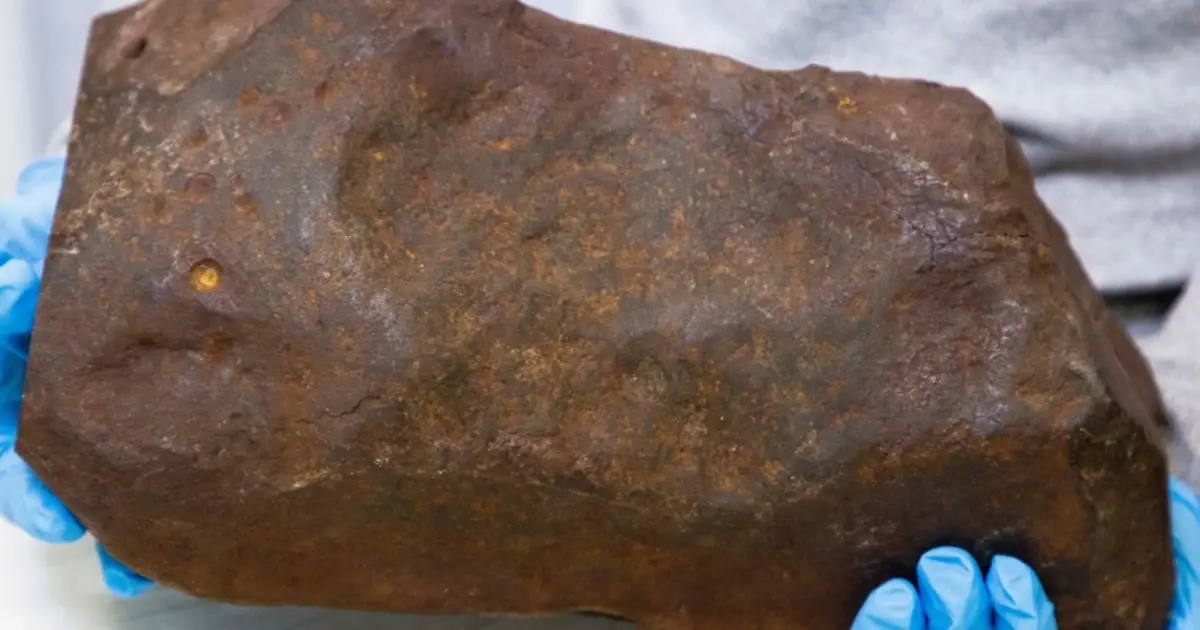
Dermot Henry, a Melbourne Museum geologist, said the stone had a distinctive exterior.
It had this sculpted, dimpled look to it.
Dermot Henry, Melbourne Museum geologist, via The Sydney Morning Herald
Henry explained that surface features formed as the object melted on the outside during its fiery passage through Earth’s atmosphere.
Henry examined thousands of rocks over a 37-year museum career and confirmed that only two turned out to be real meteorites. This specimen was one of them. “If you saw a rock on Earth like this, and you picked it up, it shouldn't be that heavy,” Melbourne Museum geologist Bill Birch, who is now curator emeritus, explained to The Sydney Morning Herald, said.
Researchers published a scientific paper in the Proceedings of the Royal Society of Victoria describing the 4.6 billion-year-old space rock. They named it Maryborough after the nearby town. Researchers used a diamond saw to remove a small slice for analysis.
The sample revealed a high percentage of iron, classifying the specimen as an H5 ordinary chondrite. Internal examination also exposed tiny crystallized droplets of silicate minerals known as chondrules.
Dermot Henry, a Melbourne Museum geologist, said specimens possess immense scientific value.
In some meteorites, there is ‘stardust’ even older than our Solar System.
Dermot Henry, Melbourne Museum geologist, via Channel 10 News
Researchers used carbon dating to estimate that the meteorite has rested on Earth for less than 1,000 years. Local records show several meteor sightings between 1889 and 1951, but none link definitively to the exact find site.
“Meteorites provide the cheapest form of space exploration. They transport us back in time, providing clues to the age, formation, and chemistry of our Solar System (including Earth),” said Henry, said. Scientists sliced open the heavy mass to reveal tiny crystallized droplets of silicate minerals distributed throughout the interior.

Certain meteorites contain pristine stardust that predates the formation of our entire Solar System. Carbon-14 dating methods further indicated that the specimen has spent fewer than one thousand years resting on Earth.
Scientists believe the rock originally drifted in the asteroid belt situated between Mars and Jupiter. A collision between asteroids likely nudged the mass out of orbit and onto a collision course with Earth.
Gold was discovered at White Hill in 1854, four kilometres north of Maryborough, drawing a massive influx of prospectors to the region. This 19th-century gold rush eventually drove the town’s peak population to an estimated 30,000 residents, establishing the area’s enduring legacy as a historic mining center.
The Maryborough find is one of only 17 meteorites ever recorded in the Australian state of Victoria. It also stands as the second-largest chondritic mass discovered in the state, trailing behind a 55-kilogram specimen identified in 2003.