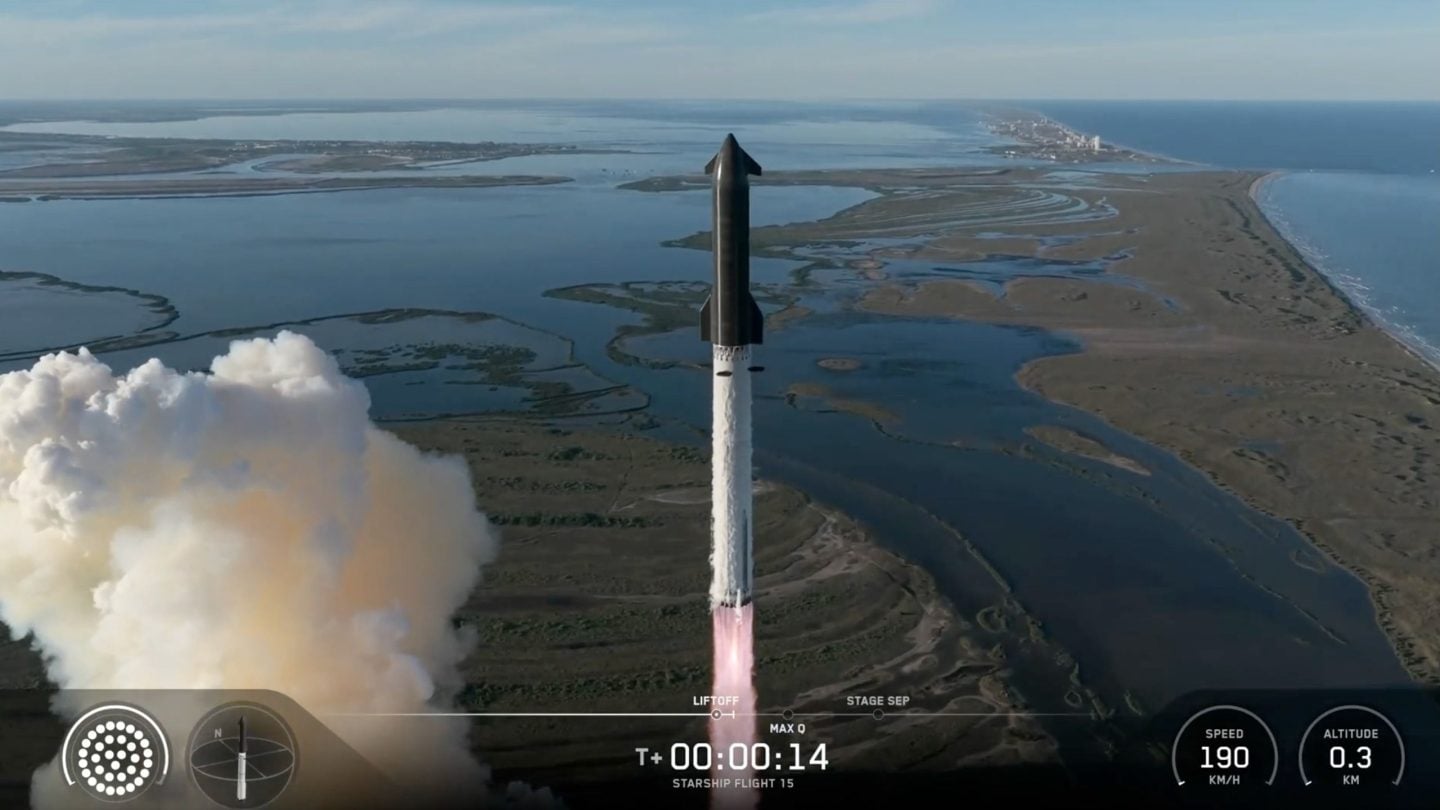
SpaceX launched its 15th Starship test flight on Friday from South Texas, embarking on an ambitious 22-hour mission designed to test orbital cargo delivery and an unprecedented double-catch recovery of both the booster and spacecraft.
Booster Abort and Splashdown at Starbase
The more than 400-foot-tall megarocket lifted off from Pad 2 at the Starbase facility in Boca Chica, Texas, at 5:47 p.m. ET. Minutes into the flight, the 236-foot-tall Super Heavy first-stage booster separated from the upper stage as planned. While the booster attempted to reverse its descent for a precision return to the launch tower, flight controllers identified an issue and ordered an automatic abort.
The booster diverted from its planned trajectory and crashed into the waters of the Gulf of Mexico. The failure bypassed the mechanical chopstick arms on the launch tower, marking a setback for SpaceX’s goal of full reusability for the lower-stage vehicle. Prior to this event, SpaceX had managed to catch a Super Heavy booster during three previous test flights by using giant mechanical arms on the launch gantry to snag the descending rockets tail first on the power of three of their 33 Raptor engines.
On this mission, long-range cameras captured the large booster slowly descending toward the gulf while shrouded in steam, followed by a fireball as residual propellants ignited. The Federal Aviation Administration had issued the necessary launch license just hours ahead of the flight.
Ship 42 moves to the Starbase pad ahead of launch pic.twitter.com/pMUFTHneJQ
“Safety is always the number one priority, and we're still testing out things that we haven't done before on these vehicles, and so we are prioritising making sure that we can perform each maneuver safely,” a SpaceX spokesperson said during a stream of the launch.
Raptor Engines Push Starship into Orbit
Following the booster’s separation, the Starship upper stage continued its climb to space powered by its Raptor engines. A single Raptor re-ignited for a short 10-second burn to push the craft into its planned orbit. The mission marked Starship’s second trip to orbit following Flight 14’s success in September.
Offshore divert for the booster. No Super Heavy catch back at Starbase.
“We’ve got a nominal orbit insertion, so Starship now in orbit around Earth for the second time ever,” SpaceX’s Dan Huot said during today’s Flight 15 launch webcast. “That’s a really great moment.”
Dan Huot, SpaceX
Once established in orbit, the spacecraft began deploying a payload of 26 next-generation Starlink V3 satellites, beginning about 36 minutes into the flight in a payload-delivery operation expected to take less than an hour. The vehicle was set to orbit Earth about 14 times during its more than 22-hour flight, with SpaceX monitoring vehicle health throughout.
“Starship will only execute a return to launch site if the flight control team has ensured that the vehicle systems critical for reentry maneuvers and final landing burn and tower approach are healthy,” SpaceX wrote in its Flight 15 mission description.

Starship Prepares for NASA Artemis Lunar Missions
The 15th test flight serves as vital preparation for NASA’s Artemis program. The space agency selected Starship as a crewed lunar lander and slated it to fly a demonstration mission with NASA’s Orion spacecraft and Artemis III astronauts in Earth orbit during the summer of 2027.
NASA is counting on the vehicle to return astronauts to the lunar surface by 2028. However, agency officials are hedging their bets by keeping Blue Origin’s Blue Moon Mark 2 lander in consideration depending on development timelines.
Starship is now in a long coast phase around Earth. Teams will monitor Starship’s systems over the next ~21 hours that we intend to be in orbit for. We do have a few early deorbit options available should we need them, but all systems are looking good right now
Meanwhile, Elon Musk has projected that SpaceX will reach a weekly launch cadence for Starship by the first half of 2027, backed by plans to open a new launchpad in Florida by the end of 2026. NASA has helped fund the rocket’s development with roughly $3.2 billion paid to SpaceX since selecting the vehicle in 2021.
“If every time you drove somewhere you had to throw away the car, you'd be 'wow' that's a crazy car where you have to throw away after every time you drive it. But that's how it works for rockets,” SpaceX CEO Elon Musk told the crowd.
Payload deploy complete. All 26 @Starlink V3 satellites are in orbit pic.twitter.com/y2ffFifGdo
Earlier coverage: SpaceX Targets First Double Midair Catch Attempt for Starship Flight 15