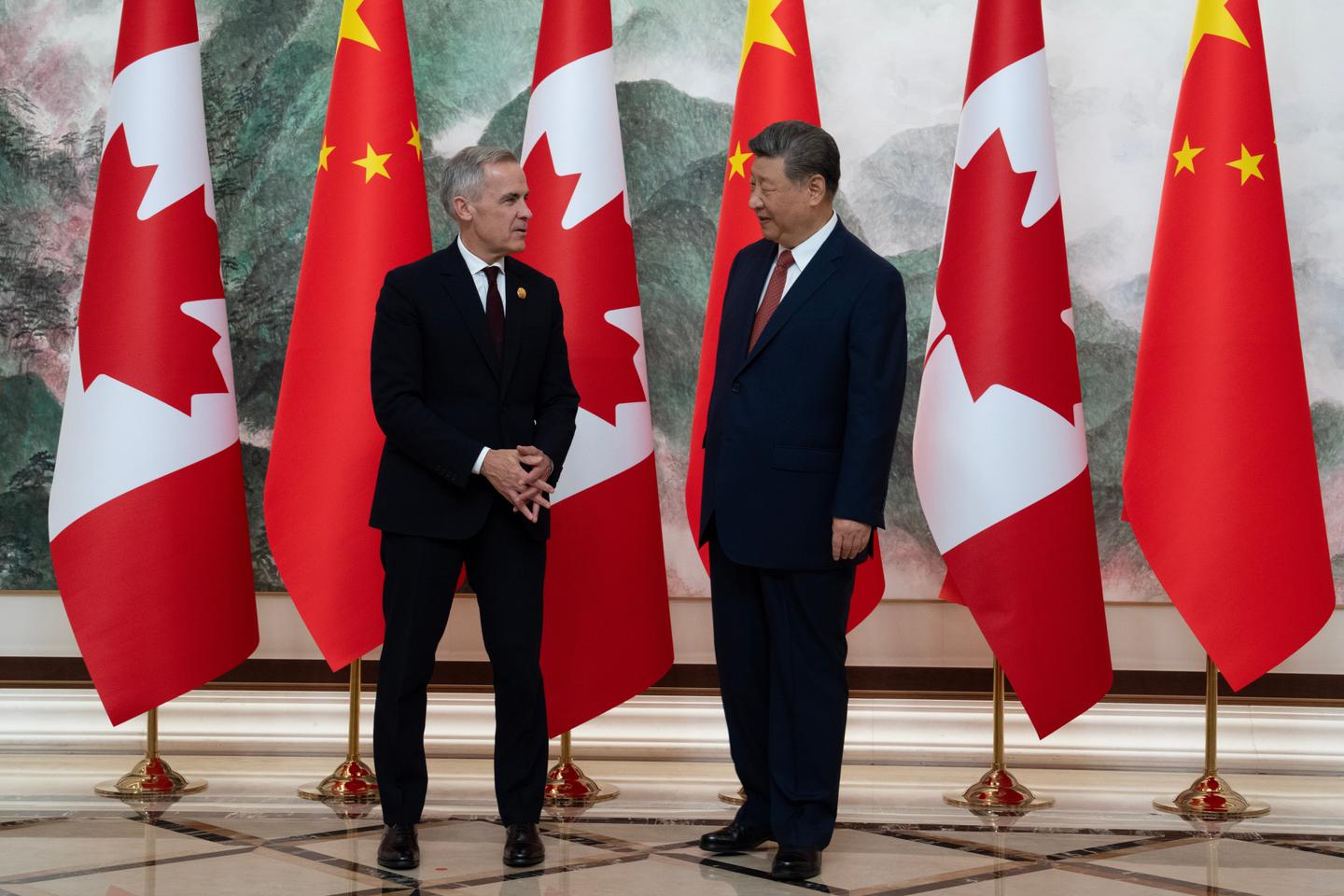
Prime Minister Mark Carney and Chinese President Xi Jinping agreed on Tuesday to new reciprocal tariff reductions during a bilateral meeting at the Asia-Pacific Economic Cooperation summit in Shenzhen, according to L’actualité.
The arrangement follows an earlier decision by Ottawa in January to allow the entry of 49,000 Chinese-manufactured electric vehicles under preferential tariff rates, alongside corresponding reductions by Beijing on Canadian agricultural exports.
Canadian exports to China surged by roughly 40 percent during the first nine months of the year, driven largely by energy and agricultural shipments.
Tariff Reductions on Seafood and Pork
The concessions Beijing granted cover major Canadian exports, including fish, seafood, and frozen pork.
In exchange, the Canadian government will extend temporary exemption measures for specific Chinese steel and aluminum products for an additional two years beyond their scheduled expiration at the end of 2026.
Both leaders also committed to concluding agreements on pet food and wild aquatic products before the end of the year, while designating 2027 as an e-commerce year to facilitate small and medium enterprise trade through platforms like Alibaba.

Prime Minister Mark Carney met with President Donald Trump in Chinese territory for a brief conversation lasting under twenty minutes to discuss trade relations between Canada and the United States.
During the summit, Prime Minister Carney addressed approximately 300 business leaders and corporate executives to present the Pacific Link pipeline project designed to transport crude oil from Alberta to the coastline of British Columbia.
Official trade statistics released by Statistics Canada indicate that total Canadian exports to the Chinese market reached 33.5 billion dollars during the initial three quarters of the year, reflecting a growth of 9.5 billion dollars, or nearly 40 percent, compared to the corresponding timeframe in the previous year.
Mujtaba Hussain, speaking as a spokesperson for International Trade Minister Maninder Sidhu, said that this expansion rate sits roughly four times higher than export growth directed toward all other global destinations combined.
Regarding import figures, Canada acquired 68.8 billion dollars worth of Chinese merchandise between January and September, shifting slightly from 68.1 billion dollars recorded during the identical period a year earlier.
Previous trade patterns show that total Canadian exports to China stood at 35 billion dollars in 2025, while total imports reached roughly 90 billion dollars, alongside bilateral service exchanges totaling 13.8 billion dollars.
Economic Realignment and Washington Tension
The diplomatic outreach forms part of a broader strategy to diversify Canada’s trade partnerships amid trade tensions with the United States under President Donald Trump, who imposed sweeping tariffs on northern imports.
That approach drew sharp criticism from American officials. Peter Navarro, a senior trade adviser to the US president, questioned the diplomatic trajectory in a memorandum addressed to the Canadian government, according to Noovo Info.
Threaten to pit China against the United States? That’s extremely offensive. You should be more concerned that China is going to devour Canada whole — as it is already doing.
Domestic critics have also raised concerns regarding the speed of the diplomatic pivot. Bloc Québécois Leader Yves-François Blanchet argued that Ottawa should have conditioned market access on human rights concessions, including independent inspections concerning Uyghur and Tibetan populations.
Yves-François Blanchet also asserted that the federal administration should have mandated the termination of overseas Chinese police outposts operating within Canadian borders to address the alleged surveillance and harassment of Chinese expatriates.
Other public figures, including Ben Mulroney speaking on the Ben Mulroney show, questioned the strategic timing and necessity of the diplomatic mission, suggesting that frequent international journeys by the prime minister risk alienating Washington further.
Vina Nadjibulla, cofounder of the Centre for Strategic Statecraft, said the talks line up with coming changes to federal legislation and the planned renewal of the Indo-Pacific strategy that began in 2022.
Bilateral Trade Figures and Next Steps
Official trade data shows total Canadian exports to China reached 33.5 billion dollars across the first three quarters of the year, representing a 9.5 billion dollar increase over the same period in 2025.
Crude oil shipments more than doubled to 9.5 billion dollars, supported by the expanded capacity of the Trans Mountain pipeline system.
Prime Minister Carney is scheduled to send a major trade mission to China in 2027 to build on the commercial framework established during the Shenzhen meetings.