China launched the Shenzhou 24 spacecraft from the Jiuquan Satellite Launch Center on Wednesday morning, carrying two Chinese astronauts and payload specialist Muhammad Zeeshan Ali of Pakistan into orbit to dock with the Tiangong space station.
Shenzhou 24 Launches and Docks with Tiangong Station
The Shenzhou 24 spacecraft blasted off atop a Long March 2F Y24 rocket at 8:18 a.m. local time (00:18 GMT) from the Jiuquan Satellite Launch Center in the Gobi Desert.
'Carrying hopes of 250m people': Zeeshan Ali to be first Pakistani in space aboard China's Shenzhou-24 #🇵🇰 #🇨🇳https://t.co/wbYY7gnENd
As the rocket ascended on a column of orange flames, Pakistan’s national anthem played in an auditorium in Islamabad, where crowds had gathered since 5:00 a.m. to witness the event. The craft successfully separated from the launch vehicle and entered its predetermined orbit, later docking with the Tiangong station at 8:56 a.m. (03:56 GMT).
Commander Tang Hongbo, 51, and spaceflight engineer Wu Yi, 39, were joined by 40-year-old Muhammad Zeeshan Ali, a wing commander in the Pakistan Air Force. Tang, a native of Hunan, is set to become the first astronaut to board the Tiangong station three times, having previously served on the Shenzhou 12 and Shenzhou 17 missions.
Joint Scientific Experiments and Orbital Schedule
The crew is tasked with conducting more than 90 scientific experiments and technology tests. Among these, Ali will perform a photosynthetic cyanobacteria experiment in orbit. Upon the conclusion of his short-term mission, Ali is scheduled to return to Earth aboard the Shenzhou 23 spacecraft alongside its crew.
While Ali focuses on his specific payload, the station continues to host long-duration operations, with other personnel maintaining routine repairs and equipment inspections to ensure the outpost’s reliable and efficient operation.
Bilateral Training and Cultural Preparation
Following a three-stage selection process—preliminary, secondary, and final—Ali and fellow military pilot Khurram Daud emerged from a pool of approximately 20 finalists. Ali spent seven months at China’s astronaut center, where he mastered spaceflight capabilities and attained proficiency in Putonghua to communicate directly with his crewmates.
At a pre-launch press conference, Ali expressed his gratitude to the Chinese government, stating, “I carry the name of Pakistan on my shoulder, the hopes of 250 million Pakistanis.” He described his training as a process of continuous growth, noting that he viewed the “space dream” of developing the sector as shared by both nations.
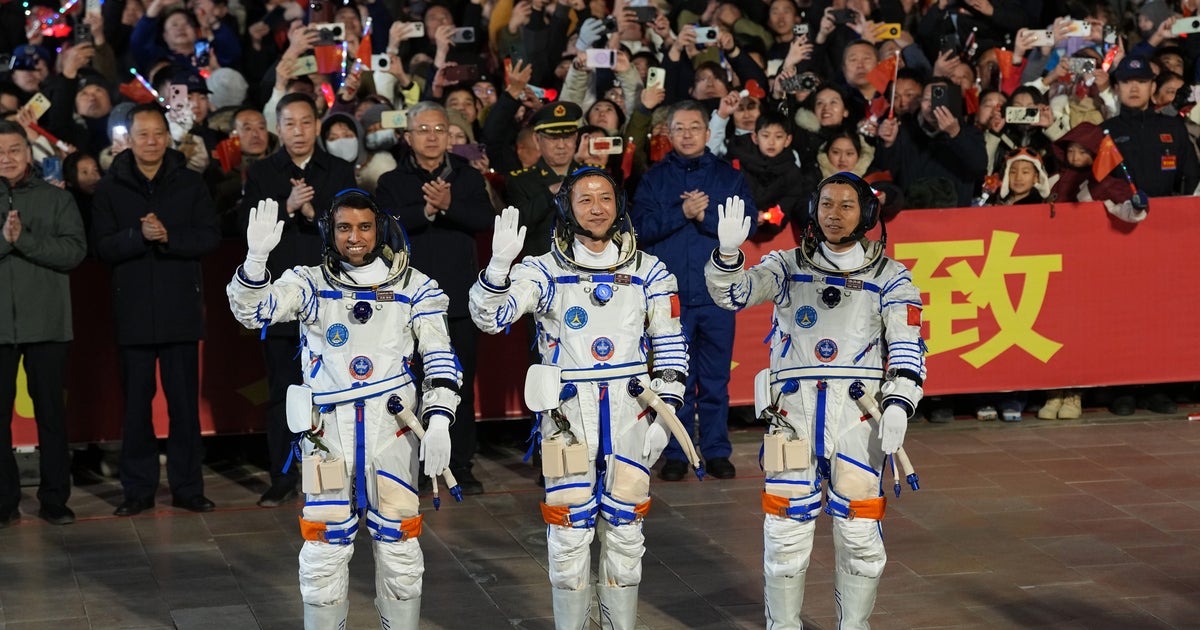
Ali’s crewmate, Wu Yi, emphasized that in space, there is no distinction between nationalities, only a single crew defined by “seamless coordination” and “mutual trust.”
Commercial Aerospace Expansion and Future Lunar Goals
The Shenzhou 24 mission occurs during a period of record-high activity for China’s aerospace sector, which completed 70 launches in the first three quarters of 2026—a 19% year-on-year increase. Commercial launches now account for over 60% of this activity. According to the CCID Research Institute, companies that master reusable, low-cost launch capabilities will likely capture the majority of the market. This high-density operational environment is intended to help commercial players bypass early-stage trial-and-error costs.
China is also preparing for a crewed lunar landing by 2030. Wang Xiang, chief designer of the lunar exploration program, said that the mission will likely involve a crew of three, with two expected to walk on the lunar surface. This goal puts China in competition with NASA, which aims to land astronauts on the moon by 2028.
Astronauts Bridge Cultures Through Shared History
During the public appearance at the Jiuquan Satellite Launch Center, Muhammad Zeeshan Ali shared his perspective on the historic mission by quoting both Chinese and Pakistani poets.
Last night I spoke with @DeutscheWelle about the launch of a Pakistani astronaut on board China's #Shenzhou24 mission and was joined by Aisha Jagirani from Pakistan's space agency. Video: https://t.co/NjwG3mkOe4
Ali recited lines from Li Bai, who wrote of a bird mounting ninety thousand li into the sky, and shared a Pakistani verse about a falcon whose calling is to soar. He described himself as a bridge linking the two friendly nations, reflecting a deep personal devotion to both his homeland and the mission’s success.
For his crewmate Wu Yi, the path to space was shaped by a childhood spent reading historical texts like the Zizhi Tongjian. Wu, who comes from a revolutionary base area in northern Shaanxi, said that he viewed every crew member as a brother or sister fighting side by side.
🔴 LIVE — Pakistan's first astronaut is going to space. We are counting down to the Shenzhou-24 launch to China's Tiangong Space Station, no earlier than 25 November 2026 at 08:19 China Standard Time, which is 00:19 UTC and 05:19 AM Pakistan Standard Time. The Pakistani… https://t.co/0ju3Sj9IsV
He emphasized that once in orbit, there is no distinction between Chinese and foreign astronauts, as they function as a single, unified team.
Commercial Markets Drive Aerospace Economic Growth
The mission highlights a rapidly expanding industry, as China’s commercial space market reached 2.83 trillion yuan in 2025 and is projected to exceed 3.5 trillion yuan for the full year of 2026.
Industry analysts note that this growth is part of a broader strategy to lower launch costs, with targets set to bring expenses below 20,000 yuan per kilogram. Dai Zheng, chief commander of the Zhuque-3, previously said that reusing rockets four to five times could reduce costs by more than 50% compared to expendable models.
This economic shift is supported by high-density operations that help commercial space players manage the capital-intensive work of early-stage testing. As China continues to lead in launch frequency, officials maintain that such advancements are essential for the peaceful use of outer space. Pakistan, having pivoted to China’s BeiDou navigation system in 2014, remains hopeful that this ongoing cooperation will help it achieve new heights in space exploration.
Diplomatic and Historical Significance
Official statements from both countries have characterized the mission as a symbol of deep-rooted friendship. Pakistani Prime Minister Shehbaz Sharif described the partnership as “surpassing the heights of the Himalayas” in its journey to outer space. Planning Minister Ahsan Iqbal said that the sky is “no longer our limit; it is our launching pad,” viewing the flight as a source of inspiration for young Pakistanis in science and technology fields.
China’s foreign ministry spokesperson, Guo Jiakun, emphasized that the Tiangong station is intended to be a platform for peace and cooperation. China has established formal space cooperation agreements with more than 50 countries and international organizations, including nine projects selected through the United Nations Office for Outer Space Affairs involving 23 institutions from 17 countries, with a focus on supporting developing nations.
For Pakistan, the mission provides practical experience in payload operations and training that the government intends to use to revive SUPARCO, which was originally established in 1961.
The Tiangong space station, China’s first permanently crewed orbital laboratory, has been operational since 2021. As the third modular space station in history, it orbits at an altitude of 340 to 450 kilometres with a pressurised volume of 340 cubic metres, roughly one-third the size of the International Space Station.
Tomorrow, Pakistan will look to the skies with anticipation, pride and deep gratitude. As Shenzhou-24 prepares to carry a Pakistani astronaut to China’s Tiangong Space Station, our nation stands on the threshold of a historic first. It is a moment that belongs to every…
Operated by the China Manned Space Agency, the station utilizes a modular design consisting of the Tianhe core module and the Wentian and Mengtian laboratory modules.
Functionally, the station hosts experiments on microgravity and materials science while maintaining continuous human occupation. It distinguishes itself by utilizing ion thrusters for orbital station-keeping and relying on the Tianlian satellite network for communications.
A proud moment for Pakistan! 🇵🇰 We congratulate Pakistani astronaut Muhammad Zeeshan Ali on his selection as a payload specialist for China’s Shenzhou-24 mission, marking a historic milestone in space exploration. This achievement underscores the immense potential of Pakistan’s… pic.twitter.com/CIRUjvs7rU
During his appearance at the Jiuquan Satellite Launch Center, Ali reflected on his journey from a pilot to a payload specialist, noting that he had read historical texts like the Records of the Grand Historian as a child, which fostered his appreciation for long-term development.
He said that he sees himself as a “bridge linking Pakistan and China.” The mission, according to Ali, is the starting point of a new chapter of cooperation that could eventually extend to joint flights to Mars and beyond.
🔴 LIVE — Pakistan's first astronaut is going to space. We are counting down to the Shenzhou-24 launch to China's Tiangong Space Station, no earlier than 25 November 2026 at 08:19 China Standard Time, which is 00:19 UTC and 05:19 AM Pakistan Standard Time. The Pakistani…