European leaders united in Berlin to demand a seat at forthcoming diplomatic talks, hours after a trilateral summit in Shenzhen brought together Donald Trump, Vladimir Putin, and Chinese President Xi Jinping.
Berlin Summit of the Coalition of the Willing
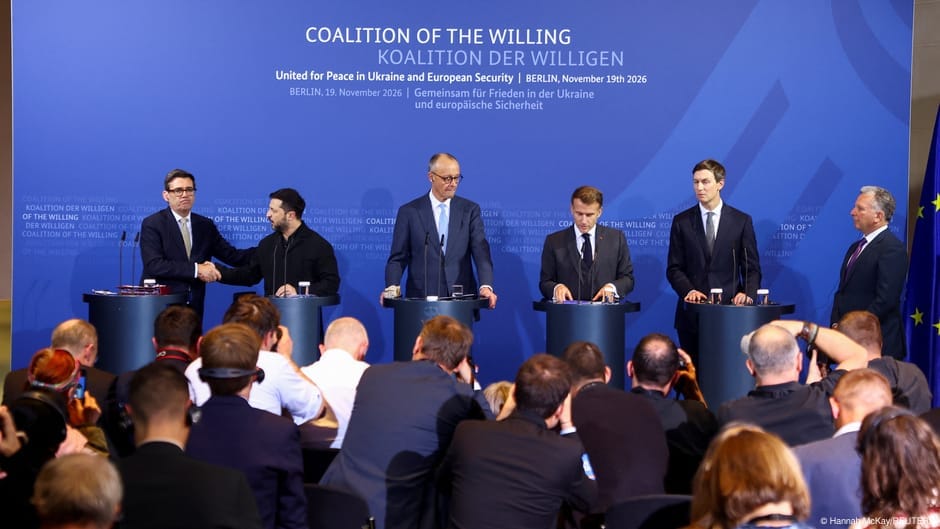
Gathered at the Federal Chancellery on November 19, 2026, leaders from across the European Union, the UK, and NATO convened for a high-level meeting of the Coalition of the Willing. German Chancellor Friedrich Merz hosted the summit alongside French President Emmanuel Macron and British Prime Minister Andy Burnham, bringing together roughly 44 delegations and over 25 heads of state and government to coordinate support for Kyiv.
The summit, held under the motto ‘Together for Peace in Ukraine and European Security’, also saw participation from European Council President António Costa, EU Commission President Ursula von der Leyen, EU High Representative for Foreign Affairs and Security Policy Kaja Kallas, and NATO Secretary General Mark Rutte.
A brief message after the meeting in Berlin. Putin is counting on winter to break Ukraine. He will be proven wrong. Europe will not back down. pic.twitter.com/6ry6Msd1Gc
The meeting followed hard on the heels of rare talks in China between the U.S., Russian, and Chinese presidents. European officials expressed sharp unease that the European Union had been sidelined during stop-start negotiations between Washington and Moscow, warning against any return to post-World War II divisions.
Merz dismissed the Shenzhen gathering as “a photo op” and explicitly rejected a revival of great-power partitioning, stating that a Yalta format cannot bring peace to the continent. Polish Prime Minister Donald Tusk also took exception to Trump’s description of Putin as a friend during the summit, stating that Putin is not a friend and will never be one.
The outcome of this war will shape security in Europe for a long time to come. Together with our partners, we continue our support for peace in Ukraine. That's why we came together today for the Coalition of the Willing. pic.twitter.com/xqnKp5aAaH
U.S. Envoys Detail Security Guarantees and Negotiating Table
U.S. peace envoys Jared Kushner and Steve Witkoff traveled to Berlin to brief European leaders on the administration’s diplomatic efforts, updating German Chancellor Friedrich Merz on Trump’s discussions in China and recent trilateral talks in the United Arab Emirates.
Kushner told reporters that President Trump wanted to reach a settlement with Europe by his side, assuring officials that Washington had no intention of imposing an agreement unilaterally. Trump also placed a phone call into the Berlin talks from aboard Air Force One while traveling back from Shenzhen.

Kushner reported progress on the architecture of postwar security for Ukraine, stating that Moscow appeared amenable to defensive commitments modeled on NATO's collective defense framework. “I think we’ve gotten the Russians comfortable with that concept where any security guarantee for Ukraine would be based on Article 5,” Kushner said, adding that Trump remained open to the proposal provided it aligned with American interests and formed part of a broader package.
Divergent Positions from Moscow and Kyiv
While U.S. negotiators emphasized multilateral coordination, signals from Moscow remained mixed. Speaking in China, Putin said that Russia had invited European leaders to Moscow through diplomatic channels to clarify their positions before deciding in what format we will continue the dialogue.
Thank you very much. On behalf of Steve and I, I'd like to thank Chancellor Merz for hosting us here so graciously, and I'd also like to compliment Chancellor Merz and President Macron and Prime Minister Burnham and President Zelenskyy on a very substantive and successful… pic.twitter.com/PTTx5d0VIy
In their joint statement, leaders of Germany, France, the UK, and Ukraine called on Russia to agree to an energy ceasefire for the duration of the winter and demanded robust, legally binding security guarantees backed by a European-led multinational force. Ukrainian President Volodymyr Zelenskyy, participating in the Berlin talks, continued to press for direct European involvement, insisting that issues concerning Europe must be resolved with Europe’s participation.
Speaking about the summit in Berlin, German Foreign Minister Johann Wadephul characterized it as the most extensive gathering of Kyiv’s backers thus far, sending a clear message to Moscow that diplomatic discussions must be treated with gravity.
The American envoys said that in Berlin, during our meetings tomorrow, they would give us a debrief on the talks the American President is currently holding in China. We will also be hearing from our partners currently in China. We and the Europeans have a clear, shared… pic.twitter.com/cOsudty2Mg
Meanwhile, Ursula von der Leyen emphasized that peace depends on putting Ukraine in a position of strength, while leaders discussed implementing the European Commission’s proposal for 45 billion euros in budgetary and military support for 2027.
German Chancellor Friedrich Merz stressed that Moscow’s maximalist demands are unacceptable and that Europe is prepared to ensure Kyiv negotiates from a position of strength. However, Russian President Vladimir Putin maintained his territorial demands and said that any military cooperation or defense ties between Ukraine and Europe would remain a problem for Moscow.
We continued our talks with Friedrich Merz @bundeskanzler in a bilateral format. The Chancellor and I discussed how the Coalition of the Willing meeting went and what we will focus on first and foremost. Of course, diplomacy is our priority, and most of today’s conversations have… pic.twitter.com/NopmweH1N0
The term “coalition of the willing” originated in the early 1970s when MIT professor Lincoln P. Bloomfield and his colleague Harland Cleveland proposed ad hoc partnerships of nations for UN-endorsed peacekeeping. It entered diplomatic usage after Secretary of State Henry Kissinger acknowledged the concept in a 1973 letter, and President Bill Clinton invoked it in 1994 regarding possible operations against North Korea.
The phrase became widely associated with the US-led Multi-National Force in Iraq during the 2003 invasion and subsequent war. In its current European iteration, Czech President Petr Pavel publicly called for a new coalition of the willing to end the Russian invasion of Ukraine on March 1, 2025; the following day, British Prime Minister Keir Starmer endorsed the idea after a London summit of 18 European leaders.
European Commission President Ursula von der Leyen later applied the label to an emergency summit of European leaders at the White House in August 2025.
Reporting for the broader coverage surrounding these diplomatic developments was provided by Veronika Melkozerova, Hans von der Burchard, Sérène Nourrisson, Bjarke Smith-Meyer, James Angelos, Victor Jack, and Nicholas Vinocur.
Earlier coverage: EU Leaders Agree to Send Delegation to Russia-Ukraine Peace Talks
Today the Leaders agreed that the European Team for negotiations on peace in Ukraine is the EU institutions and the E5 of the Coalition of the Willing – France, Germany, Italy, Poland and the United Kingdom. Our principles and our positions in these negotiations remain well… pic.twitter.com/wFLM2ElTRo