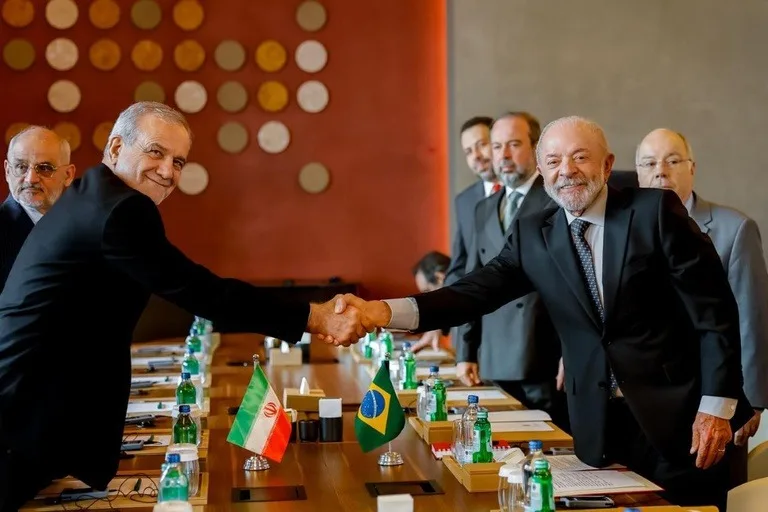
President Luiz Inácio Lula da Silva met with Iranian President Masoud Pezeshkian on Thursday at the COP31 climate conference in Antalya, Turkey, where the two leaders discussed the ongoing Middle East conflict and bilateral economic ties.
Lula Meets Pezeshkian at COP31
The meeting marked the first direct contact between the two leaders since the outbreak of war involving Iran, the United States, and Israel. Pezeshkian provided an update on peace negotiations with Washington, highlighting mediation efforts led by Qatar and Pakistan, according to a statement released by the Palácio do Planalto.
Lula advocated for a peaceful resolution to the hostilities. He referenced Brazil’s historical involvement in the 2010 Tehran Declaration, an initiative pursued alongside Turkey to address Iran’s nuclear program, and reaffirmed Iran’s right to develop and use civil nuclear energy for peaceful purposes.

In April, the Brazilian president had criticized American and Israel-led attacks, stating that claims regarding an Iranian atomic weapon were false and that Washington had initiated an unnecessary conflict.
Reports from Iranian state media regarding the Antalya discussions said Lula also asserted that Western governments repeatedly attempt to distort the image of the Islamic Republic, said that American officials are accustomed to dishonesty, and said that Brazil never anticipated an American strike against the Persian nation, describing the bombardment as a severe and bitter event. The Planalto did not confirm those specific remarks attributed to Lula by Tehran.
🚨Brasil 🇧🇷/Irã 🇮🇷: Lula afirmou que os governos ocidentais buscam repetidamente apresentar uma imagem distorcida da República Islâmica e que “Os funcionários americanos estão acostumados a mentir”, lembrando que autoridades dos EUA aconselharam o Brasil a não visitar o Irã… pic.twitter.com/kZkTDvNjYi
Strait of Hormuz Disrupts Global Commerce
Discussions also addressed the strategic Strait of Hormuz, which has remained closed since the conflict escalated in February. Lula expressed concern over the war’s impact on global fuel prices and urged that the vital maritime route remain open for international commerce.
“The Strait of Hormuz is driving up the price of fuel, which affects the price of meat, the price of coffee, the price of rice, and the price of the basic food basket for every poor citizen in the world,” Lula said in a conversation with Spanish Prime Minister Pedro Sánchez published on X, as reported by CNN Brasil.

Economic ties between Brasília and Tehran continue to expand. bilateral trade totaled $3 billion in 2025, with the Brazilian government showing a strong interest in increasing fertilizer imports from Iran.
Will the Strait of Hormuz reopen for international commerce?