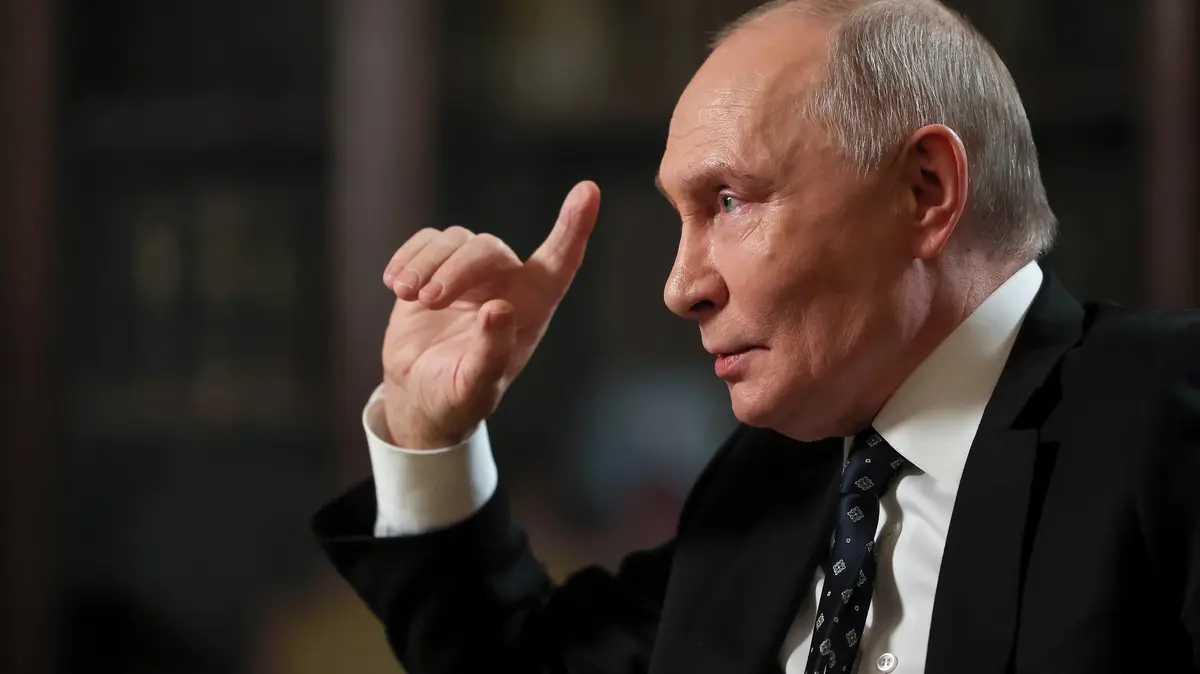
Russian civilization has never brought anyone under its control, Vladimir Putin said in an interview released Thursday, framing the country’s history as a unique force for pluralism rather than conquest.
The Russian president made the claim while speaking with Serbian filmmaker Emir Kusturica for a documentary marking the 80th birthday of Patriarch Kirill, head of the Russian Orthodox Church.
Civilization as refuge
Putin argued that Russia’s distinctiveness lies in its capacity to preserve the languages, faiths, and traditions of the peoples absorbed into the Russian Empire. It allowed the Russian people, the Russian ethnicity, to develop, and created conditions for the development of other nations and ethnic groups that were part of the Russian Empire and part of the family of the Russian state, he said, according to the Kremlin transcript.
Everyone was given the opportunity to develop, ensured their sovereign spiritual development, their religion, traditions and languages. And this to a certain extent is the uniqueness, in this lies the uniqueness of Russian civilization.
Putin: What is the difference between Russian civilization and civilizations such as the Chinese or Indian civilizations? You know, I think about this constantly. And this is the conclusion I have reached: Russian civilization has never brought anyone under its control. pic.twitter.com/BmlyUeG8GR
He cited Fyodor Dostoevsky’s observation that Russians possess an instinct for universal humanity — an ability to live alongside others and enter into foreign environments without erasing them.
The same interview returned to the theological concept of Moscow as the Third Rome, the successor to Rome and Constantinople as the center of Orthodox Christianity. In Russian theological and philosophical thought over the centuries one idea persists: Moscow is the Third Rome, a Fourth will not be, Putin told Kusturica.
Addressing Ukrainians directly
The interview turned to the war in Ukraine. He distinguished between patriotism — love for one’s country — and nationalism, which he defined as hatred of other nations. Everything there collapsed. And not now, in recent weeks due to retaliatory strikes by Russian missile forces. No, it collapsed on its own, he claimed, attributing Ukraine’s decline since 1991 to nationalist leadership rather than the invasion.
Putin also repeated his view that the West uses Ukraine to weaken and divide both peoples for its own control. He framed the 988 baptism of Kyivan Rus under Prince Vladimir as the foundational moment that created a single Russian state and people — a historical reading that underpins his argument that Russians and Ukrainians are one nation artificially split.
Patriarch Kirill and the sanctified war
The interview was filmed amid a major exhibition in Moscow honoring Patriarch Kirill, a longtime ally of Putin who has publicly backed the invasion. According to Reflex, citing the German agency DPA, the exhibition includes elements of war propaganda linking historical holy wars to the current offensive. Kirill recently published a book titled War, portraying the conflict as a struggle against liberal Western values.
Putin said that people are now moving to Russia from Europe to preserve their values, protect the family, and secure a future for their children, though Novinky pointed out that World Bank data shows a net outflow of roughly 252 thousand people from Russia last year, with most immigrants arriving from Central Asian states such as Uzbekistan, Tajikistan, and Kyrgyzstan.

A civilizational argument for the present
The interview functions as more than historical reflection. By casting Russian civilization as inherently non-imperial — never brought anyone under its control — Putin offers a moral framework that reframes the ongoing war as reunification rather than conquest.
Patriarch Kirill, born Vladimir Mikhailovich Gundyayev in 1946 in Leningrad, spent his early career representing the Moscow Patriarchate at the World Council of Churches in Geneva from 1971 and later chaired the Department for External Church Relations from 1989. He became Patriarch of Moscow and all Rus’ on 1 February 2009, bringing the Russian Orthodox Church into closer alignment with the Russian state.
Kirill has described President Putin’s rule as “a miracle of God” and characterized the invasion of Ukraine as a “Holy War” against “forces of evil,” positions that have drawn condemnation from other Orthodox leaders including Ecumenical Patriarch Bartholomew I.
The same sources that carry Putin’s words also document the war’s toll — statisíce životů na obou stranách, and a Ukrainian national identity that has hardened rather than dissolved since February 2022. The civilizational claim rests on an imperial past that many of the peoples once given the opportunity to develop remember as subjugation.


