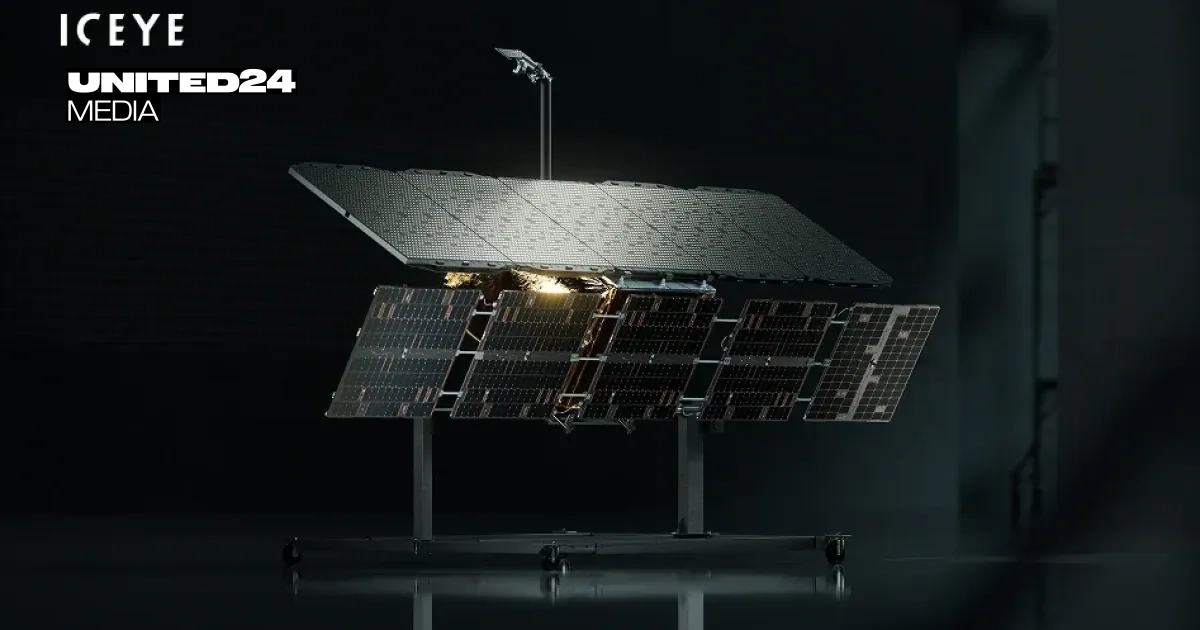
A Russian military satellite executed close-proximity maneuvers around an imaging spacecraft operated by a U.S. subsidiary of Finnish firm ICEYE, closing to within five kilometers in low Earth orbit. The uninvited approach on October 16, 2026, highlights rising space-domain friction as commercial radar data plays a direct role in supporting Ukrainian forces.
Commercial space tracking data and defense reports revealed that the Russian spacecraft Kosmos 2612 executed a sequence of synchronized orbital maneuvers to shadow a synthetic aperture radar platform known as ICEYE-X36. Launched in April 2026 aboard a Soyuz-2.1b rocket from the Plesetsk Cosmodrome alongside five other military satellites, Kosmos 2612 adjusted its trajectory to match the commercial satellite’s orbital plane.
Tracking the Rendezvous and Proximity Operations in Low Earth Orbit
Astrophysicist and independent satellite tracker Jonathan McDowell identified the orbital adjustments using updated telemetry. He noted that the Russian inspector vehicle entered an altitude profile almost identical to the targeted commercial platform, operating at approximately 557 kilometers compared to the target’s 555-kilometer altitude.
New TLEs show that K2612 made a manuever on Oct 16 and is now stationkeeping within 5 km or less of ICEYE X36. To my knowledge this is the first LEO rendezvous of two active satellites where the owner of one of the sats did not give approval.
New TLEs show that K2612 made a manuever on Oct 16 and is now stationkeeping within 5 km or less of ICEYE X36. To my knowledge this is the first LEO rendezvous of two active satellites where the owner of one of the sats did not give approval.
Jonathan McDowell, astrophysicist and independent satellite tracker, via United24Media
The closing maneuver required a velocity change of roughly 27.9 meters per second, narrowing the separation distance down from several hundred kilometers to an estimated five kilometers, with subsequent modeling indicating close passes within several hundred meters. Space surveillance company LeoLabs separately confirmed that the movement appeared deliberate.
Ukraine Utilizes Finnish Radar Satellite Imagery
The target of the orbital pursuit, ICEYE-X36, is an imaging satellite operated by the Finnish-founded company’s U.S. division. The platform belongs to a constellation that provides all-weather radar reconnaissance capable of seeing through clouds and smoke to track ground activity.
Ukraine has utilized ICEYE radar data since 2022 under an intelligence cooperation agreement with the nation’s Ministry of Defence, including imagery from a satellite purchased through public crowdfunding. A Ukrainian official confirmed the military’s ongoing cooperation with the firm to reporting outlets, while defense analysts note that Russian officials have expressed sharp displeasure over the constellation’s tactical utility on the battlefield.
Broader Patterns of Co-Orbital Friction and Space Security Strains
This encounter is part of a broader campaign observed by space domain awareness providers. According to the Center for Strategic and International Studies, five satellites from the April launch conducted orbital adjustments in May to align with ICEYE-X36, with one platform passing within approximately 2.5 kilometers of the commercial satellite on May 26. ICEYE CEO Rafal Modrzewski previously reported that the company maneuvered its satellite in response to those events.
Victoria Samson, head of space policy at the Secure World Foundation, noted that while rendezvous and proximity operations are not inherently aggressive, the geopolitical context transforms how observers view the maneuvers.
You’re looking at what Russia is doing here, not in terms, specifically, of what’s happening in space but as part of a larger examination of what’s happening on Earth, Russia and Ukraine are literally at war with each other. And so it’s kind of tinting how you view Russia’s activities here.
Victoria Samson, head of space policy at the Secure World Foundation, via Scientific American
Defense analysts warn that co-orbital shadowing allows adversarial craft to conduct close-range electronic inspection, signal interception, or non-kinetic jamming against allied remote sensing networks. Such stalking also forces commercial operators to expend nonrenewable propellant to elude threatening spacecraft, potentially shortening their operational lifetimes.
Space Force Deploys Defensive Orbital Weapons
The orbital pursuit unfolds against a backdrop of increasing militarization in low Earth orbit. In recent weeks, the U.S. Department of Defense disclosed that the U.S. Space Force has placed weapons in space to defend critical national security assets from counterspace operations.
Western defense commands are accelerating the development of dynamic orbital maneuvering tactics and responsive space surveillance to deter uncoordinated approaches. Meanwhile, independent monitors continue to watch the telemetry as Kosmos 2612 maintains its stationkeeping position near the Finnish-built radar satellite.
We’re going to wait and see what happens, This kind of thing can change quickly, but I would hold off hysterical speculation until we know more about it.
Victoria Samson, head of space policy at the Secure World Foundation, via Scientific American
>