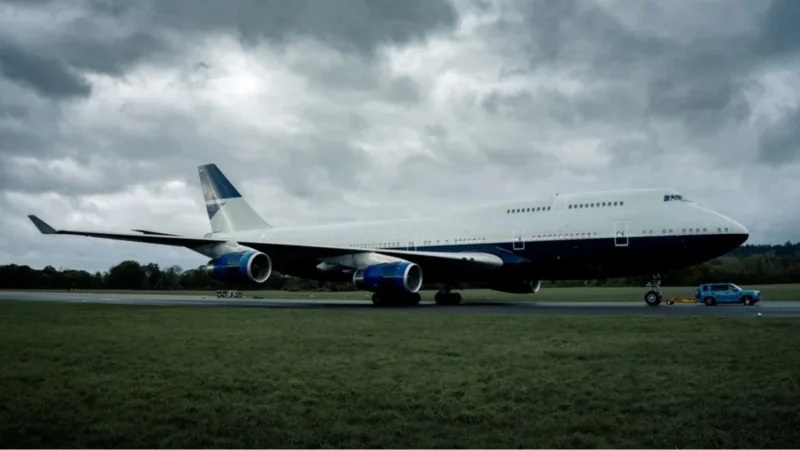
An off-road plug-in hybrid SUV from BYD’s Denza brand pulled a 180-ton Boeing 747 across a test track in Surrey, England, during a demonstration completed in November 2026.
Testing the Limits at Dunsfold Aerodrome
The heavy-duty test took place at Dunsfold Aerodrome, where engineers connected the vehicle to the commercial airliner using a rigid tow bar. The SUV used in the demonstration was a standard production model without specialized mechanical modifications, though the rear passenger seats were removed to accommodate ballast and a stabilizing setup.
Once conditions improved, the vehicle underwent three separate pulling stages across a total distance of 1,600 meters.
The manufacturer claimed this accomplishment as the first time a production vehicle has pulled an aircraft using just two wheels, as well as the first time a production vehicle has moved a Boeing 747 using only electric power. Across the trials, the commercial airliner involved was identified as a Boeing 747-400.

Step-by-Step Configuration and Weight Distribution
The test progressed through distinct stages of reduced traction and increasing internal load. In the initial phase, the SUV pulled the aircraft with all four wheels before technicians removed one wheel for a three-wheel run.
For the final and most extreme configuration, two wheels on the right side were removed entirely. Technicians then loaded 4,500 kilograms of ballast into the cabin, leaving the vehicle to pull the 180-ton aircraft while relying exclusively on two tires mounted on its left side.
| Test Stage | Active Wheels | Internal Ballast | Approximate Load per Wheel |
|---|---|---|---|
| First Phase | 4 Wheels | 2,000 kg | 60 tons |
| Final Phase | 2 Wheels (Left Side) | 4,500 kg | 90 tons |
DM-O Powertrain Delivers 400 kW and 90 Km Electric Range
The vehicle relies on the DM-O plug-in hybrid system, which pairs a 1.5-liter turbocharged gasoline engine with dual electric motors. The internal combustion engine produces 135 kW, while the front electric motor delivers 200 kW and the rear unit generates 285 kW. Combined, the setup puts out a peak output of 400 kW and 760 Nm of torque.
The powertrain utilizes a second-generation Blade Battery featuring LFP chemistry with a capacity of 31.8 kWh. In the UK market specification, this battery configuration delivers an all-electric driving range of up to 90 km based on WLTP testing protocols.
Engineers said that the front and rear axles lack a mechanical driveshaft connecting them directly. Because the axles operate independently through their respective electric motors, traction cannot be transferred mechanically between the front and rear if one end loses grip.
The vehicle also incorporates the DiSus-P hydraulic suspension system, which permits ground clearance adjustments of up to 140 mm and provides an independent lifting capacity of 9 tons. Its body structure utilizes a cell-to-chassis layout built with 96 percent high-strength steel.
Market Positioning and European Pricing
Known as the Fang Cheng Bao 5 in its domestic market, the SUV is sold in the UK market under the Denza brand in two distinct trims. The Elegance variant is priced at 70,345 pounds sterling, while the flagship Ultimate trim lists at 79,725 pounds sterling.

Expressed in alternative currency values at the time of reporting, the Elegance trim is valued at approximately US$92,570, while the Ultimate version equates to roughly US$104,910.
Following each run in the UK trial, technicians inspected the chassis, powertrain components, and tires, finding no signs of excessive mechanical stress. However, company representatives said that the official towing limit for the vehicle in everyday consumer use stands at 2,500 kg, meaning the aircraft demonstration far exceeds standard operating parameters.
Demonstrations of this scale illustrate how plug-in hybrid technology can combine fuel efficiency with substantial mechanical output and dependable performance under severe conditions. At the same time, company officials emphasized that executing such stunts involves specialized rigging, weight placement, and controlled track setups rather than reflecting routine towing capabilities.

Observers tracking the brand’s international footprint have also monitored potential rollout plans for other global territories. While initial major trials and commercial trims launched abroad, discussions regarding broader regional availability continue to draw interest across international markets.
Denza was established in May 2010 as a 50-50 joint venture between BYD and Daimler AG, with the German partner contributing premium vehicle engineering and a 125-year automotive legacy.
After a decade of China-only sales, the brand began its international push in 2024, exporting first to Southeast Asia before entering Europe, Brazil and the Middle East in 2025. Mercedes-Benz reduced its stake to 10% in 2021 and exited completely in September 2024, transferring its remaining shares to BYD and making Denza a wholly owned BYD subsidiary.
As electrified off-road options continue to evolve, high-profile evaluations of this magnitude highlight how modern battery-electric and hybrid architectures push the boundaries previously associated strictly with traditional internal combustion machinery.