Roughly 900 pilots at Porter Airlines launched a strike vote on Wednesday as negotiations for their very first collective agreement ground to a halt over pay, schedules, and work-life balance.
Hundreds of pilots gathered outside Billy Bishop Toronto City Airport for an information picket. The demonstration coincided with the start of the strike authorization ballot, marking a sharp escalation in tensions between the carrier and the Air Line Pilots Association, TravelPulse Quebec reported.
Approximately 200 of the airline’s pilots joined the airport gathering alongside flight crew members from more than 15 Canadian and American carriers, according to reporting by Profession Voyages.
Union leadership emphasized that the cross-border turnout reflects the broader stakes involved in establishing baseline workplace standards for the carrier’s flight deck crews. Crew members from more than a dozen other North American airlines stood shoulder to shoulder with the demonstrators at the downtown Toronto hub.
The labor dispute follows an official notice to bargain filed in September 2025. After months of slow progress, both sides entered federal conciliation in September 2026, with FM 103,3 noting the specific start date of September 23.
That conciliation window closes on November 22. Under federal labor rules, an agreement failure triggers a mandatory 21-day cooling-off period, opening the legal window for a strike or a company lock-out starting December 14.
The current strike authorization vote remains open until December 4. A majority vote gives union leaders the authority to launch job action once the legal waiting period expires, provided they give at least 72 hours of advance notice. Faculty expert Vincent Correira said that a strike timed just before the holidays creates operational challenges for both the carrier and industry competitors.
Pilot representatives argue that compensation needs to catch up with industry standards, pointing to unpredictable rosters and demanding flight schedules. At the same time, the airline has managed rising jet fuel expenses driven by conflict in the Middle East, a factor examined by Vincent Correira, professor and co-director of the Institute of Air and Space Law at McGill University, in an interview with LCN.

Those cost pressures prompted Ottawa to provide the carrier with a 125-million-dollar emergency loan earlier in the year following heavy spending on rapid network expansion, according to Profession Voyages. Industry analysts pointed out that jet fuel accounts for roughly half of overall airline operating expenses, leaving management with limited liquidity to meet every union demand.
Airline spokeswoman Robyn van Teunenbroek maintained that talks are continuing productively, emphasizing that operations remain unaffected by the ballot. Flights are operating as scheduled while discussions proceed.
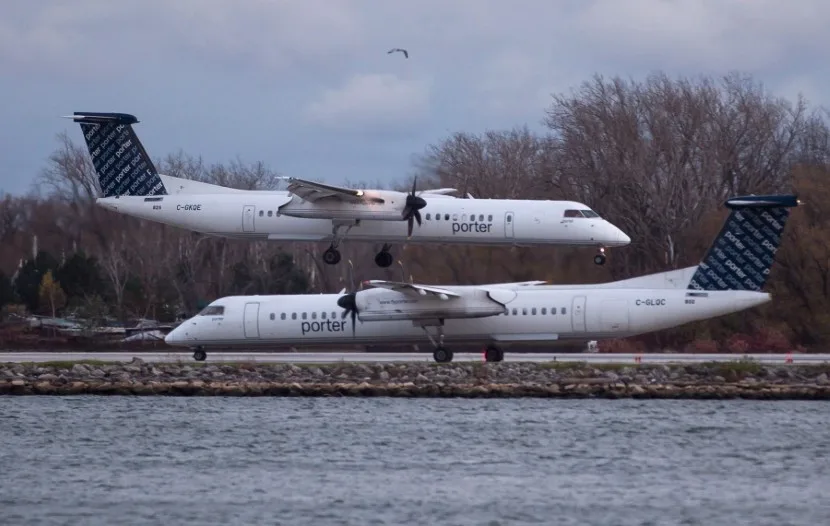
Porter Airlines, Canada’s third-largest carrier behind Air Canada and WestJet, began operations in 2006 from Billy Bishop Toronto City Airport using De Havilland Dash 8 turboprops. After years of losses and an 18-month pandemic shutdown, the airline pivoted in 2021 by ordering Embraer E195-E2 jets and launching service from Toronto Pearson, enabling new routes to Western Canada, the United States, and the Caribbean.
“We value our pilots and recognize the important role they play,” Robyn van, Teunenbroek said. “Discussions are progressing, and Porter remains determined to reach an agreement that supports our pilots and consolidates the good working relationship we have maintained for 20 years.”
Robyn van Teunenbroek, spokesperson for Porter Airlines
The potential work stoppage threatens holiday travel itineraries across an expanding route network that recently added destinations in Mexico, the Caribbean, and Central America.