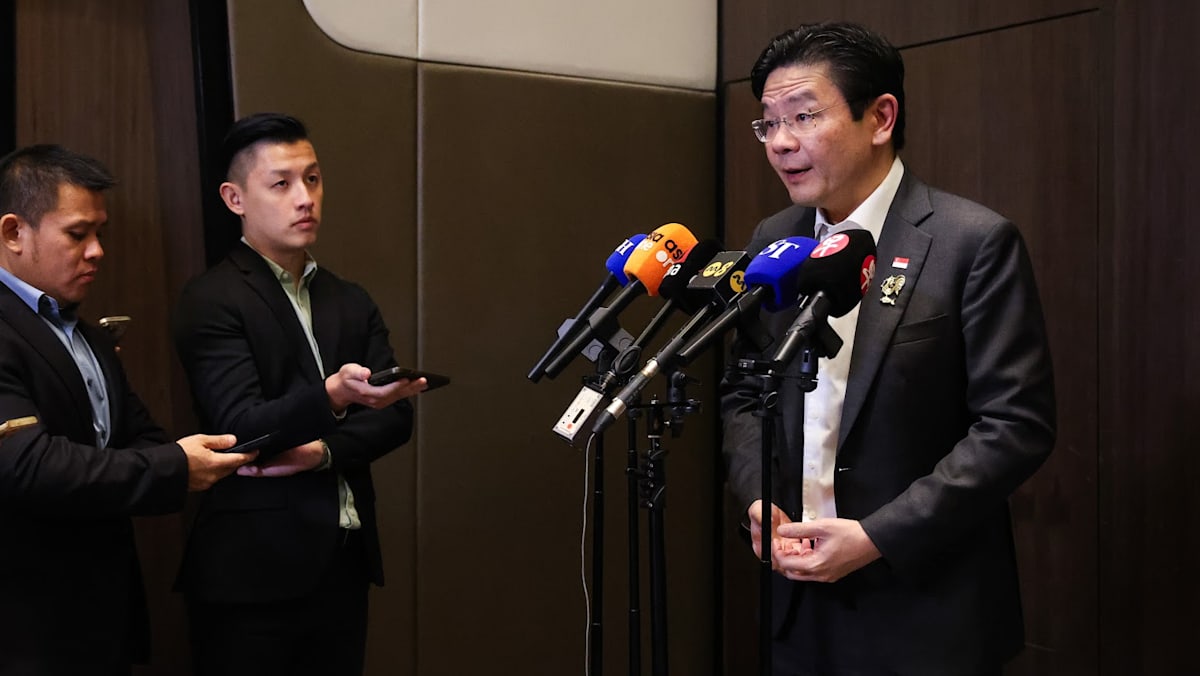
“We are not here to implement or enforce the export controls of other countries”, said Lawrence Wong, Singapore’s Prime Minister, on Tuesday in Manila.
Hours later, his government agreed to help Washington verify how advanced semiconductors are used inside the Republic. The U.S. Commerce Department had imposed licensing requirements on chip shipments to Singapore, Malaysia, Indonesia, Thailand and Brazil. The rules, announced Monday, aim to stop China from accessing American AI computing power through Southeast Asian data centres.
Singapore records high semiconductor sales, yet most chips never stay. In February 2025, the government disclosed that 22 per cent of Nvidia’s global revenue in the third quarter of 2024 was attributed to customers billed in Singapore. Products physically shipped to the Republic accounted for less than 1 per cent of total revenue. The remainder is transhipped or sent directly elsewhere.
Non-oil re-exports of integrated circuits rose 73.1 per cent year on year in October. That figure covers a broader category than the advanced AI chips targeted by the new controls. Wong said the impact on transhipment volumes is manageable. His greater concern is the chips that actually enter Singapore for use by local firms and data centres.
Malaysia’s investment, trade and industry minister, Johari Abdul Ghani, put it bluntly: “If you want to be in the game, you have to follow U.S. rules”. The U.S. envoy to Asean, Kevin Kim, said the measures reflected Washington’s belief that Southeast Asia would be “at the heart of the superintelligence industry” looking ahead.
Analysts say the rules will split the region’s operators. Owner-operated campuses serving established U.S. hyperscalers should be better placed. Those relying on Chinese customers face longer licensing, weaker utilisation and delayed expansion, said Charu Chanana, chief investment strategist at Saxo in Singapore. Gary Tan, a portfolio manager at Allspring Global Investments, expects “a two-tier market” favouring trusted providers and U.S. hyperscalers.

Neil Shah of Counterpoint Research said the burden shifts to cloud providers, with data centre firms facing heavy “know your customer” checks. Losing remote access creates a short-term compute bottleneck for Chinese tech companies. Robert Walker of the Lowy Institute warned the rules “would pose a major headwind” to data centre investment, with Singapore, Malaysia and Thailand most exposed.
Beijing condemned the move as economic coercion. China’s commerce ministry said on Tuesday it firmly opposed the rule and would take countermeasures if Washington insists on imposing it. The Straits Times Index fell 1.4 per cent on Tuesday, closing at 5,109.13, as investors weighed the impact on technology holdings. Shares of MetaOptics closed over 2% lower, and Assembly Place was down nearly 2% at the close.
“The measure is a long-overdue step in the right direction to address China’s remote access to huge computing hubs in Southeast Asia and elsewhere,” said Ryan Fedasiuk, a senior fellow at @JoinFAI who focuses on AI. “The decision reflects that the Trump administration is taking…
Wong met U.S. President Donald Trump during the ASEAN Summit in Manila and said they “had a good conversation”. He reminded Trump that Singapore assumes the ASEAN chairmanship in 2027, coinciding with the 50th anniversary of U.S.-ASEAN relations. Thailand takes the helm in 2028.
Great to join my @CFR_org colleagues Rebecca Patterson and @ChrisRMcGuire to break down the Nvidia scandal, what it means for US-China AI competition, and what it teaches us about the limits of US export controls. Watch here:https://t.co/PEZQKsoKNy