A Federal Aviation Administration official supervised and signed off on contractor repair work in rural Arkansas just eight minutes before a nationwide communications outage paralyzed U.S. air travel on Friday.
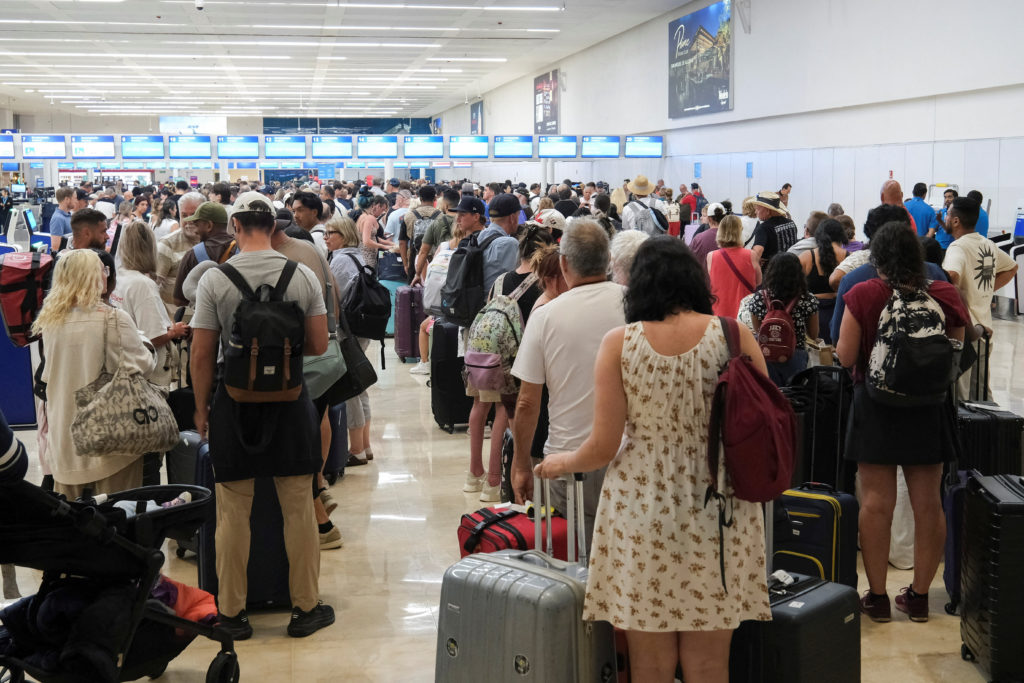
The ground stop, which lasted nearly five hours, left hundreds of thousands of passengers stranded and resulted in the grounding of over 3,500 flights.
FAA Official Signed off on Arkansas Fiber-Optic Maintenance
The maintenance involved switching vital air traffic communications lines from an old copper-wire network to a new fiber-optic system in El Dorado, Arkansas. An FAA official oversaw the installation, tested the finished product, and formally signed off on the work. Transportation Secretary Sean Duffy and FAA Administrator Bryan Bedford later confirmed that the agency had successfully landed all 3,500 aircraft that were in the air when the order was issued.
FAA Nationwide Ground Stop Update 3:00pm PST Friday, Nov. 13th, 2026: SFO confirms Pacific-bound flights are now cleared to depart from SFO, including destinations in Hawaii and Asia. Please check directly with your airline for the latest information on your flight and schedule! pic.twitter.com/6rTa6VOve7
Secretary Duffy initially suggested that the ground stop was caused by the work performed by L3Harris Technologies, a contractor tasked with updating wires and leading fiber-optic upgrades.
While Duffy questioned whether the outage stemmed from incompetence by the contractor, sources close to the investigation described those characterizations as inflammatory and insulting, noting that the FAA had a prominent role in supervising the work in Arkansas. According to reports, everything appeared to be working perfectly during the testing phase.
The FAA has issued a nationwide ground stop for all flights. Travelers should confirm their flight status with their airline before heading to the airport.
Improper Router Configuration Overwhelmed Air Traffic Control Networks
The investigation into the outage has focused on a specific router malfunction. Experts said that the router was improperly configured, causing it to send thousands of pings—or requests for information—every second.
This behavior effectively overwhelmed the network, creating static and potentially inaccurate information at 17 of the nation’s 20 en route air traffic control centers. Miles O’Brien, an aviation correspondent, said that because aviation safety relies on clarity, the FAA issued the ground stop out of an abundance of caution.
ok, so if the ground stop was really caused by a single new router 1. why was the new router installed? installed for AI? 2. why was the whole system so vulnerable to a single errant router? but, also, are we getting the whole story?https://t.co/sfBr5gXTFM
The equipment involved included Juniper routers, which were being installed to replace aging Cisco 600 routers. L3Harris has since paused the installation of these Juniper devices. Adam Bauer, a spokesman for HPE, the manufacturer of the circuit-to-packet devices, maintained that the equipment was operating as configured. L3Harris, which has performed over 4,600 installations for the FAA, said that it takes the impact on travelers and operations seriously.
The incident has intensified debates over federal funding for aviation modernization. Secretary Duffy has argued that the FAA suffers from a history of historic under-investment, calling for tens of billions of dollars to overhaul the aging telecommunications architecture.
Our team is working tirelessly to get customers to their destinations safely and as soon as possible following Friday's FAA nationwide ground stop. Customers traveling today are encouraged to monitor their flight status and view their latest rebooking options on the American app…
He said that while President Trump’s One Big Beautiful Bill provided $12.5 billion to the FAA, that funding was designated for radios, radar, and other systems, but not for the specific telecom architecture required for a new network.
However, lawmakers have challenged these requests. Rep. Adam Smith, D-Wash., questioned why the FAA has not spent the $11 billion previously allocated to the agency. A 2024 audit by the Office of the Inspector General identified that the FAA had improperly authorized 10 extensions on the original 2002 contract with L3Harris, adding $1.5 billion in costs. The audit warned that the agency may be using these noncompetitive extensions for administrative ease.
Leadership and Accountability
I take full responsibility for it, Bedford said during a public event. “I’m the guy they hired to get this done. So blame me if we need to blame somebody.”
Despite the chaos, officials have emphasized that there is no indication the outage was a nefarious attack. Secretary Duffy, appearing on ABC’s This Week, confirmed that the router in question had been moved to an L3Harris laboratory in Florida for further analysis.
"The system is antiquated and in dire need of an update, but money won’t solve the fundamental problem: the Federal Aviation Administration’s obsolete institutional model" https://t.co/OvS3dbK03Z pic.twitter.com/wJjTe1iAS9
He also dismissed concerns that the outage was related to the agency’s new AI-powered SMART system, which centralizes data streams for controllers, stating that the AI platform is not connected to the defective routers.
“Our routers actually got overloaded with data, and … they started to give us inconsistency in the data from those routers. And because of that, we shut the system down,” Transportation Secretary Sean Duffy told a White House briefing.
In an interview with National Public Radio, NATCA President Nick Daniels discussed the nationwide ground stop on Friday, Nov. 13, 2026. Listen to the full interview on National Public Radio's website. https://t.co/M3hCbDBsC5 pic.twitter.com/VEASe0PddM
Earlier coverage: FAA Ground Stop Follows Upgrade by Contractor L3Harris