Diplomatic Boycott Forces Cancellation of G20 Photo
The traditional “family photo” that typically marks the opening of G20 foreign ministers’ meetings was abruptly cancelled in Atlanta on Friday. The decision, executed by U.S. Secretary of State Marco Rubio, followed a wave of pushback from international delegations who refused to appear in a frame alongside Russian Foreign Minister Sergei Lavrov. According to The Guardian, the move serves as a visual manifestation of the deep-seated fractures currently polarizing the G20, as Western allies maintain a policy of non-normalization toward Moscow following the invasion of Ukraine.
While the U.S. did not issue a formal statement regarding the cancellation, an official noted that the administration sought to prevent the imagery from becoming a distraction, as reported by The Age. The boycott was led by a coalition of European nations, the United Kingdom, and Australia. German Foreign Minister Johann Wadephul stated clearly ahead of the session that there is “no normality with Russia,” precluding any possibility of a unified photograph with the Russian delegation.
The Impact of the Russian Presence on Global Consensus
The decision to exclude the photo reflects the broader difficulty of maintaining a cohesive G20 agenda while active conflict persists among member states. During the opening session, Australian Foreign Minister Penny Wong delivered a sharp condemnation of Russia’s actions in Ukraine directly in front of Lavrov. Wong argued that the illegal war has severely disrupted international markets and exacerbated global food security issues, a sentiment echoed by other Western ministers who refuse to engage with Russia in traditional diplomatic formats.
The tension in Atlanta is widely viewed as a byproduct of the Trump administration’s efforts to reintegrate Russia and President Vladimir Putin into the international fold. This policy has created a visible schism, with approximately one-third of the attending countries signaling they would not stand with Russian representatives. This discord has extended to the logistical planning of the event; disagreements over the guest list—specifically the exclusion of South Africa, a founding member, and the invitation of Poland—have left participants skeptical that a joint communique will be possible when the meetings conclude this Saturday.
South Africa Disputes Involuntary Exclusion from Summit
The absence of South Africa has become a point of contention, with spokesperson Phindile Kunene stating on behalf of the South African international relations minister that the nation’s nonparticipation was not voluntary. This exclusion follows a period of strained relations between the current U.S. administration and the South African government, including instances where top U.S. officials previously avoided events hosted by South Africa during its G20 presidency last year.
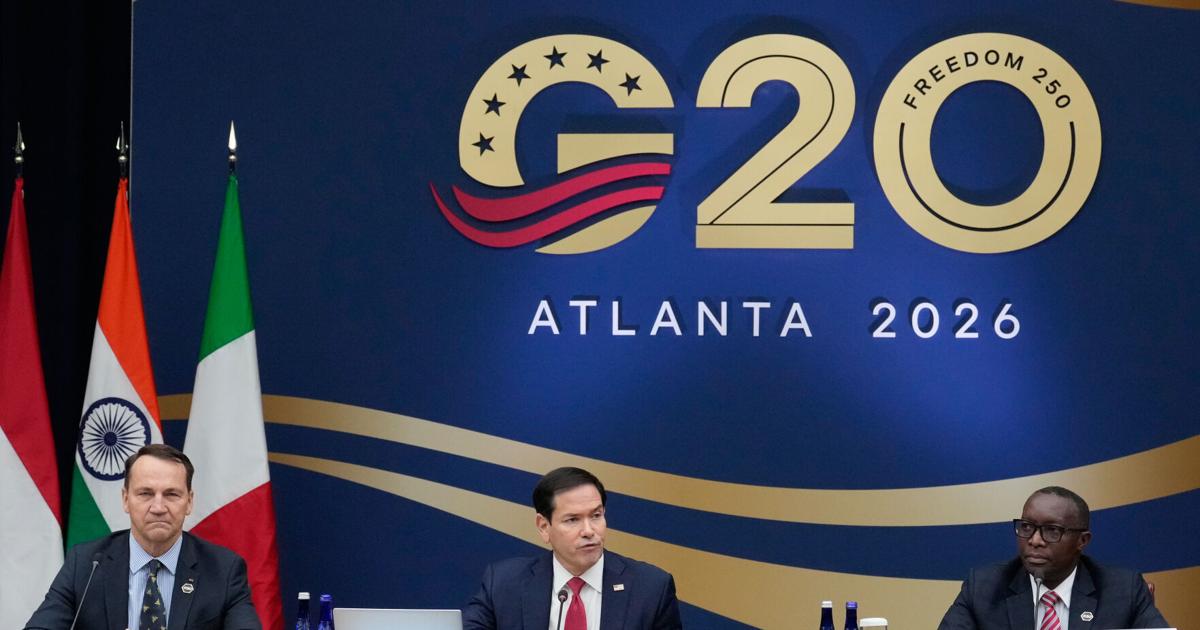
“We have wars going on and we have participants in those wars around the table, so it’s very difficult to agree a common line,” said Polish Deputy Prime Minister Radosław Sikorski.
Despite the current impasse, diplomats speaking on the condition of anonymity indicated a collective desire to salvage the upcoming G20 leaders’ summit, which is scheduled to be hosted by President Donald Trump in Florida next month. Whether the Russian president himself will attend that gathering remains unclear. For now, the focus in Atlanta remains on navigating the interconnected economic and geopolitical crises that Rubio described as a “critical moment” for the international community.
The current state of the G20 stands in stark contrast to previous years, when even during periods of high tension, the “family photo” remained a fixed point of diplomatic protocol. With Ukraine excluded from the invitation list this year—a deliberate U.S. decision to restrict attendance to formal members only—the group is testing the limits of how much geopolitical friction a multilateral forum can absorb before the mechanisms of consensus effectively stall.