Framework Ranks Virtual Cells by Capability
A review published November 17 in Expert Opinion on Drug Discovery proposes a six-capability framework that distinguishes three tiers of virtual cell models. Population-derived virtual cells generate synthetic cellular states and predict treatment responses from broad datasets. Digital twins link a computational model to a specific biological sample, enabling longitudinal updates and prospective predictions as new data arrive.
Agentic twins add spatial context, biologically constrained interactions, and environmental feedback loops, creating interactive representations of cellular ecosystems, according to authors Xixi Li, Nicolo Fabila, Xuan Liu, Christine R. Keenan, Robyn M. Brown, Phong B. H. Nguyen, and Michael P. Menden from the University of Melbourne and Helmholtz Munich.
The review, based on literature through October 2026, argues that the greatest value lies in using these models as foundation models that transfer biological knowledge across tasks, including data-limited settings. Their utility depends on faithful extrapolation beyond training data and prospective validation against biological observations.
Squidiff Predicts Drug Resistance and Space Radiation Effects
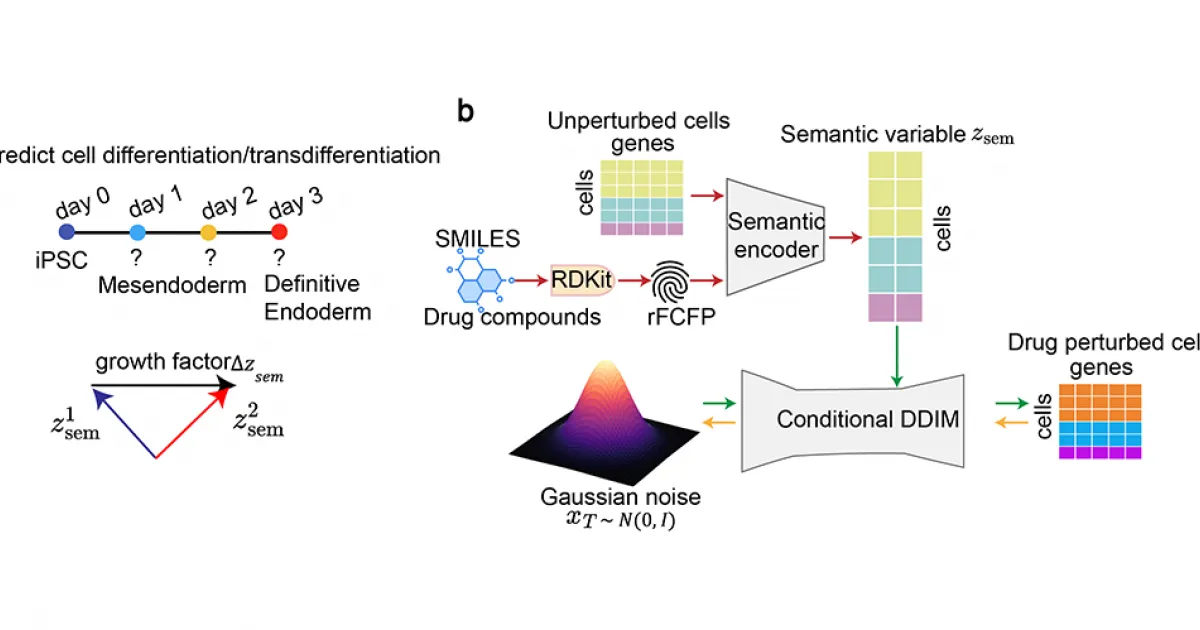
A concrete example appeared November 2 in Nature Methods. Researchers from Columbia University and Stanford University introduced Squidiff, a diffusion-based AI model that enables virtual experiments across thousands of potential drug treatments and genetic interventions in silico. The team demonstrated that Squidiff can predict how cancer cells adapt or develop resistance to treatment and forecast cellular responses to new compounds, according to co-author Daniel Naveed Tavakol.
“By bridging AI and molecular biology, Squidiff helps researchers understand the complex rules of cell behavior and accelerate the development of new therapies, especially for heterogeneous diseases like cancer,” said Daniel Naveed Tavakol, co-author of the study.
Tavakol said the next step is evolving Squidiff into a foundation model for virtual cells trained on large, diverse datasets from multiple tissues and species, which could eventually simulate organ development, disease progression, and drug development.
Competition and Funding Signal Momentum
The field’s rapid growth is visible in community benchmarks. More than 1,200 teams entered the first Virtual Cell Challenge; this year, over 1,600 teams participated, with winners announced November 18 by the Arc Institute. Funding has followed: the nonprofit BioHub committed nearly $2 billion last month for data and modeling infrastructure, with contributions from the U.S. government, Google, and Meta.
Reviews Flag Manufacturing and Regulatory Hurdles
Another review in Advanced Healthcare Materials highlighted remaining challenges in scalable manufacturing, long-term stability, and regulatory adaptation for artificial and biomimetic cell systems, including virtual cells. The integration of closed-loop learning, interpretable models, and advanced biomanufacturing will be essential to position these systems at the forefront of next-generation precision medicine, that review concluded.
Prospective Validation in Living Systems Is Still Missing
Whether virtual cells can reliably extrapolate beyond their training data and earn regulatory trust for clinical decisions remains unproven. The field’s next test is prospective validation — demonstrating that predictions made in silico hold up in living systems across diverse conditions. That milestone has not yet been achieved at scale.