Researchers at Washington University School of Medicine in St. Louis published a study in Nature on Wednesday mapping how inherited noncoding genetic variants alter gene regulation in human coronary arteries.
The study connects noncoding risk loci to distinct vascular cell types. Large genome-wide association studies had identified more than 350 inherited genetic changes associated with higher risk of coronary artery disease, but nearly all of these variants lie in noncoding regions of the genome.
Analysis of 44 Human Coronary Artery Specimens
Investigators analyzed 44 coronary artery tissue specimens recovered from patients undergoing heart transplantation. Ischemic damage stemming from severe coronary artery obstruction accounted for heart failure in about half of the tissue donors, and non-ischemic cardiomyopathies were the reason for transplantation in the remainder.
Nathan O. Stitziel, MD, PhD led the research effort as senior author. J. M. Amrute served as first author alongside an international consortium of clinical and basic science investigators.
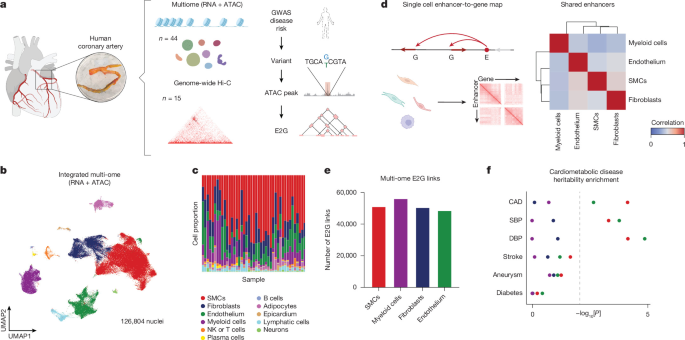
The group charted regulatory blueprints of four principal vascular cell groups across 126,804 nuclei. They used single-nucleus transcriptomic sequencing and chromatin accessibility profiling.
Smooth Muscle Cell Dysregulation in Coronary Arteries
The catalog connects more than 350 inherited genetic changes to physical enhancer elements and downstream protein-coding target genes. The researchers studied four major cell types present in coronary arteries.
Smooth muscle cells help vessels contract. Endothelial cells line the inside of vessels, fibroblasts help provide structure, and immune cells respond to infections and inflammatory injury.
Much of the heritable risk operates through smooth muscle cell dysregulation. noncoding variants prompted smooth muscle cells to downregulate essential contractile machinery and transition toward a dedifferentiated, stiffer, and pro-inflammatory phenotype.
We now have a map that connects noncoding genetic variants associated with coronary artery disease to the protein-coding genes and cell types they impact, paving the way for possible new therapeutics.
Nathan O. Stitziel, senior author and WashU Medicine cardiologist
Stitziel said that “because the gene mapping approach we employed could be applied to any complex disease, we think this study could be highly impactful for the field of human genetics broadly.”
Researchers Deploy Single-Nucleus Multi-Ome Sequencing with Genotyping
The team deployed a single-nucleus multi-ome sequencing technique paired with genotyping. They characterized the transcriptome and epigenome at single-cell resolution, and they linked extended areas of open chromatin to genes using a supervised single-cell model called single-cell enhancer-to-gene (scE2G). A score threshold of 0.171 was determined by evaluating predictions against CRISPRi-validated enhancer-to-gene pairs in K562 cells.
Researchers conducted Hi-C analysis in 15 human coronary arteries to investigate long-range genomic interactions. Human coronary artery smooth muscle cells were tested through cell-type-specific Hi-ChIP sequencing, Perturb-seq, and suppressing regulatory region activity via CRISPRi.
Validating Cell Specific Regulatory Variations
In-Hyuk Jung and colleagues detailed that half of the tissue donors had heart failure due to blocked coronary arteries while the other half experienced heart failure from alternative causes. Investigators identified 143,743 regions of open chromatin specific to different cell types.
The study received ethical approval from the Washington University School of Medicine Institutional Review Board under protocol number 201104172.
Framework Integrates Multi-Omic Datasets to Prioritize Disease Genes
Junedh Amrute, PhD and fellow researchers from Washington University in St. Louis said that the overarching approach integrates transcriptomic, epigenetic, and chromatin architecture datasets to resolve mechanistic questions in polygenic disease biology. This systematic methodology establishes an unbiased framework to prioritize pathological genes and cell types driving common heritable human conditions.

Research teams are preparing to take the single-cell variant-to-enhancer-to-gene approach beyond cardiology. They are setting their sights on other chronic conditions driven by widespread noncoding polygenic risk, including pulmonary diseases, metabolic conditions, chronic kidney disease, and type 2 diabetes.
The work provides a foundation for developing precisely targeted treatments and making genetic findings more informative for clinical care, though larger patient studies and continued investigation into individual genetic factors are necessary.
Nathan O. Stitziel, MD, PhD, a professor of Medicine and Genetics at Washington University School of Medicine, directs the Center for Cardiovascular Genetics and the Translational Cardiovascular Genetics program. His laboratory has long operated at the intersection of computational biology and human genetics, focusing on identifying novel genes and pathways underlying both Mendelian and complex cardiovascular disorders through genomics and bioinformatics.
Before leading this multi-omic analysis of coronary artery tissue, Stitziel completed a postdoctoral fellowship at the Broad Institute and Brigham and Women’s Hospital (2012), where he trained in cardiovascular genetics.
The study was supported by the National Institutes of Health under grant numbers UM1HG008853, R01HG013371, R01HL159171, R01HL171045, R01HL134817, R01HL139478, R01HL156846, R01HL151535, R01HL158525, UM1HG011972, U01HG011762, R01HL159176, R01HL164811, and F30HL179947.