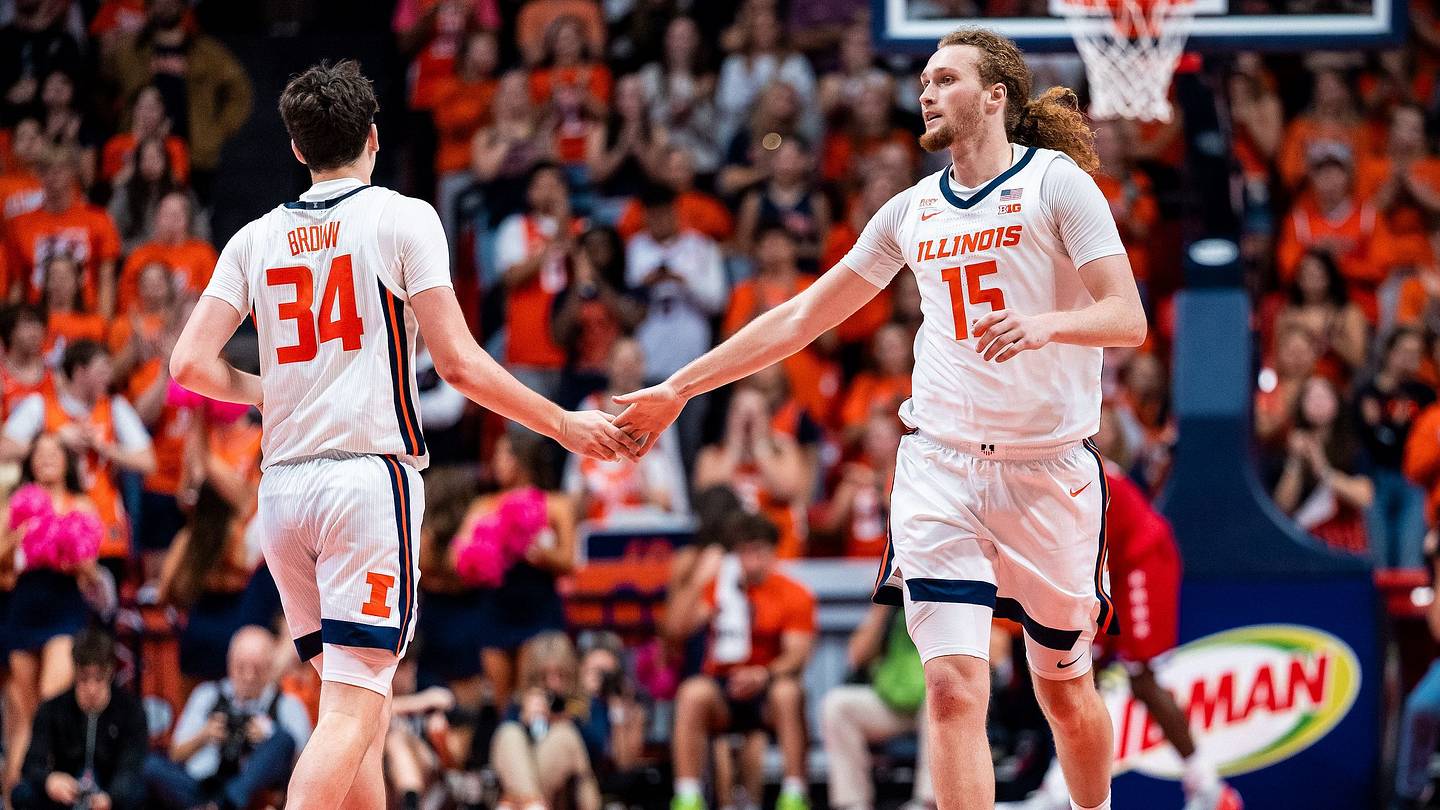
Illinois basketball is entering the 2026-27 season by intentionally discarding one of the most efficient offenses in the history of the college game. Head coach Brad Underwood has shifted the Illini to a free-flowing system that replaces set plays with conceptual, off-ball movement.
This shift represents a fundamental reimagining of how the team operates on the court. Rather than relying on the rigid structures and ball screens that defined their previous success, the Illini are now betting on the raw basketball IQ and skill of their personnel to manufacture points in real-time.
The Underwood family redesigns the court
The catalyst for this overhaul was Tyler Underwood, the coach’s son and the team’s offensive coordinator. According to Brad Underwood, the transition wasn’t an immediate “yes.” He admitted to a ten-day period of deep skepticism, largely because the team had seen significant success the previous year. However, the departure of Keaton Wagler necessitated a change in personnel strategy, opening the door for Tyler’s vision.
The new approach borrows heavily from the spread concepts Brad Underwood utilized earlier in his career. The most jarring change for opposing scouts will be the rarity of ball screens. Instead, the offense is predicated on heavy off-ball movement and a commitment to collapsing the defense by attacking the paint, while keeping players positioned at the top of the key and in the corners.
We truly don’t run plays. So that part’s pretty easy. We meet every single day and we’re talking about concepts, and adding this or adding that.
Underwood notes that this shift has fundamentally changed his role on the sideline. By delegating the offensive and defensive coordination to specific assistants—much like a football coaching staff—he has stepped back from the granular task of calling every play. He believes this distance actually increases his authority; when he does step in, his voice carries more weight because the players aren’t exhausted by hearing him constantly.

The risk of a play-less system
The essence of this strategy lies in the tension between unpredictability and stability. For the players, it is a vote of confidence in their autonomy. For the opponents, it is a nightmare to scout. When a team doesn’t run set plays, there is no “pattern” to break, no specific trigger to anticipate, and no predictable sequence to shut down.
However, the lack of structure creates a potential vulnerability during the inevitable stagnant stretches of a halfcourt game. In previous seasons, Illinois occasionally struggled with stagnation, sometimes dumping the ball into the short corner on baseline-out-of-bounds plays—a predictability that teams like Dan Hurley’s UConn exploited to secure victories. Without a “back pocket” play to manufacture an easy bucket and regain momentum, a conceptual offense can occasionally spin its wheels.
Whether the Illini still maintain a small handful of set plays for sideline or baseline out-of-bounds situations remains an open question, but the overarching philosophy is clear: trust the talent over the script.
A history of offensive volatility
While the move seems radical, Brad Underwood has a documented history of offensive brilliance and adaptability. His 2016-17 Oklahoma State team, for instance, boasted the No. 1 offense in the country according to KenPom rankings. This track record suggests that the current experiment isn’t a blind leap, but rather a calculated evolution.

The stakes are high; this is either a revolutionary leap forward or an unnecessary dismantling of a winning formula.
Ultimately, the success of the 2026-27 season will hinge on whether the players’ skill ceiling is high enough to replace the safety net of a playbook. As Underwood puts it, the goal is simply to let the players play basketball.