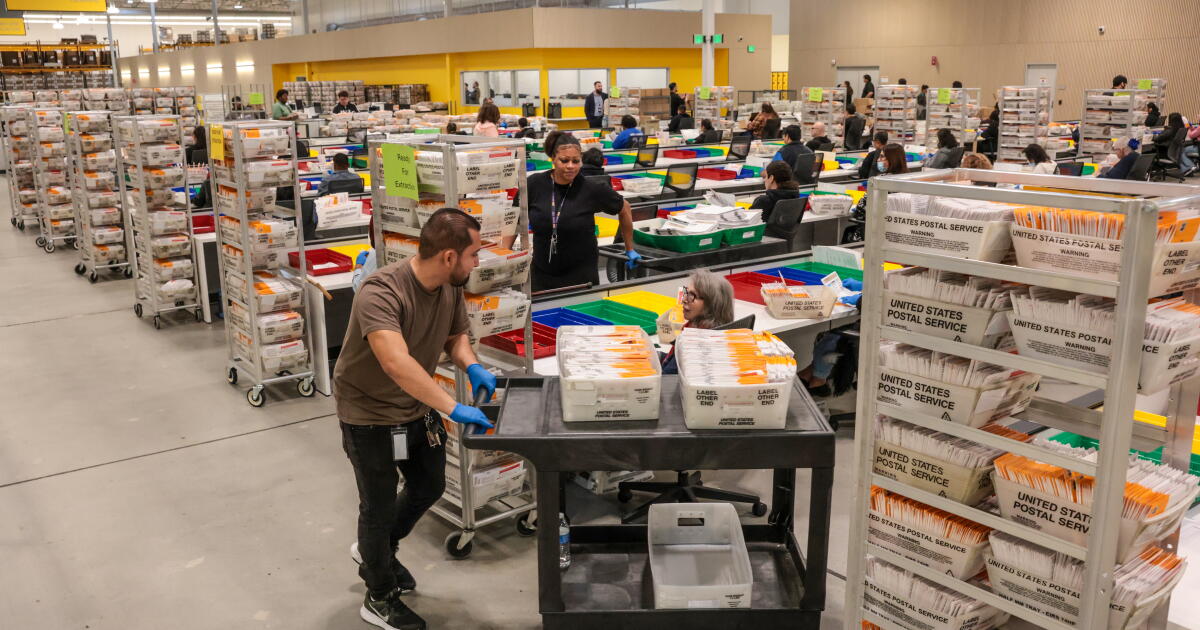
On Friday, the U.S. Justice Department took steps to drop its lawsuit targeting the counting of 20,000 ballots in California on its own accord, maintaining that the requested remedy is currently unattainable because Tuesday’s midterm voting has concluded.
This legal submission concludes a judicial dispute that unfolded right before the election, when federal authorities asked courts for authorization to compel state and local election workers to segregate specific votes while ongoing voting was taking place. Federal authorities had asked the courts to step in and force state and Los Angeles County election officials to set aside the ballots, asserting they might belong to noncitizen voters. But that push hit a brick wall in the lower courts and ultimately failed at the Supreme Court, where justices denied the administration’s appeal without noting any dissents.
U.S. District Judge David O. Carter had previously rejected the government’s request for immediate intervention in an October 28 ruling, warning that the proposed action could disenfranchise eligible voters and sow chaos. Even so, Carter had scheduled an evidentiary hearing for November 13, appointing a special master to dig into the data behind the disputed 20,000 names. That fact-finding mission is now off the table.
Why the Justice Department Dropped the Case Now
Assistant U.S. Atty. Julie Hamill wrote in Friday’s court filing that the planned judicial inquiry was no longer necessary because it could not deliver the outcome the government originally wanted. By the time the scheduled November 13 hearing arrives, California will have already commingled the challenged ballots with lawful ones.
“There is then no way to get the challenged ballots segregated. As a result, the relief the United States sought and needed is no longer available — rendering voluntary dismissal necessary,” Hamill wrote to Judge Carter.
While walking away from the ballot segregation demand, Justice Department officials made it clear they are not backing down in their targeting of alleged noncitizen voters. Department spokesperson Kiersten Pels noted that while this specific litigation is now moot, the administration continues to pursue a separate case demanding that California conduct list maintenance to remove noncitizens from its rolls.
Local Election Officials React to the Dismissal
California election officials welcomed the end of the federal challenge, emphasizing that local processes operated securely through the midterm vote count.
“At each stage of this election, and in response to the Department of Justice, we have been clear that state and federal law sets well-defined standards for verifying and challenging voter eligibility,” said L.A. County Registrar-Recorder/County Clerk Dean Logan. “Our commitment and focus remain on the fair, secure, accurate, and legal processes we are engaged in to complete and certify the election.”
Logan added that he was pleased the administration accepted the clarity of the court findings against it. California Atty. Gen Rob Bonta took an even sharper view, stating in a released statement that after losing in every court it tried, the administration gave up its latest unlawful effort to interfere with state elections.
Meanwhile, Tricia Webber, president of the California Assn. of Clerks and Election Officials, noted that while administrators are very pleased with the voluntary dismissal, they remain prepared for future battles over state voting procedures.
Federal Prosecutors Continue Utilizing Flagged Data for Criminal Voter Prosecutions
The reliability of the government’s flagged voter list formed the core of the courtroom battle. Logan’s office reviewed a sample of roughly 200 flagged individuals and found that a substantial portion appeared to have been born in the United States—a finding disputed by Homeland Security officials.
While the voluntary dismissal halts Judge Carter’s upcoming evidentiary hearings, the underlying data lists have not vanished entirely. Federal prosecutors in California continue to utilize portions of that same data to target individual voters for criminal prosecution, keeping questions about the methodology alive even as the election litigation comes to a close.