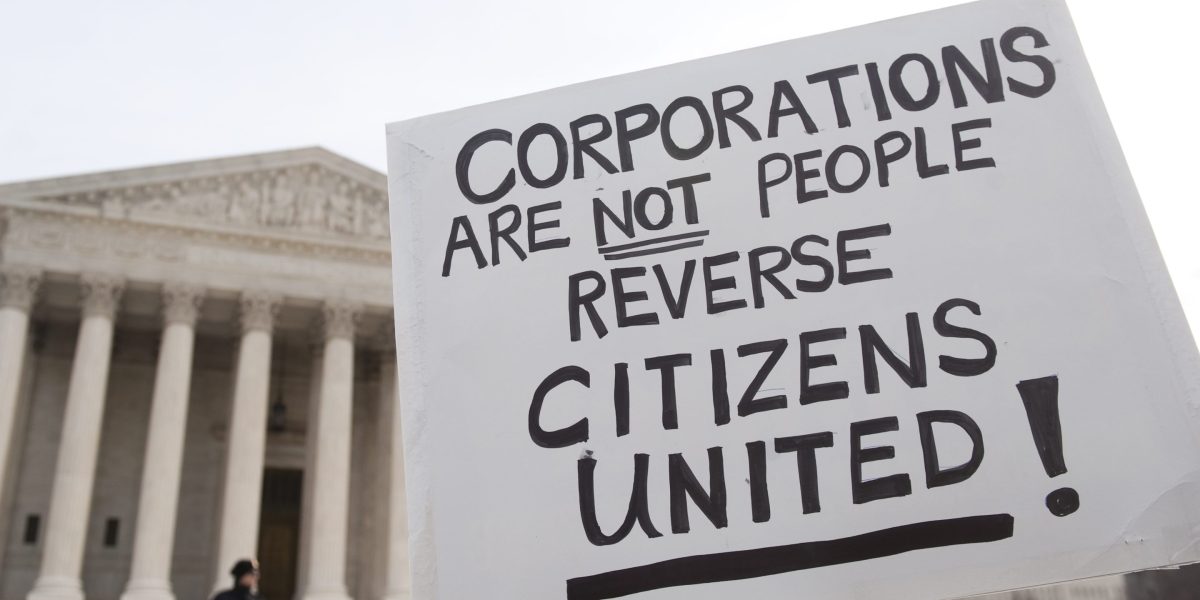
Montana Voters Decide on Initiative 194 to Restrict Corporate Political Spending
Sixteen years after the Supreme Court established in the Citizens United case that corporations have a First Amendment right to spend money to influence elections, Montana voters head to the polls on Tuesday to decide a direct challenge to that ruling. Initiative 194, known as the Montana Plan, would strip corporations, trade associations, nonprofits, and other organizations of the legal power to spend money supporting or opposing a political candidate or ballot initiative in Montana.
The ballot measure approaches the issue through corporate law rather than a direct campaign finance ban. By redefining what Montana allows for entities it designates as “artificial persons,” I-194 restricts their powers strictly to those deemed “necessary and convenient.” Organizations that do business or hold property in the state would lose political spending privileges, though individuals, political action committees (PACs), and news or editorial content are exempt. Violators would forfeit state-granted privileges, including limited liability protections.
Tom Moore, a senior fellow at the Center for American Progress and former chief of staff to FEC Commissioner Ellen Weintraub who devised the legal theory behind the plan, told Fortune that states hold foundational authority over corporate powers. “When the state creates a corporation, it is starting from nothing and deciding what to give the corporation, and no case has ever held that they have to give local spending power to a corporation,” Moore said. He argued that the measure shifts the framework from regulation to redefinition, aiming to eliminate dark money by cutting off nonprofit and trade association donations.
This is not going to stop Elon Musk from writing a big fat check to some election in Montana. What it will stop them from doing is laundering the money through a dark money group. — Tom Moore, Center for American Progress
Opponents contend that the distinction between corporate powers and constitutional rights remains legally fragile. Bradley Smith, a professor at Capital University Law School, told Fortune that states cannot circumvent the First Amendment by labeling political spending a corporate power.
The Supreme Court isn’t engaged in a semantic game. States can set rules for corporations, but they can’t make them surrender constitutional protections in exchange for the benefits of incorporation. — Bradley Smith, Capital University Law School
Montana carries a century-old history of confronting corporate political influence. In 1912, voters passed the Corrupt Practices Act with 76% of the vote amid public anger over mining giant Amalgamated Copper and bribery by state mining magnates known as the Copper Kings. That historical restriction barred corporate election spending until the Supreme Court struck it down in American Tradition Partnership v. Bullock in 2012, citing conflict with Citizens United.
Montana shares this legislative approach with Hawaii, which enacted a similar law, Act 11, in May. Act 11 currently faces two federal lawsuits filed by the U.S. Chamber of Commerce and the Grassroot Institute of Hawaii, represented by the Institute for Free Speech, which Smith founded. Legal observers anticipate that the disputes surrounding I-194 or the Hawaii litigation will ultimately reach the Supreme Court.
If Montana voters approve Initiative 194 on Tuesday, the measure is scheduled to take effect on January 1, 2027, barring any intervening court orders.



