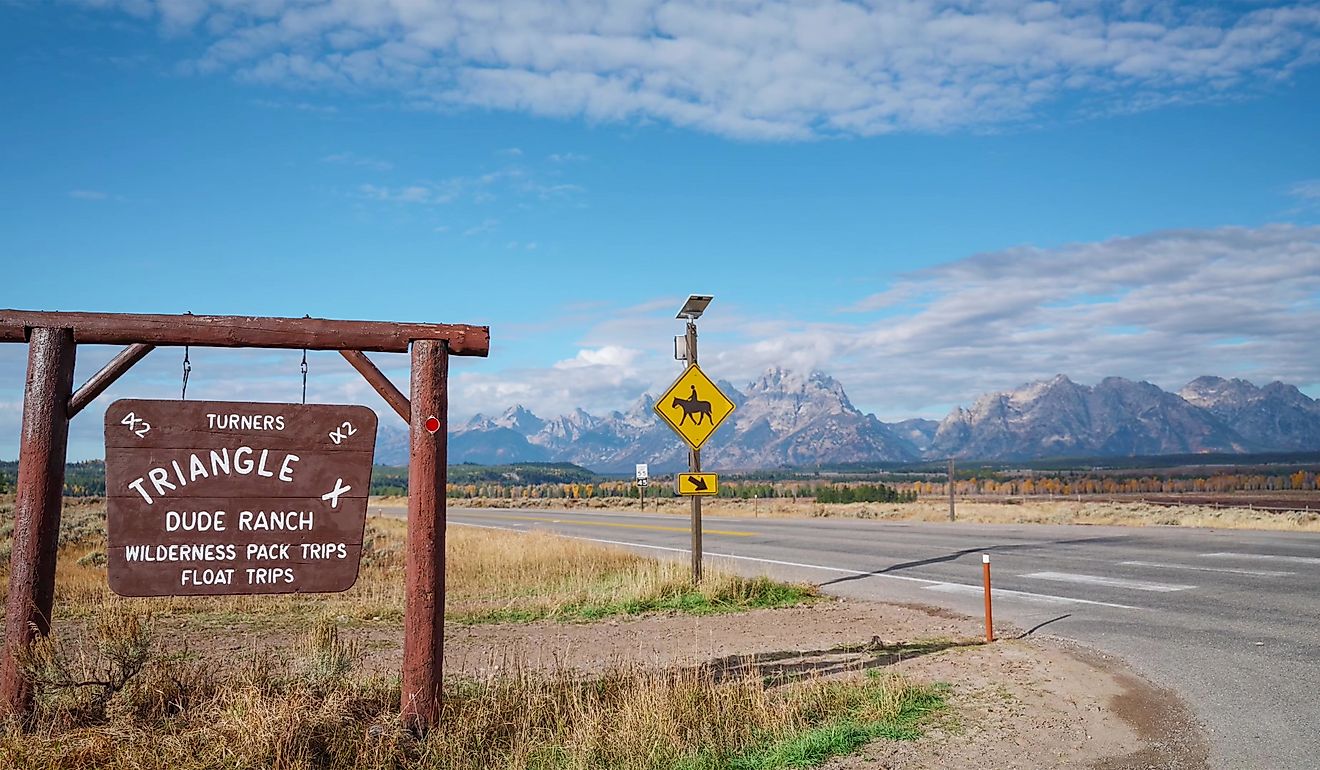
Most visitors to America’s national parks expect a landscape defined entirely by federal stewardship, where the imprint of human industry stops at the gate. Yet, in select corners of the West, the boundaries of our most protected wilderness areas overlap with the daily operations of working ranches. In select corners of the West, this coexistence is a deliberate preservation of the American West’s agricultural heritage.
At Wyoming’s Triangle X Ranch, the distinction between a federal park and a private enterprise becomes particularly thin. Grand Teton National Park has a working dude ranch directly on the property. Its history predates the park’s formal expansion; John S. Turner purchased the homestead in 1926, and by the time Congress extended much of the Jackson Hole valley as part of Grand Teton National Park in 1950, the ranch was already established. Rather than forcing a closure, the federal government established a concession arrangement, allowing the Turner family to continue providing horseback riding and guided fishing while adhering to park rules.
The Evolution of Private Land in Public Spaces
The relationship between these ranches and the National Park Service (NPS) varies significantly depending on the site’s history and the legal framework governing the land. In Colorado, the MacGregor Ranch offers a different model. Founded in 1873, well before Rocky Mountain National Park was formed in 1915, the ranch remains privately owned and protected by the Muriel MacGregor Charitable Trust. Following the death of Muriel MacGregor in 1970, the property was transitioned into a charitable trust. In 1983, the NPS secured a conservation easement on roughly 1,221 acres of the ranch while the land continued to remain privately owned.

This arrangement serves a dual purpose: it maintains a working cattle business while providing an educational platform for the public. The ranch functions as a living laboratory, teaching younger generations about the realities of pioneer life, livestock management, and the agricultural challenges posed by the local weather and landscape. For visitors, it provides a rare glimpse into the logistical demands of a working ranch that exists within a protected ecosystem.
Conservation Through Strategic Grazing
Perhaps the most complex integration of commerce and conservation occurs at the Medano-Zapata Ranch, which overlaps with the Great Sand Dunes National Park and Preserve. The history of this land is deeply rooted in the 1860s, long before the area was designated a national monument by President Herbert Hoover in 1932 or became a national park and preserve in 2004. Today, the land is managed through a partnership involving The Nature Conservancy and the ranch management firm Ranchlands.
The ranch employs a system of sustainable grazing that utilizes bison herds to maintain native grasslands and wetlands. By integrating commercial Angus cattle production with strategic conservation grazing, the operation demonstrates that agricultural productivity can coexist with federal wilderness protections. Approximately 9,362 acres of the original land were transferred to the NPS, helping protect the wildlife, wetlands, and geological dune systems.
The Economic and Civic Stakes
So, why does this matter for the average visitor or taxpayer? The presence of these ranches challenges the binary view that land must be either strictly “wild” or strictly “industrial.” By allowing these operations to persist, the NPS preserves a cultural legacy that shaped the identity of the American West. However, this model also requires a constant balancing act between commercial hospitality, such as the guest programs at Triangle X, and the stringent environmental mandates required by the National Park Service.
The Nature Conservancy, which holds significant interests in the Medano-Zapata site, emphasizes that these partnerships are essential for managing large-scale landscapes that require active, rather than passive, stewardship.
Ultimately, these three ranches act as historical anchors. They remind us that the American West was not just a wilderness to be discovered, but a landscape to be worked, lived in, and eventually, protected. As we look toward the future of federal land management, the success of these ranches suggests that the most effective conservation strategy might be one that honors the people who were there long before the parks were drawn on a map.