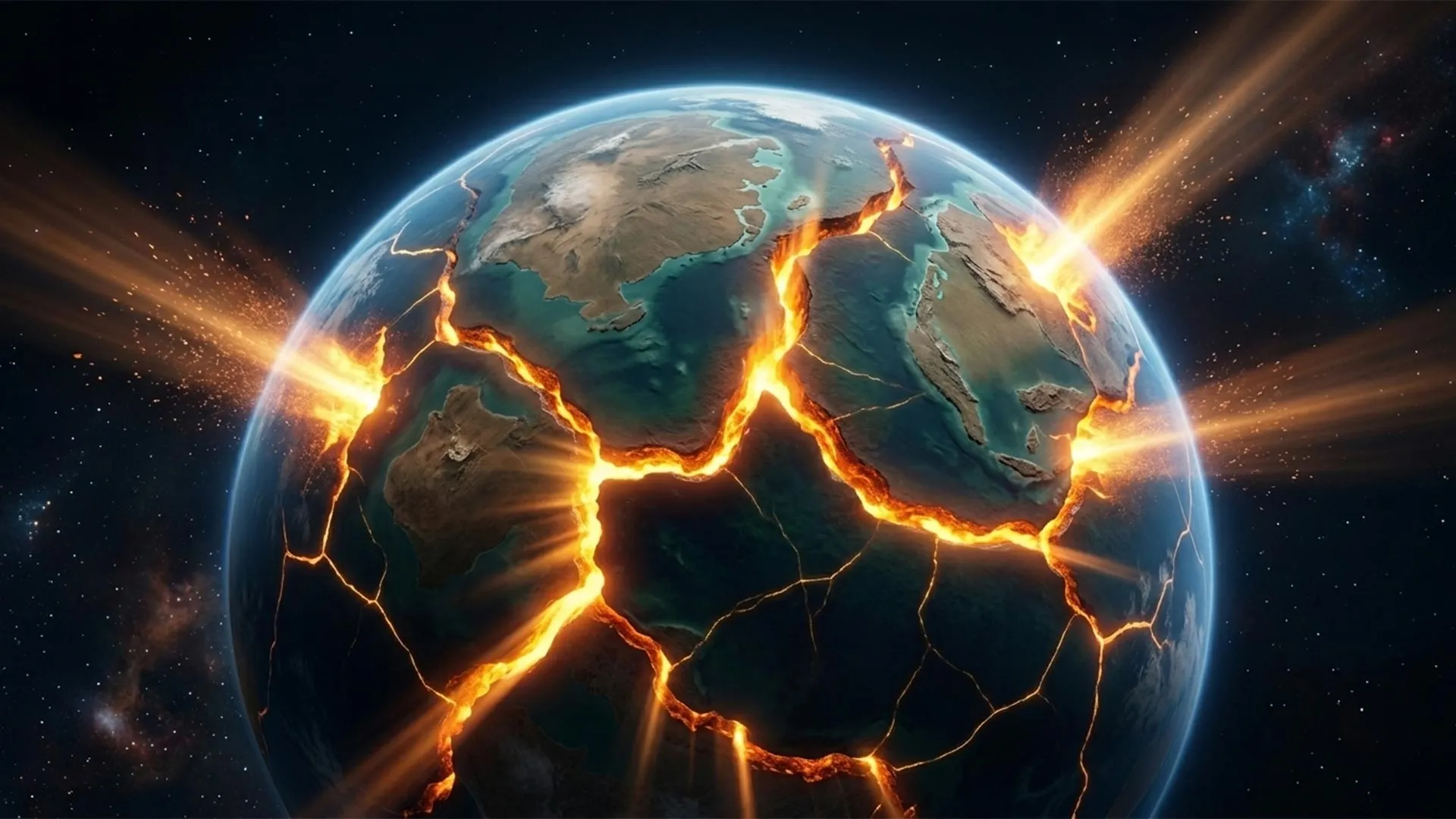
Chemical fingerprints preserved inside ancient rocks suggest that Earth’s tectonic engine switched on 2.5 billion years ago, marking a profound shift in how the planet forms and recycles its crust.
The movement of tectonic plates builds mountain ranges, triggers earthquakes, and shapes continents and ocean basins over deep time while helping regulate climate and magnetic fields. Yet pinning down when this dynamic system began has proven exceptionally difficult because plate tectonics continually destroys its own geological evidence by dragging old crust deep into the mantle during collisions.
- Researchers analyzed more than 1,200 rocks from ancient landmasses across Australia, Africa, North America, and Europe.
- The samples span nearly four billion years of Earth’s history, preserving chemical traces inside minerals like feldspar and sulfide.
- The findings were published in Proceedings of the Royal Society A under the title “Loss of ancient crustal reservoirs marks a shift in Earth’s geodynamic regime”.
Chemical Fingerprints in Ancient Continental Rocks
New continental crust does not always form fresh from crystallizing mantle magma. Often, it is created by melting older rock already sitting inside existing crust, which leaves a lasting chemical trace comparable to the DNA a child inherits from parents according to field researchers.
A team at Curtin University searched for this distinct chemical signature across thousands of rock samples spanning almost four billion years. They found the fingerprint consistently in rocks older than 2.5 billion years, indicating those samples derived from a pool of ancient crust formed about four billion years ago in the aftermath of Earth’s formation.
New crust often forms by melting older rock, leaving behind a distinctive chemical fingerprint. We searched for this fingerprint in thousands of rocks from around the world, spanning almost four billion years of Earth’s history. We found it consistently in rocks older than 2.5 billion years, showing they were derived from a pool of ancient crust that formed about four billion years ago. But after 2.5 billion years ago, that fingerprint disappears from the geological record – and despite examining thousands of rocks, we never see it again.
Dr. Janne Liebmann, Research Fellow in Curtin’s Timescales of Mineral Systems Group
The Abrupt Disappearance at 2.5 Billion Years Ago
The turning point arrived when that ancient chemical signature vanished from the geological record abruptly after 2.5 billion years ago. Despite examining thousands of younger rocks, researchers never found the distinctive signature of those ancient crustal reservoirs again during field studies.
Before this transition, ancient continental material was melted and remelted repeatedly in place for well over a billion years to produce early granite-like rocks without much input from other sources. After 2.5 billion years ago, the planet began producing crust from a mix of old and new sources, resembling the volcanic activity and crustal recycling seen at modern tectonic plate boundaries today.
Broader Geodynamic Shifts and Planetary Habitability
The vanishing signal aligns with other major changes across the globe, including shifts in rock chemistry, alterations in crust thickness and composition, and the assembly of Earth’s first supercontinent during the same era. These combined developments shaped the life-friendly surface environment that allowed complex organisms to flourish while distinguishing Earth from tectonically inactive neighbors like Venus and Mars.
Plate tectonics is fundamental to the way Earth has evolved over billions of years, continually reshaping the continents and oceans and influencing the planet’s atmosphere and climate. What makes this finding remarkable is that we can see the fingerprints of an ancient Earth disappear from the geological record at a very specific point in time. It marks the transition from an early Earth where ancient crust could be repeatedly melted and reworked in place, to a system capable of moving and recycling crust on a much larger scale. This gives us our clearest geological evidence yet for when the tectonic engine that drives the modern Earth ‘switched on’.
Professor Chris Kirkland, Curtin’s School of Earth and Planetary Sciences
This suggests that this pivotal shift in planetary processes fundamentally altered how the crust and atmosphere interact over geological time.