Four ancient human teeth recovered from limestone caves in southern China reveal that the extinct Denisovans shared the region with a previously unknown human lineage.
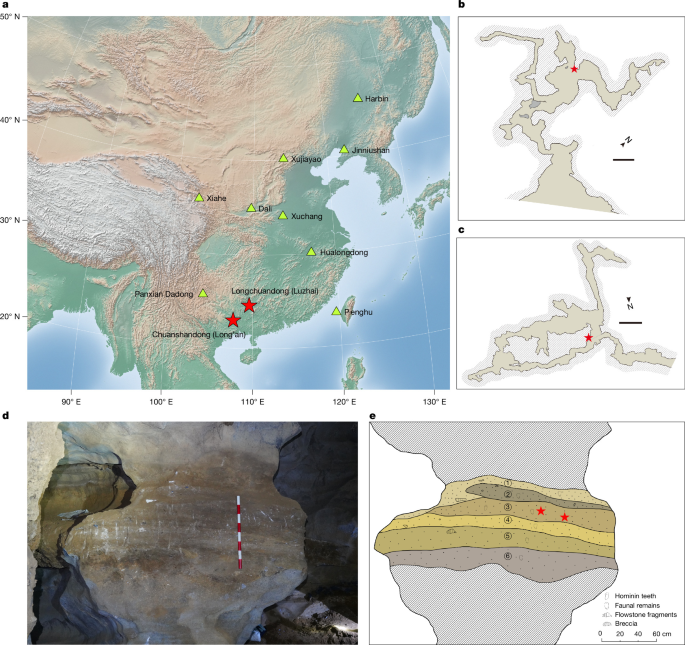
Researchers identified hominin fossils from two sites in the Guangxi Zhuang Autonomous Region: Chuanshan Cave in Long’an County and Longchuan Cave in Luzhai County. The team recovered four human teeth from these caves in 2021.
The team dated the sites using high-resolution U-series in situ analysis and a laser ablation system with MC-ICP-MS. Longchuan Cave specimens range from 43,000 to 105,000 years old. Chuanshan Cave samples are at least 101,000 years old.
Researchers measured the teeth using a sliding calliper to a precision of 0.1 mm. They performed principal component analysis on the resulting shape variables.
The team compared the Chuanshandong and Longchuandong hominins with East Asian late Middle Pleistocene archaic Homo or Denisovans. They also compared them to East Asian and Southeast Asian H. erectus, Homo heidelbergensis, and early and late Neanderthals.
Scientists conducted two LC–MS/MS runs for each tooth fraction for proteomic analysis. They analyzed eluted peptides on an Orbitrap Exploris 480 interfaced with an Easy n-LC 1200 HPLC system at the Central Laboratory of Capital Medical University in Beijing.
Peptide separation used a 125-minute linear gradient (0–1 min, 1–9% B; 1–101 min, 9–28% B; 101–113 min, 28–42% B; 113–117 min, 42–99% B; 117–125 min, 99% B) with a flow rate of 350 nl min−1. Mass spectrometry scans used a 350 to 1,500 m/z interval, 60,000 resolution, a 300% AGC target, and a 50 ms maximum injection time.
A 5,000-year-old Neolithic tooth from the Xiawanggang Site in Henan Province served as a positive control. A blank extraction served as a negative control. The researchers detected non-missing sites in the samples: 16.67% in Longchuandong M2, 14.51% in Longchuandong P4, and 14.68% in Chuanshandong P3.
Teeth from Longchuan Cave matched the heritable traits of previously identified Denisovan teeth. This confirms the extinct hominin group lived far south in the warm, humid transition zone of modern-day Guangdong and Guangxi.
Abundant rainfall and plant resources there supported early populations. This research disputes the assumption that most archaic humans in East Asia during the Middle Pleistocene—roughly 770,000 to 130,000 years ago—belonged to one single Denisovan lineage.
Denisovans have been viewed as a widely distributed group of archaic humans since their 2010 identification. Scarce fossils previously hindered efforts to map their exact range.
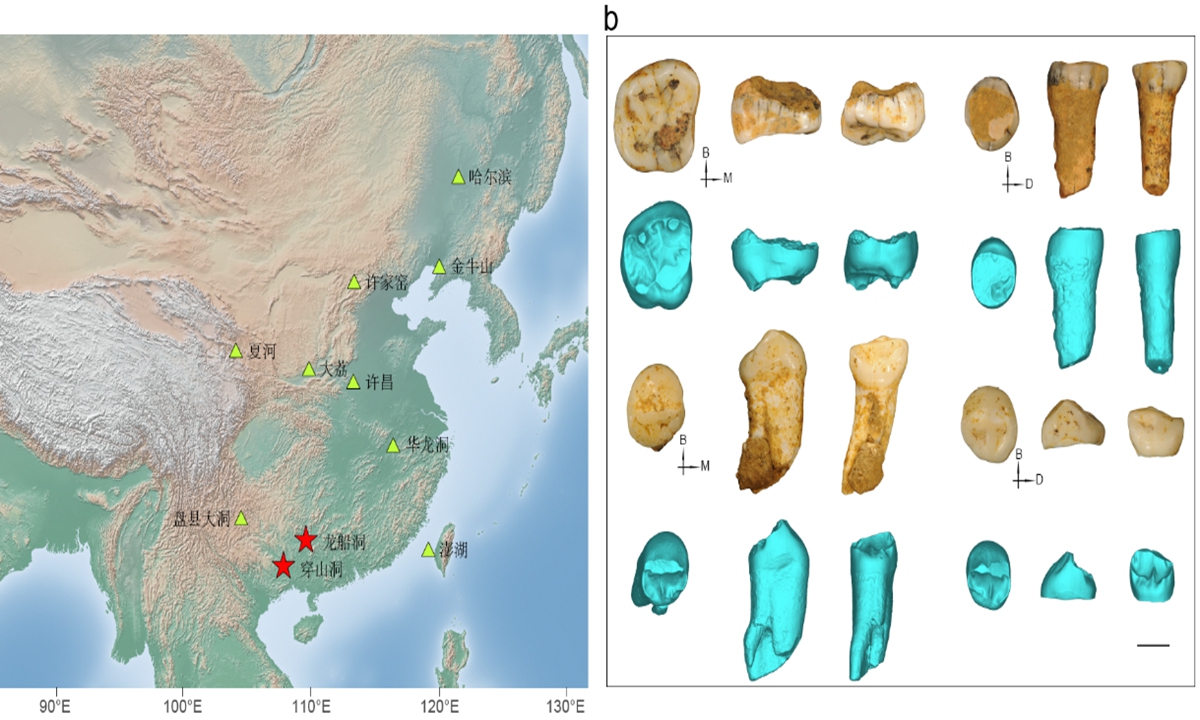
Longchuan remains fell into the Denisovan group, but the bicuspids from Chuanshandong stood apart. The Chuanshandong proteome included an ancestral genetic variant linking the specimens to H. erectus. Their physical structure shows a combination of features; they are more advanced than Homo erectus but more primitive than modern humans.
The Guangxi Zhuang Autonomous Region, situated in the mountainous terrain of far southern China, has served as a significant frontier throughout history. This geographical context, characterized by its historical role as an expansive, often untamed territory since the creation of the Guang Prefecture in 226 AD, provided a distinct environment for early populations.
The region’s landscape and its position as a cultural crossroads for various tribal groups, including the Baiyue, underscore the complexity of the area where these archaic humans once resided.
At least two non-sapiens Homo populations may have existed in southern China’s subtropics during the Middle and Late Pleistocene.
Research team, published in Nature
Qiaomei Fu said that the team has already identified new findings from the region. She said they are conducting further analyses. We are looking at more sites to clarify the diversity of these archaic humans, Qiaomei Fu said.