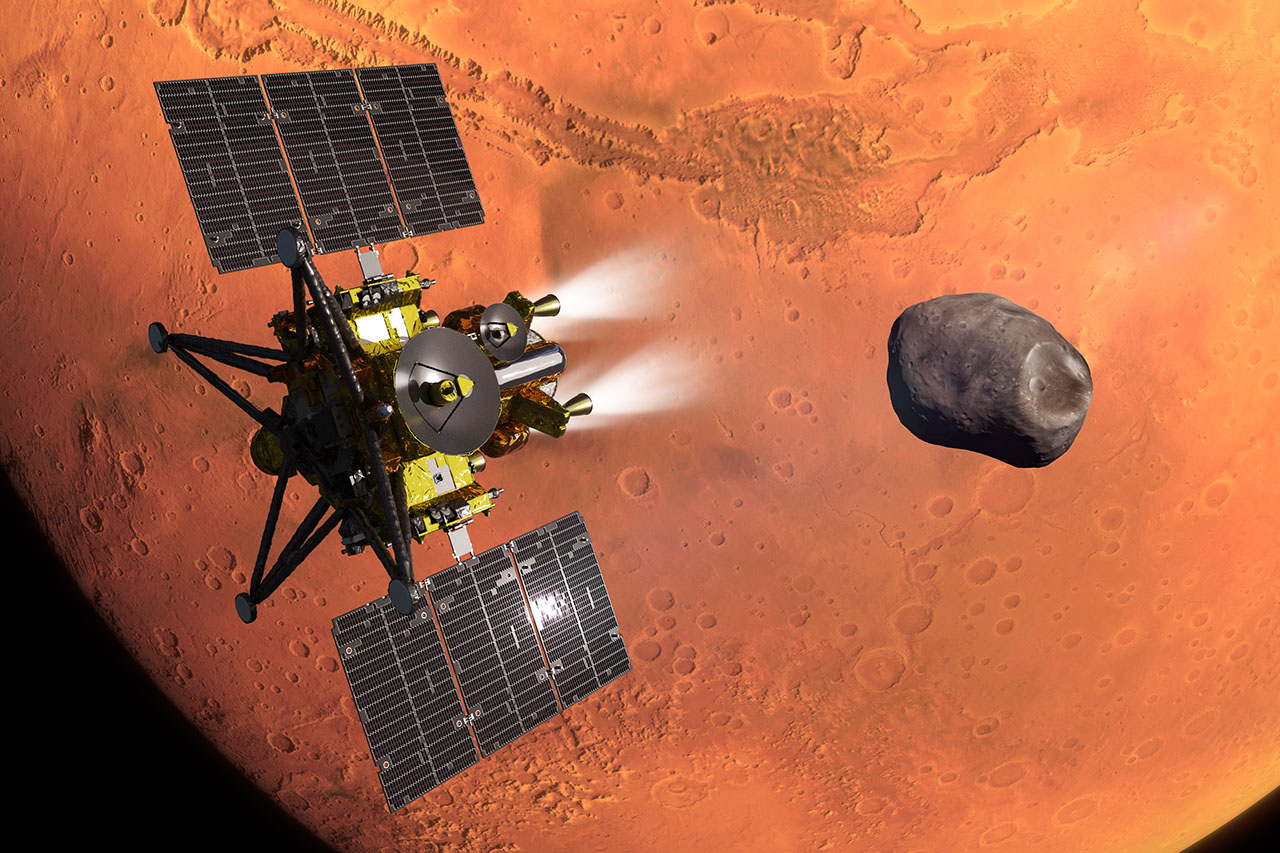
Japan is launching the unmanned Martian Moons eXploration (MMX) mission on an H3 rocket from the Tanegashima Space Center to land on Phobos, collect soil samples, and complete the world’s first round trip to the Martian system.
The spacecraft is scheduled to lift off at 4:41 a.m. Tuesday Japan time, corresponding to 7:41 p.m. Monday UTC, from Kagoshima prefecture in southwestern Japan. The unmanned probe marks a major milestone as the world’s first attempt to retrieve material directly from a moon orbiting the Red Planet and bring it back to Earth. Developed by the Japan Aerospace Exploration Agency (JAXA), the MMX mission carries a total development cost of 55.3 billion yen, which translates to roughly $350 million. The spacecraft weighs about 5 tons and is made up of three modules, for propulsion, exploration and return.
The Long Journey to Phobos and the Search for Solar System Origins
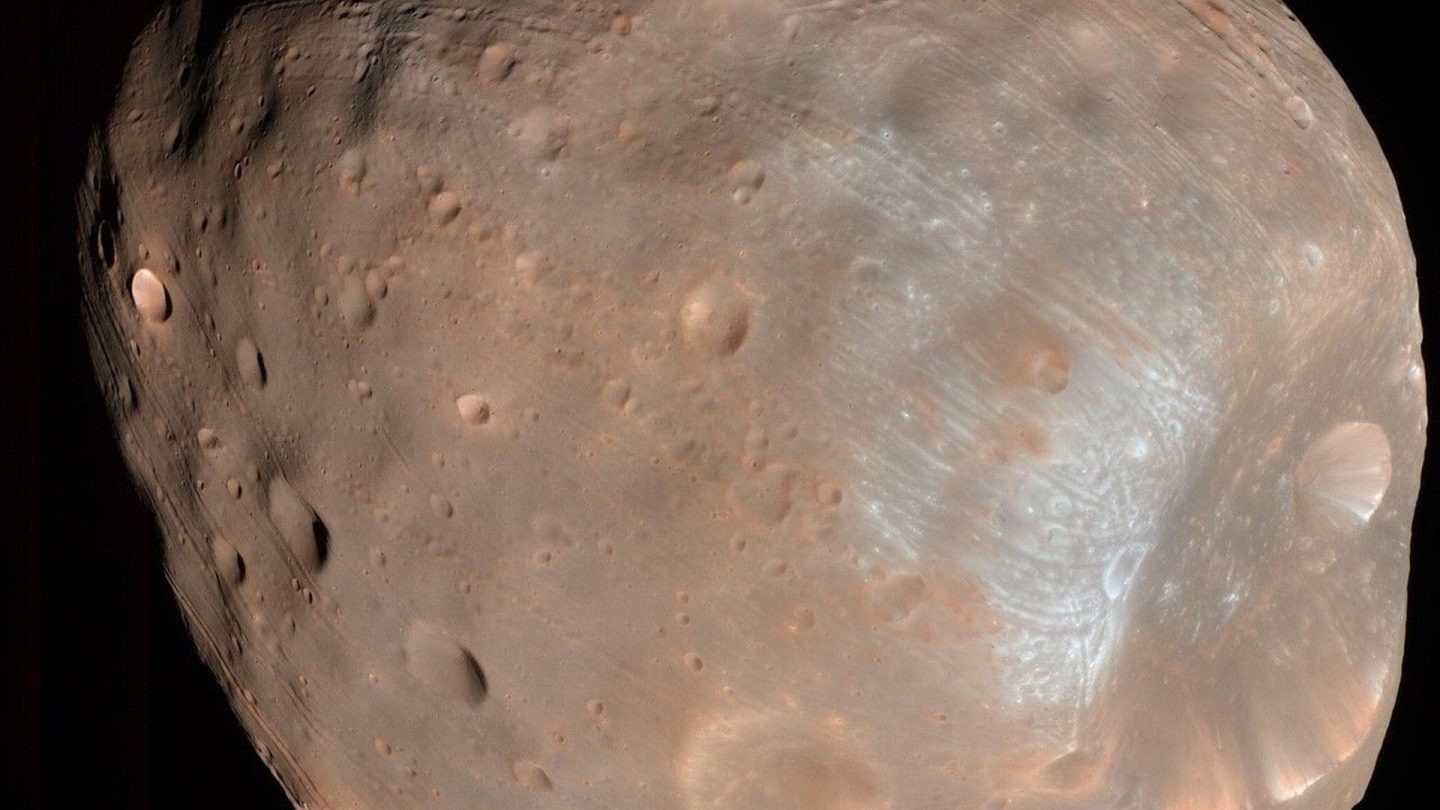
After leaving the Tanegashima Space Center in Japan, the spacecraft will arrive at the Mars region a year later to begin its survey of the Red Planet’s two moons. Spanning roughly 20 to 30 kilometers (10 to 20 miles) across, Phobos travels around Mars at a distance near 6,000 kilometers (3,700 miles) with a frequency of three daily orbits. It will then spend three years surveying both Phobos and Deimos before attempting to gather samples. Scientists chose Phobos because its closer proximity to Mars may yield crucial data about the planet itself alongside clues to how the solar system formed. Processes responsible for transporting water, volatile elements, and organic molecules from the outer solar system into the inner rocky worlds—which may have been instrumental in fostering planetary habitability—will be clarified by MMX. The Martian moons Phobos and Deimos derive their designations from the Greek mythological figures representing panic and dread, who were offspring of Ares, the god of war whose Roman counterpart is Mars. Multiple Russian attempts to land on Phobos, including one launched in 2011, have failed.
Despite their potential importance, Martian moons have never been fully investigated,
said, describing the bodies as unclimbed mountains. “We can almost certainly come to a conclusion by analyzing (Phobos) soil samples,” MMX principal investigator Kiyoshi Kuramoto remarked, pointing out that Phobos specimens could also help clarify Deimos’s beginnings given that both satellites are thought to share common origins.
Phobos and Deimos may be the remains of a massive impact on Mars that sent material into orbit around the planet, or they could be ancient asteroids that were captured by Mars’ gravity billions of years ago.
Tom Statler, MMX program executive and program scientist at NASA Headquarters
International Partnership and Dual-Sampling Technology on a Low-Gravity Moon
The mission brings together space agencies from the United States, France, Germany, and Europe. Operating deep within the gravitational potential well, MMX is a joint effort involving France’s National Center for Space Studies (CNES), the German Aerospace Center (DLR), NASA, the European Space Agency (ESA), alongside roughly 20 academic institutions and technology companies. NASA is contributing the MEGANE spectrograph, a pneumatic sampling device, Deep Space Network communications support, and funding for U.S. scientists on the MMX science team. The European Space Agency provides deep space communication gear, while France and Germany jointly developed the Idefix rover.

Landing on Phobos presents severe engineering hurdles due to an extremely weak gravitational pull that measures just one two-thousandth of Earth’s. The exploration module relies on specialized four-legged landing gear designed with shock absorption features. Before the main spacecraft touches down, the Idefix rover will spend 100 days exploring the surface to help JAXA select a smooth landing site for the soil collection. Featuring wheels engineered to maintain grip in minimal gravity, the rover can autonomously recover from a tip-over and creeps forward at an extremely slow pace.
| Space Agency | Contribution |
|---|---|
| JAXA | Spacecraft development, H3 launch vehicle, C-Sampler coring tool |
| NASA | MEGANE spectrograph, P-Sampler pneumatic device, Deep Space Network support |
| CNES & DLR | Idefix surface exploration rover |
| ESA | Deep space communication device |
Collecting Samples and Returning to Earth
JAXA aims to retrieve at least 10 grams of material from the moon through two distinct sampling efforts utilizing both American and Japanese mechanisms. Material from Mars is expected to make up about 0.1% of the material collected from Phobos, according to JAXA officials.
The mission architecture consists of propulsion, exploration, and return modules, with a total weight around 5 tons before shedding hardware during the journey home. Only the return module will make the trip back to Earth, carrying the samples inside a heat-protected capsule designed to survive atmospheric entry and land in Australia before final delivery to Japan.

The sampling (from) Phobos is of course the world’s first, but it means… this is the first round trip to the Martian system.
Yasuhiro Kawakatsu, MMX project manager
Approximately 15 percent of the retrieved material will be allocated to NASA for preservation and analysis at the Astromaterials Laboratory located within the Johnson Space Center in Houston, ensuring its availability for scientific inquiry over coming decades. The return module is scheduled to deliver the samples to Earth during the fiscal year ending in March 2032.