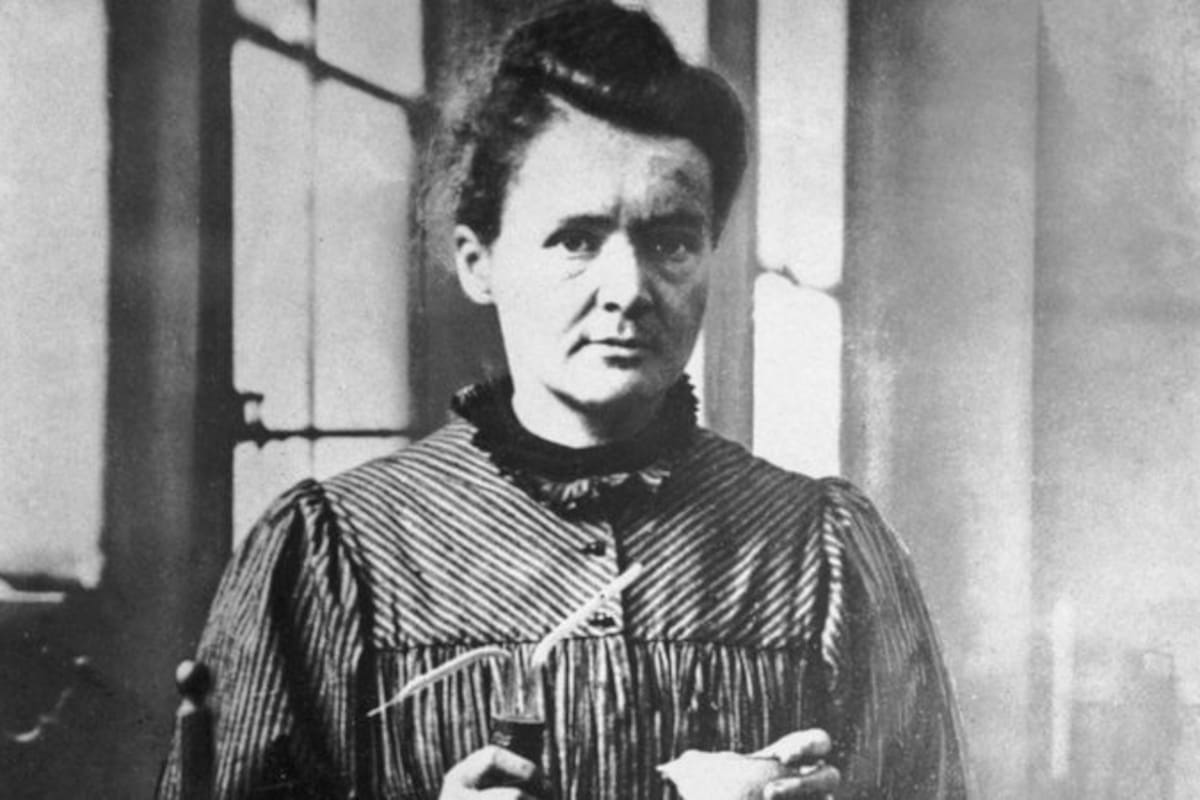
Marie Curie wrote to her brother Joseph from Paris in March 1894, setting down a maxim on tenacity that her daughter Ève later preserved in a biography according to La Nacion.
Long before winning two Nobel Prizes, the young Polish physicist faced severe financial strain and academic exclusion in a scientific community dominated by men. Her early days in France involved living on very little while she pursued her studies at the Sorbonne as Cuerpomente notes.
Before moving to Paris, she worked as a governess in Warsaw to help fund her sister’s education alongside her own as reported by Mejor con Salud. Born in Warsaw in 1867, Maria Skłodowska experienced the early loss of her mother and one of her sisters during her childhood, alongside serious financial hardships and restrictions that limited access to formal education.
The 1894 Letter to Joseph
The lines penned to her brother captured the reality of pursuing difficult goals without any guarantee of success, Radio Mitre reported. She expressed a clear view on the necessity of self-reliance when facing relentless obstacles. Her personal reflections emphasized that maintaining determination does not mean engaging in blind persistence or neglecting one’s personal well-being.
Instead, her perspective invited individuals to recognize their own capacities to learn, even during periods filled with doubt or failure. True perseverance functions as a driving force for overcoming limits rather than acting as an absolute guarantee of a triumph, reminding students and researchers alike that important results rarely appear immediately and difficulties should not automatically be interpreted as signs of incapacity.
Life is not easy for any of us; but what of that? We must have perseverance and above all confidence in ourselves. We must believe that we are gifted for something, and that this thing, at whatever cost, must be attained.
Marie Curie told La Nacion
Reflecting on her life and philosophy, she also collected the sentiment that one must make a dream of life and a reality of a dream, treating ideals and consistent action as an inseparable lifestyle. This active approach meant combining daily discipline with high scientific ambitions, working persistently in silence to achieve goals without letting obstacles halt progress entirely.
Maria Skłodowska Discovered Polonium and Radium
Born Maria Skłodowska in Warsaw in 1867, she eventually married physicist Pierre Curie in 1895 Cuerpomente notes. Together the pair discovered the elements polonium and radium, and she coined the term radioactivity according to Cuerpomente. Both researchers carried out these ideals continuously in practice, knowing that unguided actions or unfulfilled dreams lead only to frustration.
She shared the 1903 Nobel Prize in Physics with Pierre Curie and Henri Becquerel Mejor con Salud reported. Following Pierre’s death, she maintained her dedication to research and teaching. In 1911, she received the Nobel Prize in Chemistry, making her the first person to win two Nobel prizes Mejor con Salud noted.
During the First World War, she promoted the deployment of mobile X-ray units to treat wounded soldiers, La Nacion noted. Her work exposed her to radiation hazards that science did not yet fully understand Mejor con Salud stated, and she died in 1934 following years of exposure, Cuerpomente reported.